
BLOGS
Churches across the country are stepping up. Read their stories and access other climate and energy resources here.

Our Cultural Heritage and Community Engagement
In admiring the stunning Gothic cathedrals that overlook our downtown centres, we can all agree that places of worship hold our collective cultural heritage. But what about our smaller faith community buildings?
In admiring the stunning Gothic cathedrals that overlook our downtown centres, we can all agree that places of worship hold our collective cultural heritage. But what about our smaller faith community buildings? The rural church in a Nova Scotia village that may not have been built by hundreds of people, but by a local shipwright in the off-season, or the chapel in an Alberta community constructed by one mason and farmers, bringing rocks off their farms?
People were baptized, married, and buried within those walls. They celebrated the high points of life together or rallied around an important cause for the greater community. Meals were had, friendships were made, communities were strengthened. Folks learned how to dance in the hall, cook in the kitchen, play basketball in the gym, and did homework in the classrooms after school. Whether large or small, built by many or few, our buildings, sanctuaries, halls, lounges, and classrooms have been gathering places for the congregational and the greater community for decades. They, like the cathedrals, hold our cultural heritage and memorable history.
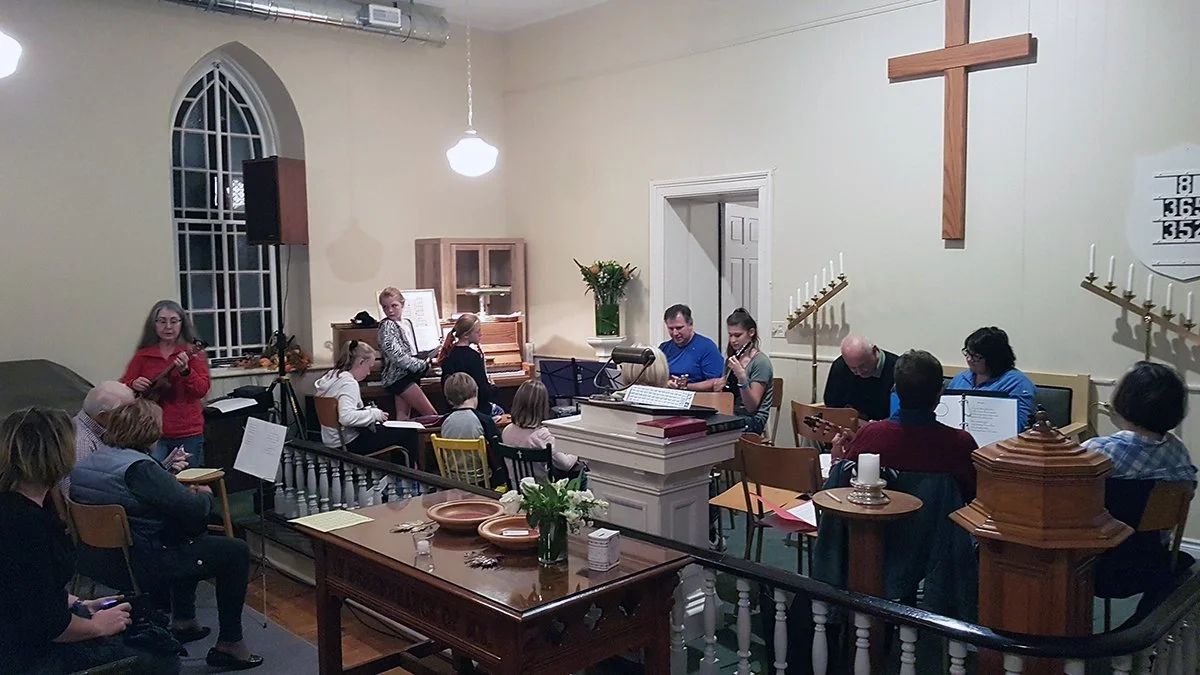
Ukulele Group. Kilworth United, London
However, since the pandemic, in-person gatherings have been limited, as many communities have transitioned to streaming their services and events virtually. As a result, gatherings have felt distant, leaving many members craving community and the chance to laugh, cry, and celebrate together. As we slowly start to open back up and hopefully return to public life again, we will want to come together not only for worship, but for Tai Chi, antique radio clubs, singing, sewing classes, learning English, and many other community gatherings.

Baking. Trinity United, Shediac
Looking ahead to when we can welcome our communities back, now is the time to improve the comfort, health, and understanding of our buildings. Before the doors open, a fresh coat of paint might be in order but why not start to focus on making our spaces more energy-efficient and user-friendly? Installing LED lights, water-efficient fixtures, and energy-efficient appliances will make for a more environmentally friendly kitchen or facility, as will caulking leaky windows against the winter cold.

Bollywood Night. Norval United, Norval
This is also a perfect opportunity to start tracking your energy and operational costs, for a better understanding of what fair community rental rates should be. Energy tracking is a critical piece of that calculation that most people miss. You can have mission rentals at deep discounted prices, of course, but you should make sure that the regular rentals are actually covering your costs.
The more you can learn about your building, the more you can save energy, minimize maintenance costs, and maximize the usage of your amazing faith community building. You can utilize our professional knowledge with virtual Green Audits that look at energy, air quality, food, water, waste, maintenance, rental agreements, heritage, and much more.
By thinking about the opportunity and role your building can play for the greater community, you can help create sustainable income for your faith community, and actively invest that money in energy upgrades, mission work, and strengthening your communities and cultural heritage.
Faithful Footprints Program
The United Church of Canada (UCC) Faithful Footprints program offers grants, tools, and inspiration to help its congregations reduce their carbon footprint. With UCC’s commitment to reducing its greenhouse gases (GHG) emissions 80% by 2050, this one of a kind pro,gram offers up to $30,000 in grants towards energy conservation and renewable energy projects (conditions apply).
Faith & the Common Good is the delivery partner for UCCs Faithful Footprints program. To date, we have engaged over 200 UCC congregations, camps, and buildings across the country. Your participation in the program puts your faith into action and helps UCC reach its target.
Stephen Collette is the Building Manager for Faith & the Common Good and can be reached at 705-652-5159 EDT, scollette@faithcommongood.org

A Great Team Making Great Decisions - Ralph Connor Memorial United Church
Nestled in a beautiful village at the feet of the Canadian Rockies, Ralph Connor Memorial United Church (RCMUC) in Canmore, Alberta has a 130 year old sanctuary and a 40 year old hall.
RCMUC’s Faithful Footprints story is one of how congregants’ connections and working together as a team led to incredible energy savings and conservation within their church building.
Nestled in a beautiful village at the feet of the Canadian Rockies, Ralph Connor Memorial United Church (RCMUC) in Canmore, Alberta has a 130 year old sanctuary and a 40 year old hall.
RCMUC’s Faithful Footprints story is one of how congregants’ connections and working together as a team led to incredible energy savings and conservation within their church building.

Rooftop Solar Installation, RCMUC
Wanting to tackle climate change and save energy at the same time, the very first step in the church’s greening process was to engage members whose skills and knowledge could be put to use. As with many congregations, RCMUC has a large portion of retired members, among which included engineers, a public building architect, and a high school shop instructor.
Their initial plan and focus was to partner with Bow Valley Green Energy Cooperative (BVEC) to install 30 solar panels on their roof. Becoming the first public partner for BVEC in September, 2021, the solar partnership produced 1,590 kWh in the first 90 days, with the planned goal of offsetting 80% of their electrical needs.
However, their efforts did not stop there. In discussions with Faithful Footprints’ Building Grants Manager, Stephen Collette, RCMUC learned that although solar is great, it is important for the church to be lowering energy usage and improving efficiencies as well. Both had been on the team’s mind, and when presented with the DIY Energy Audit Guidebook the team found some low hanging fruit that made sense to them to include in their efforts. This included LED lighting, Energy Star kitchen appliances, and solar powered outdoor lights.
To improve the efficiency of the building they learned that their narthex had two supply vents and no return, resulting in no air circulation, causing the area to be cold. So they decided to remove a supply and add a return to improve comfort. While doing so, they discovered that the ductwork in the crawlspace wasn’t insulated, so they fixed that as well. With the addition of a heat recovery ventilator, cold winter air is pre-heated by outgoing airflow, which improves the efficiency of their furnace.

Ducting under sanctuary
In addition to being the poster child for future partnerships with BVEC–thanks to its highly visible location in downtown Canmore–RCMUC‘s carbon reduction and energy saving projects have also provided many other benefits. The newly installed LED lights are much better for reading by reducing strain on eyes. The air quality has improved with sealed and insulated ductwork, noticeable during the fires this year in the region, and comfort for all using the building.

Greg Wooley, Minister of RCMUC & Jeff Roberts, Chair of BVEC

Solar-powered outdoor light
With various volunteers coming together, sharing their knowledge and skills, and working together, RCMUC is a great story of how your own congregation can similarly leverage these existing elements and help do your part to save energy, some money and the planet all at the same time.
Like RCMUC, the more you can learn about your building, the more you can save energy, minimize maintenance costs, and maximize the usage of your amazing faith community building.
Learn more about your building by utilizing our professional knowledge with virtual Green Audits that look at energy, air quality, food, water, waste, maintenance, rental agreements, heritage and much more.

Heat recovery ventilation system

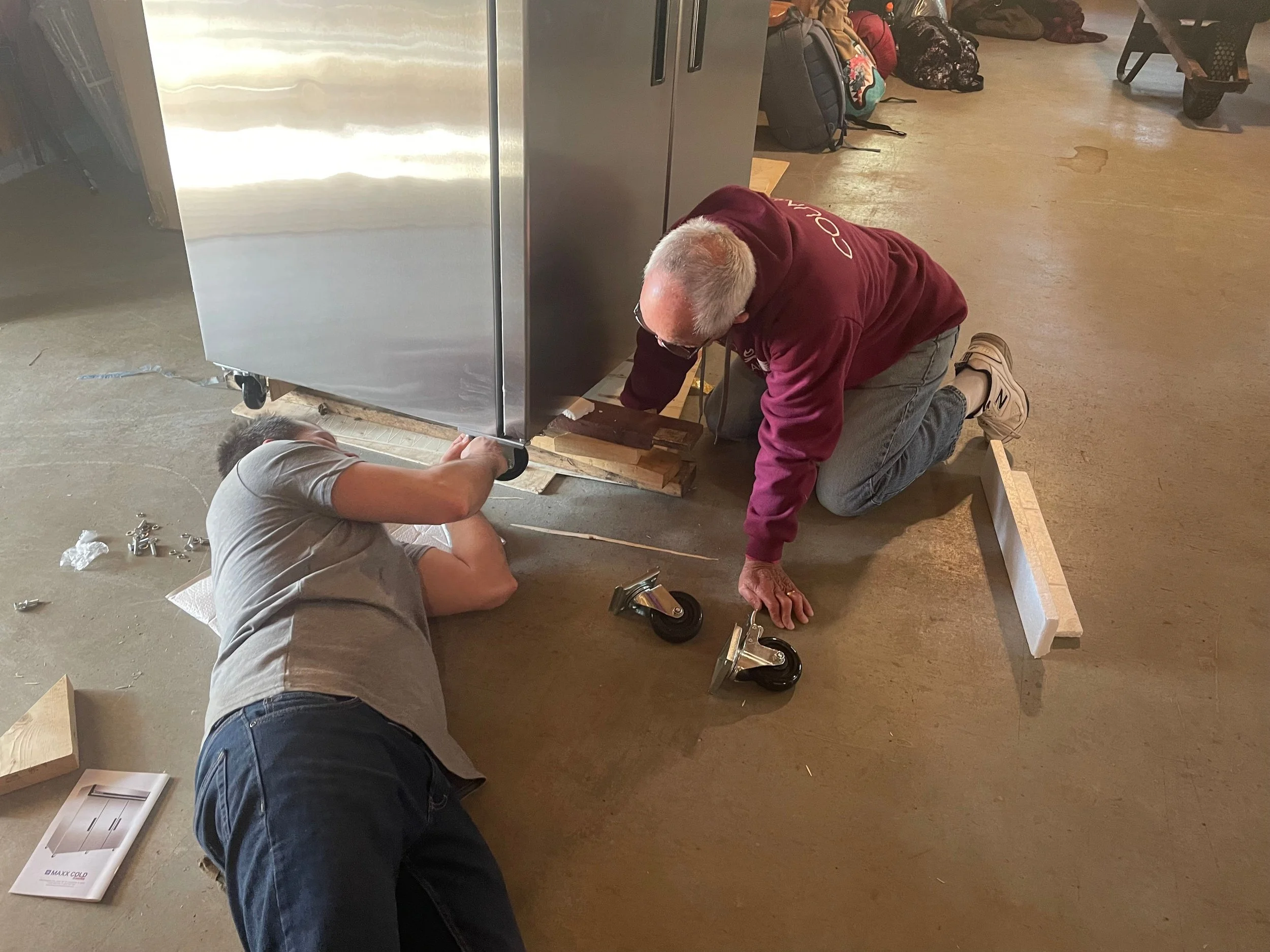
New fridge and freezer
Faithful Footprints Program
The United Church of Canada (UCC) Faithful Footprints program offers grants, tools and inspiration to help its congregations reduce their carbon footprint. With UCC’s commitment to reducing its greenhouse gases (GHG) emissions 80% by 2050, this one of a kind program offers up to $30,000 in grants towards energy conservation and renewable energy projects (conditions apply).
Faith & the Common Good is the delivery partner for UCCs Faithful Footprints program. To date, we have engaged over 200 UCC congregations, camps, and buildings across the country. Your participation in the program puts your faith into action and helps UCC reach its target.
Stephen Collette is the Building Manager for Faith & the Common Good and can be reached at 705-652-5159 EDT, scollette@faithcommongood.org

Efficiency – Squeezing Every Bit of Energy Out of What You Have
When we look at radiator systems with all the various parts, there are numerous opportunities to improve efficiencies. Learn how you can maximize what you have.

Refurbished radiators installed with electric heating coil inside. St Paul’s United Magog.
In a previous blog post, I recommended switching your fossil fuel-burning appliances over to heat pumps to heat your building. That recommendation still stands for everyone who has mid and low energy efficiency furnaces and boilers and anyone whose heating appliance is older than 25 years. I recently spoke with a congregation whose heating system predates their building from 1962 (it was used and donated to them). Their heating contractor estimates that it is currently operating at 15% efficiency! So keep that in mind folks.
But what if you have a pretty new boiler, for example, and still want to maximize efficiency? Is there anything you can do? Yes, there is! When we look at radiator systems with all the various parts, there are numerous opportunities to improve efficiencies.
For one, would you say that you have effective thermal comfort in every room everywhere in your building? Based on my experience, the answer is probably no. Oftentimes, some rooms will be too hot, with people opening windows, while others will be too cold with space heaters under desks. So what can you do to improve comfort? There are valves on the individual radiators that can be adjusted, but they typically have 12 coats of paint and couldn’t be moved without a hammer and vice grips. Having all of the valves serviced, and operable, will allow minor adjustments to the temperatures within each of the rooms, ensuring heat is not blowing out the window, but delivered where you need it.
If you walk into the boiler room and find it sweltering hot in the winter, all of that heat is being wasted, as it is not going where you need it to go. Installing insulation around any or all of the pipes you can access between the boiler and the radiator can save you tremendous amounts of money on energy.
Additionally, you can even have the radiators removed and restored with new valves, cleaned inside and out, so that the rust is gone. This can reduce clogging and inefficiencies, and restore the heritage value of your heating system to the 21st century!
In addition to properly located programmable thermostats that can help improve efficiency, in large thermally massive buildings (like stone churches), keeping the temperature even may help to ensure better comfort. For example, ceiling fans in the sanctuary and in the halls are great, and can really help keep constant temperatures.
Finally, having a competent heating contractor that truly understands radiant heat go through and commission the entire system (not just the boiler), will most definitely find efficiencies in the layout and delivery of the hot water or steam to guarantee energy and money savings for your congregation.
Those who have a modern boiler in place, make sure that the system it is connected to is also operating at maximum efficiency to reduce the fossil fuels burned, and save energy.
The more you can learn about your building, the more you can save energy, minimize maintenance costs, and maximize the usage of your amazing faith community building. You can utilize our professional knowledge with our virtual Green Audits that look at energy, air quality, food, water, waste, maintenance, rental agreements, heritage and much more.
Faithful Footprints Program
The United Church of Canada (UCC) Faithful Footprints program offers grants, tools and inspiration to help its congregations reduce their carbon footprint. With UCC’s commitment to reducing its greenhouse gases (GHG) emissions 80% by 2050, this one of a kind program offers up to $30,000 in grants towards energy conservation and renewable energy projects (conditions apply).
Faith & the Common Good is the delivery partner for UCCs Faithful Footprints program. To date, we have engaged over 200 UCC congregations, camps, and buildings across the country. Your participation in the program puts your faith into action and helps UCC reach its target.
Stephen Collette is the Building Manager for Faith & the Common Good and can be reached at 705-652-5159 EDT, scollette@faithcommongood.org

Your Fridge Might be Keeping the Milk Cold and the Planet Hot
We all love to gather after worship and share food and drink together. It’s at these times that we grow as a community. For this reason alone, a major hub of activity in faith communities (post COVID) is the kitchen. So it is worth taking the time to look at the major energy consumers within this space in order to save some energy and money.

Old fridges and freezers are energy guzzlers.
We all love to gather after worship and share food and drink together. It’s at these times that we grow as a community. For this reason alone, a major hub of activity in faith communities (post COVID) is the kitchen. So it is worth taking the time to look at the major energy consumers within this space in order to save some energy and money.
Fridges and freezers are present in every congregation’s kitchen. Typically, the efficiency of these kinds of appliances increases dramatically every few years with newer models. That means that the energy consumption of a new fridge compared to one made approximately five years ago can be half the energy! That’s a lot of energy savings to be had.

From coast to coast to coast, I have seen several examples where the freezers for fundraisers (those were great turkey pot pies), or food banks are so old that the cost to run these beasts is actually a liability for the fundraising or operation of the food bank.
Now, if your faith community, like many others, is rocking a donated Harvest Gold or Green Avocado fridge from the 1970s, it is absolutely impacting your bottom line, and the climate. A rule of thumb is if it has chrome on it, it’s really old! You can check the age of your fridge or freezer by looking for the manufacturer’s data plate. It should be right on it. If you don’t see the date, it will be baked into the serial number.
Older dishwashers also consume a great deal of energy. The newer commercial dishwashers work incredibly fast and are effective and fun to use; fun enough that some folks might get dragged into the kitchen “to help,” just so that they can play with these efficient washers.
For stoves, we really want to start moving away from gas stoves. Current research has shown that they have a massive impact on indoor air quality, and with continuously running pilot lights, burn fuel when not even in use (such as during the pandemic). Because of this, switching to electric stoves has become more common.
As with all appliances, when purchasing new, we want to purchase ENERGY STAR® rated ones, so we get the maximum value for our purchase. ENERGY STAR® rating means it is in the top 10% of efficiency for its category. So you get the best of the best.
To improve your building’s carbon footprint, you can also utilize our professional knowledge with virtual Green Audits that look at energy, air quality, food, water, waste, maintenance, rental agreements, heritage and much more.
The more you can learn about your building, the more you can save energy, minimize maintenance costs, and maximize the usage of your amazing faith community building.
Faithful Footprints Program
The United Church of Canada (UCC) Faithful Footprints program offers grants, tools and inspiration to help its congregations reduce their carbon footprint. With UCC’s commitment to reducing its greenhouse gases (GHG) emissions 80% by 2050, this one of a kind program offers up to $30,000 in grants towards energy conservation and renewable energy projects (conditions apply).
Faith & the Common Good is the delivery partner for UCCs Faithful Footprints program. To date, we have engaged over 200 UCC congregations, camps, and buildings across the country. Your participation in the program puts your faith into action and helps UCC reach its target.
Stephen Collette is the Building Manager for Faith & the Common Good and can be reached at 705-652-5159 EDT, scollette@faithcommongood.org

Retrofitting our Sacred Space with Faithful Footprints Funding
Our buildings, our spaces matter. There are, of course, the practicalities of making drafty rooms comfortable and bringing energy and climate costs down. But more than these issues, our spaces house and embody our values. They hold our gatherings, celebrations, prayers and sacred ceremonies and should reflect who we are and what matters to us.
Guest post by Nanci Lee, Executive Director, Tatamagouche Centre
Our buildings, our spaces matter. There are, of course, the practicalities of making drafty rooms comfortable and bringing energy and climate costs down. But more than these issues, our spaces house and embody our values. They hold our gatherings, celebrations, prayers and sacred ceremonies and should reflect who we are and what matters to us.
So, when we decided to green retrofit our main building, Stewart Hall, we realized that this would be more than a bricks and mortar project. We began Phase I with two practical and strategic projects. The first was to replace our main roof and insulate it to R40 from R3, essentially putting a hat on. The second project was to renovate our sanctuary space, one of the most meaningful spaces in all of our buildings that would set the tone for what was to come.
With 18-foot ceilings, a wall of windows and lovely boat-shaped curves, the sanctuary space had been awe-inspiring in its day and still holds such meaning. I recently met a woman who married her husband in this chapel. It has remained an intimate place of coming together in song and learning, in prayer and smudging, grief and joy. While the magic of the space has been held by the people and talented facilitators, the room itself was beginning to feel tattered. Built in the fifties, it also had the unfortunate condition of being too hot in the summer and too cold in the winter.
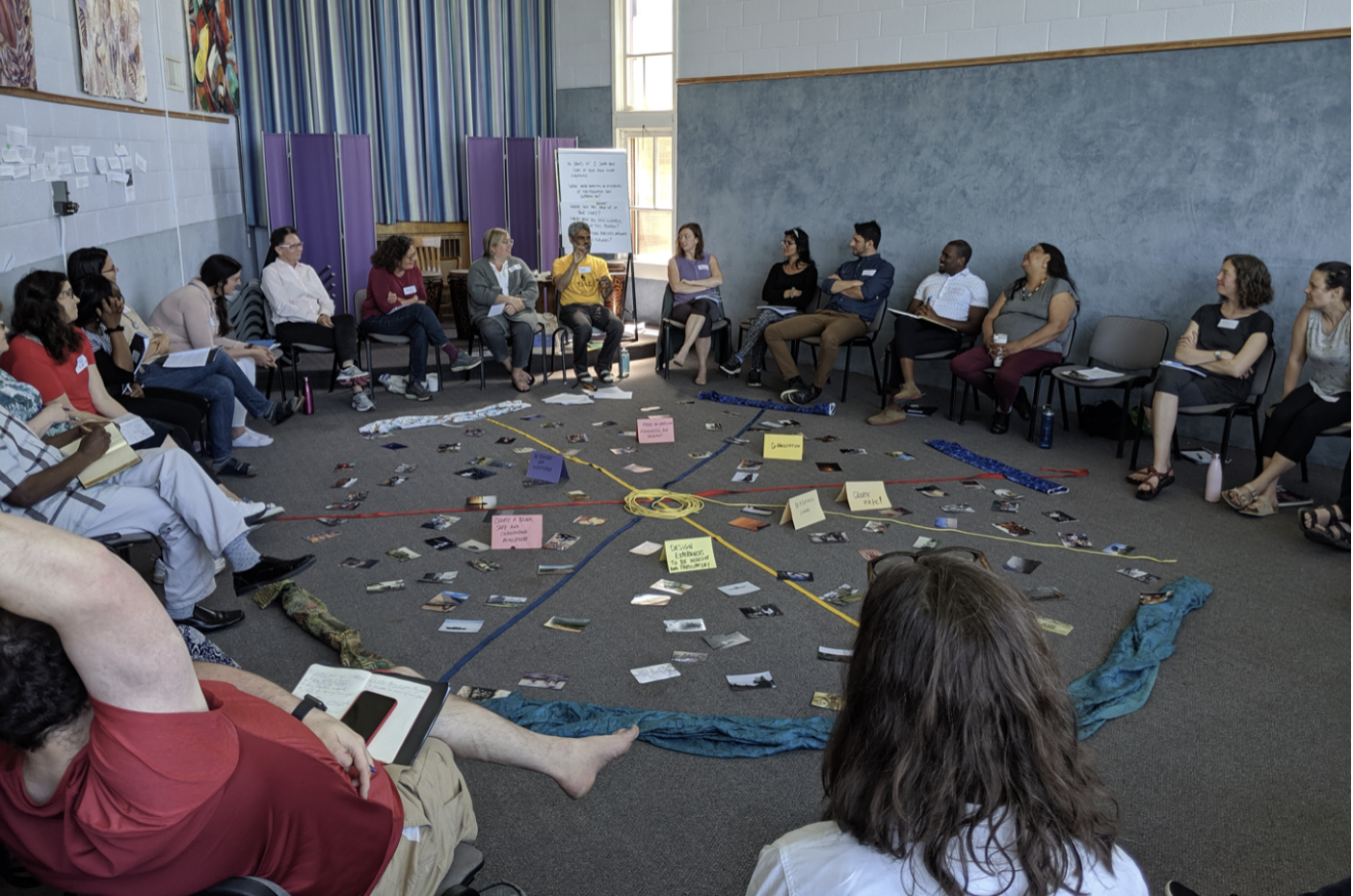
Sanctuary space before retrofits. Photo credit: Lee Fleming, Manager (Green Retrofit)
In conversations with our partners and our Board of Directors, it was clear that the project of renovating our sanctuary would be a balancing act. How to be widely welcoming and practically energy efficient while keeping that sacred intimacy? How to genuinely embody our communities across such a diversity in faith, spirituality, race and gender identities?
As we think about decolonizing our organizations and our churches, our faith institutions, how we decolonize our space is important. We heard that people wanted the space to be comfy, sacred but not precious, good air circulation, good energy efficiency, welcoming to different faiths. Honouring our origins, connections and core funding with the United Church, how could the space reflect the multi-faith and multi-cultural nature of our communities? That meant that it is as home to a Black Baptist choir as it is to an Indigenous circle or contemplative Christian silent retreat.
Practically-speaking, this meant windows that we kept the wall of light but weren’t so clearly associated with one faith. Even the raised floor at the front, designed to point the space toward a Minister was taken out and replaced with a removable riser that could be used for prayer, ceremony, ritual but also removed for more circular gatherings. The once single cross will be joined with a number of other spiritual and sacred objects celebrating the diversity of communities we have of spiritual seekers. We are still in dialogue about how to do this well. As one Board member put it, we are a microcosm for society’s struggle with values, equity, safety and community.
A Welcoming Space

Sanctuary space after retrofits
What does it mean to be widely welcoming and sacred across faith and spiritual diversity? Some have asked- why isn’t it enough that we welcome with open arms? The United Church has long been welcoming and early worked at apology and reconciliation with Indigenous friends and neighbours. While this is true, it is also true that it is not enough to be a welcoming chapel if, as we heard from Elders, the cinder block and the large cross remind you of the residential school you attended. Apology is a practice. Being able to truly relax and feel at home in a space is as much a part of reconciliation as any of these processes.
We decided to go with warm, neutral tones that can later invite final flourishes and welcoming touches. Ideas include textiles and blankets, art from different communities. The ceiling could hold ribs of a boat, like ribs of our bodies, an image that came from one of the Mi’kmaw grandmothers, Women of First Light. For the floor, we chose a natural, local Ash on recommendation from our architect Jane Abbott and main contractor, Hal Fowler. Certainly, it will require a little more care but for this space, we are happy to invest in those extra touches.
We have more work to do, more conversations to ensure that the space feels like home as widely as possible but it feels like a place where we can embody the world we want of love and justice that I feel come together through spirit. Through this lovely space we can talk about who we are and how to be in step together. We are committed to these right relations.
We were grateful for the seasoned experience and insights of Stephen Collette, Building Manager for Faith & the Common Good (FCG) and coordinator of the United Church of Canada’s (UCC) Faithful Footprints Program. FCG is the delivery partner for this grants, resources and inspirational program. Stephen was able to help us think through first steps, how to make sense of monitoring energy efficiency and provided excellent support through the process.
Overall, Phase I cost $214,600 for both the roof (41%) and the sanctuary space and we were able to raise $199,824. Faithful Footprints funding provided 15% of our funding raised. Certainly partners like UCC make other funding possible. We are immensely grateful for both this funding and the technical support from Stephen. Gratefully, we have also raised $88,920 for Phase II of Stewart Hall retrofit to focus on heating, cooling, space utilization, windows and groundwater.
Our first program offered this year onsite, Licenced Lay Worship Leaders will be the first to make use of the Sanctuary Space. We are all very excited and look forward to welcoming each and every one of you to our new stunning, sacred space.
About the Faithful Footprints Program
The United Church of Canada (UCC) Faithful Footprints program offers grants, tools and inspiration to help its congregations reduce their carbon footprint. With UCC’s commitment to reducing its greenhouse gases (GHG) emissions 80% by 2050, this one of a kind program offers up to $30,000 in grants towards energy conservation and renewable energy projects (conditions apply).
Faith & the Common Good is the delivery partner for UCCs Faithful Footprints program. To date, we have engaged over 200 UCC congregations, camps, and buildings across the country. Your participation in the program puts your faith into action and helps UCC reach its target.
Stephen Collette is the Building Manager for Faith & the Common Good and can be reached at 705-652-5159 EDT, scollette@faithcommongood.org

Why a Heat Pump For Your Place of Worship?
For faith communities, replacing a heating system is one of the single largest capital cost expenses (the other one is replacing the roof). Most congregational spaces have either boilers with radiators, or furnaces with ductwork that consume oil, gas or propane. While the typical lifespan may be 25 years for these appliances, I have seen many span decades of service.

Dundas Cardigan, PEI
For faith communities, replacing a heating system is one of the single largest capital cost expenses (the other one is replacing the roof). Most congregational spaces have either boilers with radiators, or furnaces with ductwork that consume oil, gas or propane. While the typical lifespan may be 25 years for these appliances, I have seen many span decades of service.
Sure, they keep going, so why change them? Well, just like you and I, we get less efficient with age. For instance, a furnace from the 1990s may have started out at, say, 84% efficient (meaning, for simplicity’s sake that 84% of the fuel is turned into heat, and 16% of the energy is wasted), but after 25+ years may be operating in the low 70% range. Older furnaces and boilers could be much, much lower efficiency. Now take your gas/oil/propane bill for the year and find what that 30% costs you per year. It is a lot! Your payback to switching becomes much clearer.
Instead of swapping out old units for new ones and carrying on, many congregations are switching to air source heat pumps.

Kings United, Bay Fortune NS
You may know these as mini-splits, or just heat pumps. These are electrically powered, so they remove the need for fossil fuels within your building. They work like a refrigerator taking cold air from the outside of the building, and with a fan blowing it over a coil with a refrigerant in it. There is a compressor, and basically it makes heat. How much heat? Well, for every unit of electricity it uses, it can make 3-4 units of heat! Compare this to an electric baseboard where 1 unit of electricity makes about .75 units of heat, and you get the efficiency picture really quickly. Now the cool thing (literally) about these is that they can run backwards and also make cool air, so it also supplies air conditioning to the building. With climate change and other factors to consider, such as more and more permanent tenants in these spaces, air conditioning helps to make renting your various spaces much easier.
Again, it is even more efficient than your regular air conditioning. So you may have seen the mini split systems with a head on the inside, and the compressor on the outside, which being split in two units, is where the name comes from. But you can also have a compressor on the outside run to a new furnace blower box and supply conditioned air to your existing ductwork. There are also rooftop units for those larger buildings and mechanical systems.

Brunswick Street Mission, Halifax NS

The main question people ask is will they still provide heat in the really cold winter? The answer is yes. Newer units, especially ENERGY STAR® approved units, have dual stage compressors, so they can basically “go around again” and extract more heat from the coils. Yes, the efficiency of the unit does drop as it gets really cold. So if you are working at 4:1 efficiency at -12C, then maybe 3:1 at -19C and 2:1 at -26C, as a rough example. That’s a conversation to have with your HVAC contractor.
I know that the Faithful Footprints grant program (see below) has approved heat pumps for ALL climate zones across the country, with everyone praising the comfort and energy savings gained. So consider heat pumps wherever you are as a way to reduce your energy costs and impact upon the climate.
You can also utilize our professional knowledge with virtual Green Audits that look at energy, air quality, food, water, waste, maintenance, rental agreements, heritage and much more.
The more you can learn about your building, the more you can save energy, minimize maintenance costs, and maximize the usage of your amazing faith community building.
Faithful Footprints Program
The United Church of Canada (UCC) Faithful Footprints program offers grants, tools and inspiration to help its congregations reduce their carbon footprint. With UCC’s commitment to reducing its greenhouse gases (GHG) emissions 80% by 2050, this one of a kind program offers up to $30,000 in grants towards energy conservation and renewable energy projects (conditions apply).
Faith & the Common Good is the delivery partner for UCCs Faithful Footprints program. To date, we have engaged over 200 UCC congregations, camps, and buildings across the country. Your participation in the program puts your faith into action and helps UCC reach its target.
Stephen Collette is the Building Manager for Faith & the Common Good and can be reached at 705-652-5159 EDT, scollette@faithcommongood.org

Music to My Ears – Pipe Organs and Heat Loss
One of the most beautiful experiences in religious services is the sound of a pipe organ filling a church, whether in a small wood framed, rural church, or a full size Casavant in a large Gothic, stone church. The sounds fill the building as well as one’s soul with joy.
One of the most beautiful experiences in religious services is the sound of a pipe organ filling a church, whether in a small wood framed, rural church, or a full size Casavant in a large Gothic, stone church. The sounds fill the building as well as one’s soul with joy.
What people may not know is that many pipe organs have leather and wood parts, specifically in the stops in the pipes. This is merely an interesting detail until you think about what happens to those materials when temperatures drop – that is, they change in shape and size. These changes can impact the sound of the organ.
So when the temperature drops, the sound of the organ can change for the worse. Now that’s not music to anyone’s ears. With the pipes at the top of the sanctuary, sometimes right near the attic hatch, the heat loss, and sound quality change can be dramatic. So start by making sure the attic hatch, especially if near the pipe organ is airtight.
Air circulation can be a quick solution. Ceiling fans can move the air easily, spreading conditioned air around the space, keeping the temperature more even. The old metal 1980’s ceiling fans that beat themselves to death only blow down. That’s great for keeping cool in summer as well as for picking up the wobbly sounds in the microphones, but having cool air blow down on us in the winter time isn’t helpful. Ideally we want Energy Star rated ceiling fans that are reversible, so in the winter they blow upwards, forcing the air along the ceiling and down the walls without any drafts, and stirring the heat like a pot of tea. Also commercial fans can move much more air at a slower speed with the bigger blades, making the process quieter and more effective.
Insulation in the attic, where possible, would be the final step to help keep the organ in tune and sounding amazing throughout the entire year. Energy efficiency is something everyone can benefit from and is music to one’s ears!
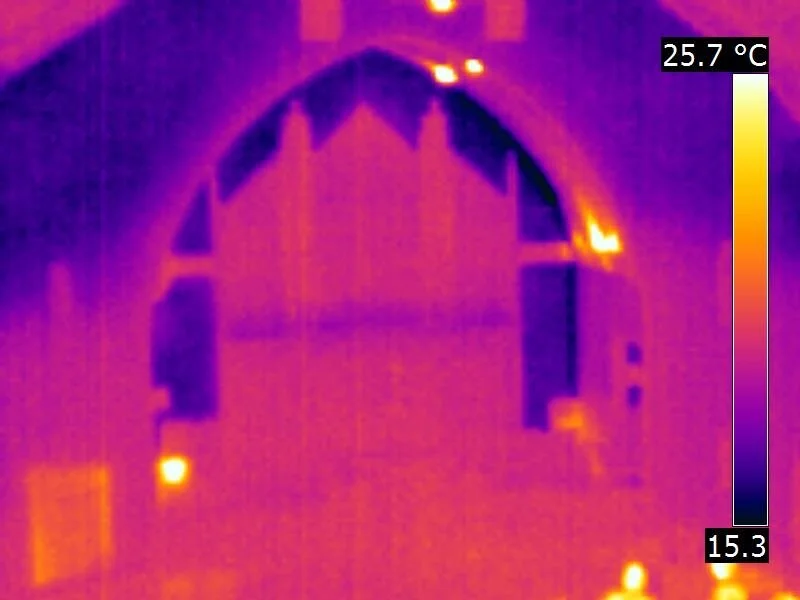
Infrared image of a pipe organ in winter. The darker the colour, the colder the temperature. Note: there is an attic hatch located over this pipe organ.
Financing your project
If you are wondering how you might finance upgrades that benefit your organ - and any other energy efficiency projects you group might be interested in conducting - the United Church of Canada (UCC) has just the program for you. Launched in 2018, the Faithful Footprints program offers grants, tools and inspiration to help UCC congregations reduce their carbon footprint. With UCC’s commitment to reducing its greenhouse gases (GHG) emissions 80% by 2050, this one of a kind program offers up to $30,000 in grants towards energy conservation, decarbonization, and renewable energy projects (conditions apply).
Faith & the Common Good is the delivery partner for UCC’s Faithful Footprints program and I am the voice on the other end of the phone for congregations, since I am a sustainable building consultant, a building scientist, and a heritage professional specializing in faith community buildings.
To date, we have engaged over 200 UCC congregations, camps, and buildings across the country. Your participation in the program puts your faith into action and helps UCC reach its target.
I invite you to begin your energy efficiency journey by reading the free guides that we have on our website. The DIY Faith Building Energy Audit Guidebook and the Energy Star Action Workbook for Congregations are amazing free resources.
You can also utilize our professional knowledge with virtual Green Audits that look at energy, air quality, food, water, waste, maintenance, rental agreements, heritage and much more.
The more you can learn about your building, the more you can save energy, minimize maintenance costs, and maximize the usage of your faith community building.
Stephen Collette is the Building Manager for Faith & the Common Good and can be reached at 705-652-5159 EDT, scollette@faithcommongood.org

Fix What We Already Have: Renovate today’s buildings for a carbon-neutral tomorrow
When we think about the year 2050 and our climate goals of being carbon neutral in all of our activities, including operating our buildings, we often have this utopian vision of space age buildings. That vision is not what 2050 will look like; not even close.
When we think about the year 2050 and our climate goals of being carbon neutral in all of our activities, including operating our buildings, we often have this utopian vision of space age buildings. That vision is not what 2050 will look like; not even close.

Source: Archdaily.com
80% of the buildings of 2050 are actually standing right now, right here. That’s right: 80%.
You are living in them, working in them, and worshipping in them today; so we won’t be building, but rather, renovating our way to a solution. This means that these buildings need to be improved today. We need to upgrade the energy efficiency of our places of faith, our community spaces, our religious homes, schools and offices. We must move all of these buildings towards carbon free energy sources as soon as possible.
But surely knocking down these old buildings will be better for the environment, you say? Actually not. Embodied energy or embodied carbon is the energy it took to extract, transport, manufacture/process, ship, build and operate the building for all of these years. If you were to knock these buildings down, you would also have to add the energy in transportation and disposal of the same building. A replacement would have even more embodied energy and it would take typically 30-40 years of operation to eventually overcome all of that embodied energy in the process, compared to using the existing building.
Old buildings will actually help to save the planet. Improving your existing building to use less energy is not only a great thing to do, it is the right thing to do.

Source: Serverfarm, April 2020.
Faithful Footprints Program
The United Church of Canada (UCC) recognized an opportunity to live out its climate mission through upgrading its building stock, by launching the Faithful Footprints program. This program offers grants, tools and inspiration to help UCC congregations reduce their carbon footprint. With its commitment to reducing its greenhouse gases (GHG) emissions 80% by 2050, UCC’s one of a kind program offers up to $30,000 in grants towards energy conservation and renewable energy projects (conditions apply).
Faith & the Common Good is the delivery partner for the Faithful Footprints program. As a staffer and sustainable building consultant for this national, multifaith network, I was asked to be the voice on the other end of the phone for congregations. Also a building scientist, and a heritage professional specializing in faith community buildings, I’m a nerd! I’m a nerd, here to help you save energy, reduce your carbon footprint, and save the planet, all while lowering your operational costs so you have more money for mission.
To date, we have engaged over 200 UCC congregations, camps, and buildings across the country.
Your participation in the program puts your faith into action and helps UCC reach its target.
More energy efficiency actions you can take
As you start on your energy efficiency journey, you also might want to make use of the free guides that we have on our website. The DIY Faith Building Energy Audit Guidebook and the Energy Star Action Workbook for Congregations are resources you can download, read, learn from, and take action!
You can also utilize our professional knowledge with virtual Green Audits that look at energy, air quality, food, water, waste, maintenance, rental agreements, heritage and much more.
The more you can learn about your building, the more you can save energy, minimize maintenance costs, and maximize the usage of your faith community building.
Stephen Collette is the Building Manager for Faith & the Common Good and can be reached at 705-652-5159 EDT, scollette@faithcommongood.org

How can rural and isolated faith communities take climate action?
As Canadians, when it comes to actions we can take to protect the climate, we automatically think about energy conservation. We head over to the local hardware store for some caulking, insulation, a new Energy Star window etc., to fix up our buildings that will in turn, help lower maintenance costs, save energy, and save the planet.
As Canadians, when it comes to actions we can take to protect the climate, we automatically think about energy conservation. We head over to the local hardware store for some caulking, insulation, a new Energy Star window etc., to fix up our buildings that will in turn, help lower maintenance costs, save energy, and save the planet.
But that only works if you live in a city or close to a large hardware store. Have you thought about how difficult it is to get an energy audit for a fishing port village church on a remote coast of Newfoundland, with the nearest energy auditor over three hours away? Have you thought about trying to fly in new windows and doors to a remote northern Manitoba reserve’s church without any being damaged?
These are real challenges faced by people who experience nature at its most powerful. In contrast, those of us with steady, reliable power, clean drinking water, and experts who are accessible to us in under an hour, forget that what we have is not common for most rural communities.

Rural Church, Alberta. By Debby Hudson on Unsplash.
The United Church of Canada (UCC) recognized this concern when launching the Faithful Footprints program for United Church properties. With UCC’s commitment to reducing its greenhouse gases (GHG) emissions 80% by 2050, this one of a kind program offers grants, tools and inspiration to this end. It offers up to $30,000 in grants towards energy conservation and renewable energy projects (conditions apply).
Since Faith & the Common Good is the delivery partner, and I am the Building Manager for this national organization, I was asked to be the voice on the other end of the phone for interested congregations. I am a sustainable building consultant, a building scientist, and a heritage professional specializing in faith community buildings. Ya got me: I’m a nerd! I’m a nerd not just for downtown city churches, but for the rural churches reaching out, wanting to know what they can do because they see the effects of climate change more than most; because they care as much as anyone else.
As of June 2021, over 200 UCC congregations, camps, and buildings across the country have participated in the program. Your participation in this program puts our faith into action and helps UCC reach its target.

Left to right: Emma Norton (Ecology Action Centre), Tom Urbaniak (FCG Chair), Stephen Collette (FCG Building Manager). Union Presbyterian Church, Louisbourg, Nova Scotia.
More help is at hand
Need more help? Start with downloading the free guides that we have on our website. The DIY Faith Building Energy Audit Guidebook and the Energy Star Action Workbook for Congregations are amazing, free resources that you can read, learn from, and even take action!
You can also utilize our professional knowledge with virtual Green Audits that look at energy, air quality, food, water, waste, maintenance, rental agreements, heritage and much more.
The more you can learn about your building, the more you can save energy, minimize maintenance costs, and maximize the usage of your place of worship.
Stephen Collette is the Building Manager for Faith & the Common Good and can be reached at 705-652-5159 EDT, scollette@faithcommongood.org
Faith & the Common Good is the delivery partner for UCCs Faithful Footprints program.

What You Don’t Know Can Hurt You: When your faith building is wasting energy and money!
The more you learn about your building, the more you can save energy, minimize maintenance costs, and maximize the usage of your amazing faith community building.
Within our faith communities we all help out; that’s the ‘community’ in faith community. Some people take care of the building — often the most thankless job, because if they do a good job, no one notices anything. These dedicated people care about the building, but unfortunately don’t always understand how their building works, which is completely normal. In highschool, we were not taught how to maintain our homes let alone maintain and operate large, oftentimes massive places of worship. For example, the huge decorative ceiling grilles in many places of worship are, from my experience, 95% of the time open to the attic. One church I worked with had four 8-foot diameter ceiling vents and the congregation couldn’t worship in the space in the summer because the heat coming off the roof drove them out! How would people know this? They wouldn’t, since we don’t have anything comparable in our homes. So to the building maintenance teams reading this, don’t be hard on yourselves.
How then, can you make a difference? Start with the free guides available on our website. The DIY Faith Building Energy Audit Guidebook and the Energy Star Action Workbook for Congregations are amazing resources you can download, read, learn, and from there, take action. You can also utilize our professional knowledge with virtual and in person (when safe for all) Green Audits that look at energy, air quality, food, water, waste, maintenance, rental agreements, heritage and much more.
The more you learn about your building, the more you can save energy, minimize maintenance costs, and maximize the usage of your amazing faith community building.

UCC’s Faithful Footprints: Helping congregations get to net-zero
For the United Church of Canada (UCC), faith buildings are its largest, overarching carbon contributor and its biggest fixed expenses. By correcting heating, cooling and lighting gaps in buildings, congregations can reduce their carbon emissions and cut costs.
With UCC’s commitment to reducing its greenhouse gases (GHG) emissions 80% by 2050, the Faithful Footprints Program offers grants, tools and inspiration to this end. As of April 2021, over 200 UCC congregations, camps, and buildings across the country have participated in the program. Your participation in this program is putting our faith into action and helping UCC reach its target.

Stephen Collette is the Building Manager for Faith & the Common Good and can be reached at 705-652-5159 EDT,
scollette@faithcommongood.org
Faith & the Common Good is the delivery partner for UCCs Faithful Footprints program.

Let Your Light Shine: LEDs, solar panels and greening faith buildings
McClure United Church in Saskatoon is shining new light on its congregation.
By line: Ava Gulino
McClure United Church in Saskatoon is shining new light on its congregation.
“The choir in particular appreciates being able to see the music and words the way the composer intended,” chuckles Angie Bugg, when she tells me about the lighting improvements in the church sanctuary.
A board member of the property committee, and a mechanical engineer herself, Angie says that replacing their fussy lighting system (from the late 1980s) and transitioning to energy efficient LED lighting has made a big difference.

“LED lighting is so much more efficient than any of the other kinds of lighting that we have,” she says. “It’s worth upgrading the lighting of any space that is used even just a little bit to LED. You know you’ll get a good payback on it.”
Environmentally-minded since her teenage years, Angie reflects on how her faith and the church LED upgrade project are connected.
“My profession is very closely tied to my faith. Protecting God's creation has to be part of how we live our lives and we can’t separate the church we go to on Sundays from how we live daily with this planet and how we show our respect to Creation.”
***************
The blessing of high quality lighting has tangible benefits not only for congregants and community members who use the church’s space for events, but also for the church budget by cutting down on lighting costs. And when combined with the United Church of Canada’s Faithful Footprints grant in partnership with Faith & the Common Good, which offers up to $30,000 per grant application, more expensive types of projects can be supported that will ultimately save a congregation money in the long-term.
Colleen Rollings of Rockingham United Church in Halifax saw a large financial payback when her church used the Faithful Footprints grant to carry out a sustainability project. As the chair of the building and property committee, her focus is clear: “certainly my goal has been to reduce operating costs and to leave the organization in better fiscal strength than when I came on board.”
In order to achieve this goal, Colleen gravitated towards solar panels. “I had been interested personally in solar both from an environmental perspective as well as the passive income piece to it,” she says.
Since it often produces surplus energy, a solar energy system can supply energy to the building as well as contribute energy to the grid. When the church expressed interest in replacing the roof, Colleen recognized a perfect opportunity to present her plan for a solar installation system.
Solar panels, as Colleen explains, are well suited to a brand new roof so as to avoid removing the solar panels when a new roof is needed. Since her church needed a new roof anyway, she figured she would suggest adding solar panels as a part of the renovation process. Colleen’s proposal for the project took flight with other church members, and soon after, solar panels were affixed to the new roof.
“The money saved from this project is astounding,” Colleen reports. “As well, once we pay off the small amount we owe, it's projected to generate around $20,000 a year in revenue, which is significant for an organization like ours.”
Colleen is grateful that her congregation trusted her vision for a solar panel installation.
It was a really nice feeling that they had faith in what I was presenting to them--the opportunity we had,” she says. “To see it come to fruition on such a large scale kind of gives me goosebumps just telling you about it.”
Similar to Angie, Colleen’s personal faith influenced the inception of the project. As she puts it, “we have been given a world with sunshine--the main ingredient needed for solar installations.”
Coupled with technical expertise to execute on such a project, Colleen tapped into her engineering prowess to push for solar: “I'm a strong believer in utilizing my God-given talents for the greater benefit of the church,” she concludes.

New Energy Efficiency Grant Available for Faith Communities in Alberta
The Alberta government has released the Energy Savings for Businesses (ESB), a new energy savings grant program that includes nonprofits and cooperatives. The great news is that faith communities qualify for this funding opportunity.
The Alberta government has released the Energy Savings for Businesses (ESB), a new energy savings grant program that includes nonprofits and cooperatives. The great news is that faith communities qualify for this funding opportunity.
The ESB grant allows each participant to access up to $250,000 per building. An à la carte menu of eligible items indicates what percentage of the costs per item the grant covers.
Some examples of items that can have 25% of the costs covered include qualifying LED fixtures, lighting controls, and solar photovoltaic installations.
Qualifying Energy Star boilers and furnaces, and air source heat pumps can have up to 50% of the costs paid for by the grant. As well, you can access 50% of the grant for the costs of increasing your insulation to meet the standard outlined, or for installing new Energy Star windows.
Why Apply?
Incentives like this can help you reduce your overall operational costs by lowering your energy bills, as well as reducing your carbon footprint. Consider passive strategies first, such as air sealing and insulation, as once these are installed and upgraded, your savings will continue on for years. Ensuring you have LED lights throughout the entire building, inside and outside will save you money and is an easy action for most faith communities. If you are up on a ladder, consider improving ceiling fans to Energy Star new ones, so that they can push the heated, conditioned air back down, reducing the number of times the heat has to come on. Appliances can be a huge energy source, especially old fridges and freezers in your building. Upgrading your old appliance will typically pay for itself in a few months with a new Energy Star rated unit. Finally, you can also upgrade your heating system and hot water tanks from oil to air source heat pumps, and high efficiency electric.
Please click on the link to contact Emissions Reduction Alberta to get more information and to start your energy saving, operational cost savings, and planet saving plan now!
More Savings!
There are even more ways to save! For United Church of Canada properties, you can use the ESB grant to access even more energy efficiency funds from the United Church of Canada’s Faithful Footprints grant program, making your energy efficiency project very cost effective.
For more information on FCG programs, please contact our Building Audit Manager, Stephen Collette, at scollette@faithcommongood.org.

Faith Climate Accountability in Action
The United Church of Canada has committed to reducing its greenhouse gases by 80 percent by 2050, and local congregations across the country are already responding, aided by more than $3 million in available grant money from the denomination.
Faithful Footprints putting climate accountability in action

Energy retrofits power renewed mission for faith communities
The jury is still out on the Canadian government’s recent climate accountability act but not everyone is waiting for a verdict.
The United Church of Canada has committed to reducing its greenhouse gases by 80 percent by 2050, and local congregations across the country are already responding, aided by more than $3 million in available grant money from the denomination.
St Paul’s United Church, in Magog, QC, for example, needed to replace an older, gas-powered furnace (named Betsy). Staying with steam heat looked too costly, but what to do with the ancient, cast iron radiators? St. Paul’s found a Quebec-based company to convert the radiators to standalone electric units. It was an elegant solution: converting to electric is projected to reduce the church’s carbon emissions by 15%, reusing the radiators kept them out of the landfill, and employing a local company helped strengthen the region’s green economy.
“This is literally a case of the church putting its money where its mouth is,” said Mardi Tindal, former United Church Moderator and spokesperson for the greening program, known as Faithful Footprints. “The United Church has long advocated for climate justice and greenhouse gas reduction. Integrity demands that we get our own house in order.”
St. Paul’s United is one of 148 United Church communities of faith across Canada seeking to reduce their carbon emissions, assisted by grants of up to $30,000 from the Faithful Footprints program.
By aggregating carbon impact data from these greening projects, the United Church will be able to track progress towards its climate goals.
““The best time for us to start living as a healthy part of the world was decades ago. The next best time is today,” said United Church of Canada Moderator Right Rev. Dr. Richard Bott. “All of us, especially the church, need to be part of healing God’s creation.””

“When we designed the Faithful Footprints program, tracking and reporting were very important,” says Tindal, who made climate change a priority in her term as the church’s elected leader, 2009 to 2012. “Of course, we know we will stumble along the way. But being transparent about our successes and failures is how we will ultimately achieve our goals.”
A UCC 2019-2020 Sustainability Report, tracking progress in the first two years of the program, has just been released.

For more information about the United Church of Canada’s 2019-2020 Sustainability Report or the Faithful Footprints initiative, contact:
Mardi Tindal, former Moderator, United Church of Canada
mardi.tindal@gmail.com
Lucy Cummings, Senior Advisor, Faith & the Common Good
lcummings@faithcommongood.org
Faithful Footprints is a United Church of Canada climate program delivered by Faith & the Common Good.
How a Community can Grow through a Building Project
Volunteers, EAC staff and architects formed the ambitious project team responsible for the 2015-2016 renovation that doubled the office space within the building and cut the building’s energy consumption in half. Through the project, a great community was developped.
How a Community can Grow through a Building Project
The Ecology Action Centre has operated in many different buildings, from a downtown office space to an old house to its current building which Is a renovated saltbox style house. The Ecology Action Centre (EAC) is currently housed in a building that is 104 years old and yet it is considered one of the most energy-efficient office buildings in Canada.

The Ecology Action Centre and its green transition.
A building forms the center of an organization’s operations and should always reflect the values that the organization wishes to promote to everyone around them. The EAC bought and renovated 2705 Fern Lane in 2005 in the hopes that their workspace would finally represent the values that it wished to promote and preserve. Many United Church congregations in Atlantic Canada have older buildings compared to the EAC building and these churches have just as many opportunities to improve their energy efficiency.
Volunteers and the Community
Volunteers, EAC staff and architects formed the core project team responsible for the 2015-2016 renovation. This project team was responsible for doubling the office space within the building and at the same time cutting the building’s energy consumption in half. The EAC project team chose ambitious goals and other teams such as green teams or sustainability committees in faith-based buildings can do the same. There are many examples of green teams or sustainability teams being formed across Atlantic Canada to make environmental changes within their communities. Woodlawn United Church located in Dartmouth, Nova Scotia has formed a Sustainability Committee as well as Beacon United Church, located in Yarmouth, Nova Scotia.

Energy Efficiency Volunteers at Trinity United Church, Rosebay, Nova Scotia.
In the beginning, the EAC renovation team identified what they needed, what they wanted and what resources were available to them to make the proposed changes a reality. United Churches across Canada can access the same initial professional advice by using the Faithful Footprints website. Through the Faithful Footprints website, congregations or “green teams” can access the information they need to connect with building professionals that can help make their building project a success.
Planning is very important if you want to ensure that your building will last another 100 years. You need to consider the increased risks of extreme storm weather, the increased extreme cold/hot climatic conditions as climate change continues to occur. The renovation team at the EAC knew that future winters would be more extreme and planned for increased insulation that could withstand the test of time. Any green team must face the harsh reality of our current climate; we will never have the same winters we experienced 50 years ago and so we cannot continue to design buildings as we did 50 years ago.
Once the renovation team had a plan in place, they then proceeded to fundraise for the project and apply for various grants that were available. There are retrofit grants and rebates available in Atlantic Canada for non-profit organization projects (including church buildings) information about these funding programs can be found on the Faithful Footprints website.
Volunteers were then gathered to perform different tasks that would lower the overall capital cost of the project. Donated steel door insulation cut-outs were gathered and organized by volunteers. Volunteers applied natural non-toxic preservatives to spruce siding used on all exterior walls. Volunteers applied clay-based plaster and paints to the inside walls and helped reuse insulation in the attic. Over 150 volunteers dedicated more than 1,800 hours to the renovation, in addition to our full-time building crew. Nothing brings together a community like a building project and there are many people that like to help build things whether they are already connected to your community or not.
Focusing on the Future
It is important throughout a renovation project to think about the long-term goals and make decisions based on those goals. The renovation team was focused on ensuring that the building would let in more sunlight to help heat the building and provide natural sunlight for staff during the daytime. There was also a focus on preserving some historical aspects which led to reusing flooring materials, leaving original wallpaper in specific rooms and reusing doors inside the building. As people enter our building, after having seen our new exterior finishing, many are shocked when they see the number of old doors we have re-used inside our building.

Energy Efficiency Volunteers at Trinity United Church, Rosebay, Nova Scotia.
Applying energy efficiency strategies in your building does not mean “Out with the old, and in with the new!” Single pane church windows can be preserved and/or re-used. Beautiful church steeples can be preserved by simply insulating specific areas of the steeple. Foundations can be better preserved by adding exterior insulation.
There are many examples across Canada of United Churches becoming rejuvenated from the energy efficiency improvements and climate change initiatives they have made. United Churches in Atlantic Canada have also been doing their part, especially Rockingham United Church, St. Paul’s United Church and Rose Bay Trinity United Church. Visit the Faithful Footprints, Inspiration Page, for more ideas.
The Ecology Action Centre and our newly renovated building is a place of learning and sharing for anyone interested in addressing climate change. As the Atlantic Information Hub for the Faithful Footprints Program, anyone willing to improve their church is welcome to organize a building tour or give Ben Grieder, the Atlantic Regional Coordinator, a call, 902-422-0199 or email, bengrieder@ecologyaction.ca.
“One of the great features of the Faithful Footprints program is that there is support for a range of different energy action projects. Taking care of the basics is a vital part of any congregation’s energy management journey.” Stephen Collette, Building Audit Manager, Faith and the Common Good
Now fly: Wesley United Church takes the lead in St. Andrews, New Brunswick
Across the country, United Churches are doing their part to address the climate crisis by getting their houses in order and reducing their own carbon emissions. Through a partnership with Faith & the Common Good, the United Church of Canada is offering grants and support for churches to measure their energy use and reduce their climate pollution, in ways that save money and strengthen congregational renewal.
Across the country, United Churches are doing their part to address the climate crisis by getting their houses in order and reducing their own carbon emissions. Through a partnership with Faith & the Common Good, the United Church of Canada is offering grants and support for churches to measure their energy use and reduce their climate pollution, in ways that save money and strengthen congregational renewal. The initiative, called Faithful Footprints is about living climate commitments, for future generations, and for all of creation. To inspire your congregation to get involved, we have stories from participating congregations.

Wesley United Church building is 152 years old and Faithful Footprints allows for renovations and updates while saving money.
Now fly: Wesley United Church in St.Andres, New Brunswick

The treasurer has the pulse of the church,” says Barb Sheen of Wesley United, in the tiny town of St. Andrews, New Brunswick. “We are always looking to reduce our costs.”
When Barb heard about the FF grant and brought it to the attention of the renovation committee, and church board, she secretly thought it sounded too good to be true, “but in our case it was true.”
Prior to the grant, Wesley United had already started a renovation project thanks to receiving a bequest. They had been visioning for two years about how they would use it to benefit the congregation and community at large: “We wanted to think bigger, widen our doors, asking, ‘what can we do to participate, what can we accomplish?’”

The Church building is 152 years old, “so there is no problem to find things to do,” Barb jokes. “As the stars lined up, we lined up.”
They restored some of the stain glass windows, revamped the heating systems, and with the FF grant and a fundraising campaign, they were able to pay for insulating much of the sanctuary, eliminating drafts by caulking the cracks in the original floors and doors and putting in energy-saving lighting in the halls and sanctuary. Of the $155,000 spent on renovations and energy-saving initiatives, they garnered $30,000 back.

Similarly to all the churches in the program, the congregations’ participation was key.
“We invited them all the way, kept the communication alive and they really came on board,” Barb says. With consistent updates at the forefront, “it gave us a real sense of energy use in the church, and to actually see what we were able to accomplish.” Nine months later they had finished the renovations.
“We have spread our wings and will continue to go further as we move into 2020,” concludes Barb. “The Faithful Footprints program has helped us do that.”
Helpful Hand-holding
Preparing a grant application can be daunting, but Stephen Collette, Grant Project Manager for the Faithful Footprints program is here to help! Stephen ensures your application form is properly completed and that your energy efficiency package will actually save you money. Stephen’s assistance helps expedite the application approval process tremendously, with typical turnaround times under two weeks, and often in a matter of days.
The Faithful Footprint program also features support hubs for United Church congregations in the Prairies and Atlantic Canada. “We know that lack of capacity is one of the major obstacles to “Greening” our sacred spaces, so we are proud to be working with Ecology Action Centre in Halifax and Purpose Construction in Winnipeg to pilot how to provide in-person support to United Churches around energy efficiency action,” said Cummings. Guided by regional multi-faith advisory circles, the hubs are lead by local building and energy efficiency experts and aim to connect congregations with municipal and provincial energy incentives, recommend contractors, and foster collaboration among other local places of faith facing similar challenges.
UCC Carbon Baseline Report
The United Church of Canada is committed to reducing its carbon emissions by 80% by 2050, in line with the Paris Climate Targets. With an initial focus on buildings – one of the church’s largest sources of emissions – the program Faithful Footprints will be working with 500 congregations by 2025 to reduce their energy use and energy costs.In 2016 the UCC General Council commissioned Caring for Creation, Our Communities and Our Congregations: The Case for a National Carbon Reduction Program for Faith Buildings. Faithful Footprints is the beginning of implementing those learnings.
As people of faith, we recognize that to bring truly inspiring climate leadership to our communities, we must practice what we preach. Together we can renew our congregations, care for the planet, save money, and stop climate pollution.
Stay tuned for a full feature of Faithful Footprints in the February 2020 edition of the United Church of Canada’s Mandate Magazine.
Nurturing collaborations: Mckillop United in Lethbridge, Alberta
Across the country, United Churches are doing their part to address the climate crisis by getting their houses in order and reducing their own carbon emissions. Through a partnership with Faith & the Common Good, the United Church of Canada is offering grants and support for churches to measure their energy use and reduce their climate pollution, in ways that save money and strengthen congregational renewal.
Across the country, United Churches are doing their part to address the climate crisis by getting their houses in order and reducing their own carbon emissions. Through a partnership with Faith & the Common Good, the United Church of Canada is offering grants and support for churches to measure their energy use and reduce their climate pollution, in ways that save money and strengthen congregational renewal. The initiative, called Faithful Footprints is about living climate commitments, for future generations, and for all of creation. To inspire your congregation to get involved, we have stories from participating congregations from across the country.

Mckillop United Church in Lethbridge Alberta started with a modest proposal to renovate their kitchen which evolved into a 1.6 million dollar project.
Nurturing collaborations: Mckillop United in Lethbridge, Alberta

It started with a modest proposal for a kitchen renovation and evolved into a 1.6 million project.
“So much of our activities centers around food, so many initiatives grow from it,” says John Bolton, coordinator for the renovation committee at Mckillop United in Lethbridge, Alberta.
But for as long as he can remember, the congregation had been talking about a kitchen renovation, because they had an ancient stove out of the prisoner of war camp: “People were afraid to use it.”
Pushing to be a community hub, a federal New Horizon grant for Seniors helped pay for the kitchen. Moving on to the main hall, in terms of safety, they recognized the heating system as being antiquated; large, inefficient 1950 vintage boilers.

“The FF grant allowed us to do what we wanted to do,” says John. $30,000 funded two boilers. “What that means is that there is a significant reduction in our utility costs, allowing more funds to be directed into community outreach.”
Now, thanks to a FF grant and other monies, including fundraising, the church enjoys a commercial-level kitchen, high-efficiency furnaces, new inclusive washrooms, full-service elevator for accessibility, and several other infrastructure improvements.
Being a congregation with “a strong social justice conscience,” and the belief that they can do a lot to “make a better world,” (they work to uplift LGBTQ+ and Indigenous communities and are eco-focus, sitting as the only church on the Environment Lethbridge Committee), John says they really needed to move beyond the walls. “We couldn’t only be a Sunday morning service, we have too much potential for one day a week use.”

It was important that they look out for partnership options and organizations that mesh well with their faith pillars. “You have to look for partners that fit, they don’t just drop in your lap,” John says. Mckillop contracted with a consultant to help identify collaboration opportunities. In January of 2019, area organizations started to use the renovated facilities, including a meal-preparation program to address senior isolation, in cooperation with the Lethbridge Senior Community Organization. Coming up is the possibility for a similar program for disabled adults to run with L’Arche. “Next, we hope to continue to green the church, perhaps using solar panels--with government incentives.”
UCC Carbon Baseline Report
The United Church of Canada is committed to reducing its carbon emissions by 80% by 2050, in line with the Paris Climate Targets. With an initial focus on buildings – one of the church’s largest sources of emissions – the program Faithful Footprints will be working with 500 congregations by 2025 to reduce their energy use and energy costs.In 2016 the UCC General Council commissioned Caring for Creation, Our Communities and Our Congregations: The Case for a National Carbon Reduction Program for Faith Buildings. Faithful Footprints is the beginning of implementing those learnings.
As people of faith, we recognize that to bring truly inspiring climate leadership to our communities, we must practice what we preach. Together we can renew our congregations, care for the planet, save money, and stop climate pollution.
Stay tuned for a full feature of Faithful Footprints in the February 2020 edition of the United Church of Canada’s Mandate Magazine.

Crescent Fort Rouge United Church takes steps toward climate action with Faithful Footprints
In 2018, Crescent Fort Rouge United Church participated in a National Trust and Faith & The Common Good seminar in our building and benefitted from an energy audit. We discovered the possibility of a Faithful Footprints grant for energy upgrades which aligned perfectly with planning and built on our activities to date.

Across the country, United Churches are doing their part to address the climate crisis by getting their houses in order and reducing their own carbon emissions. Through a partnership with Faith & the Common Good, the United Church of Canada is offering grants and support for churches to measure their energy use and reduce their climate pollution, in ways that save money and strengthen congregational renewal. The initiative, called Faithful Footprints is about living climate commitments, for future generations, and for all of creation. To inspire your congregation to get involved, we have stories lined up from three participating congregations from across the country. Crescent Fort Rouge United Church, in Winnipeg, Manitoba is the first.
As well, stay tuned for a full feature of Faithful Footprints in the February 2020 edition of the United Church of Canada’s Mandate Magazine.
In 2018, Crescent Fort Rouge United Church participated in a National Trust and Faith & The Common Good seminar in our building and benefitted from an energy audit. We discovered the possibility of a Faithful Footprints grant for energy upgrades which aligned perfectly with planning and built on our activities to date.
As with many churches, CFRUC has considered its future. In 2012, CFRUC explored possible building development with EDGE National. In 2015, we began a further clarification of values by turning to community consultation to mine the wisdom of the congregation and external partners. Our thinking was that we needed to build on our strengths – who we are and our success to date which includes the asset that the building provides to external partners, especially to the arts. A key question at every turn is “What is God calling us to do?” Thus, in 2017, the congregation of CFRUC approved outreach missions in three areas: 1. Children, Youth, and Families 2. Seniors 3. Hospitality to the Arts. We live out our ministry in these multiple ways.
CFRUC sees the arts as transformative, revealing of truth and new ways of seeing feeding spirit, and a means of serving others outside our walls. Opening our doors to the arts and using art in our programming with children and seniors helps us to live out our values of inclusion and engagement with the community.
CFRUC boasts a large, acoustically acclaimed sanctuary that seats over 700, a fellowship hall, a second-floor hall with a stage and small kitchen area, several small meeting rooms, a basement child care facility with large gymnasium and outdoor play area. CFRUC seeks to become a multi-use community facility offering hospitality and care to our missional areas with energy and reciprocal benefits between the arts initiatives and the programming for children, youth and seniors.
CFRUC continues to explore change and ways to sustain and increase operational funding. At the same time, we are not currently financially threatened and can continue should we not be able to create any substantive additional change. The congregation at CFRUC has always been steadfast and peaceful about the way forward. They do not wish to trade their values for economic decisions that are presented to them because of their prime real estate in Winnipeg. They are not willing to incur debt to keep the doors open. They are willing to increase their effort to better serve their mission and vision.
CFRUC has the asset of skilled, experienced and energized volunteer congregation members added to by engaged and committed external partner networks and expertise. We have been blessed by a property management team that are skilled and dedicated and who have kept our building in good shape on top of its sound foundation and has made small and steady progress in energy improvements.
Faithful Footprints offered us an opportunity aligned with our values and we are grateful! It allows us to participate as a partner in addressing climate change while adding funding to our own monetary and in-kind contributions. We are replacing two fridges, a freezer and a dishwasher with energy-efficient appliances which will impact the electricity bill. We are also replacing dated and inefficient light bulbs and fixtures, also reducing the bill. We are replacing the baseboard heaters in our Fellowship Hall on the main floor with infrared heating panels, and replacing caulking and seals on the windows, thus also reducing the electricity bill and potentially the natural gas bill. These efforts, along with our commitments to recycling, composting and buying locally, demonstrate our dedication to climate justice.
Written by: Sandi Howell, sandihowell@shaw.ca

Climate Justice: Building the World We Want To Live In
Partnering with Purpose Construction, as a support Hub in the Prairie region, Faithful Footprints is going beyond carbon reductions and working towards climate justice.

Lisa Atkinson - Purpose Construction graduate and lead hand trainer
Kalen Taylor, the Executive Director of Purpose Construction, is an award-winning social entrepreneur whose work focuses on growing social enterprise businesses that build a sustainable future, while creating trades training opportunities, long term jobs and economic opportunities in marginalized communities. Purpose Construction is a non-profit social enterprise construction company that provides trades training and employment to people with barriers to traditional labour force access. Purpose Construction provides long term, living wage employment to refugees, Indigenous peoples, single mothers and people transitioning out of the justice system, while delivering competitively priced commercial and residential construction services.
Some days, dinner conversation at my house feels like a ping-pong match between fear and hope for the future. My partner is an environmental scientist, working for Inuit governments across Northern Canada as they grapple with the rising impacts of climate change and increased industrial development in Canada’s arctic regions. From her side of the table, we hear about the rising human impact of the climate crises and the urgent need for change. Some days, the scale of the challenge feels overwhelming. And it can be.
I have been lucky enough to spend my time working on some truly groundbreaking climate justice projects that give me a deep sense of hope for the future, and the chances to build an inclusive green economy that provides opportunities for environmental, economic and social prosperity for all our communities.

Vicki Nelson - Purpose Construction trainee
From my end of the dinner table, I talk about Indigenous-owned social enterprise creating green jobs in northern First Nations building renewable energy. Social enterprise creating living wage jobs for refugees building energy-efficient, low income housing. I talk about how something as simple as a job insulating buildings can create long term career opportunities for people transitioning out of the prison system. How that job can lead to families reuniting with their children, getting access to safe and secure housing for the first time in their lives.
In some ways, dinner conversation in my family represents the yin and yang of the climate change conversation happening globally today. The road ahead is challenging, to be sure, but it’s also full of hope and possibility.
Climate justice calls on us to ask, “what kind of world do we want to live in?” Climate Justice challenges us to tackle climate change in ways that safeguards the rights of the world’s most vulnerable, and focuses on building a green economy for tomorrow that provides access to sustainable livelihoods and prosperity for those people most marginalized in our communities.
Climate justice is about reconciliation with Indigenous nations, it’s about safeguarding the rights of migrants, it’s about ensuring that both the burdens of addressing climate change and the benefits of the new green economy are shared equally by all.
Today, we have a chance to invest in carbon reduction at the same time as building a new green economy that creates opportunities for the most vulnerable among us.
It is in this spirit of hope that Faith & the Common Good has partnered with Purpose Construction in Manitoba to deliver the newly launched United Church of Canada “Faithful Footprints” carbon reduction program -- a program designed to provide inspiration, tools, and grants to help the church and its communities of faith live their climate commitments.
The Faithful Footprints program provides up to $30,000 in grant funding per congregation to support United Church communities to invest in insulation, heating system replacement, the installation of energy efficient windows, appliances and renewable energy system. This funding opportunity represents a chance to lower utility bills in faith buildings, reduce our carbon footprint and invest in the long term sustainability of our communities.
By partnering with Purpose Construction to act as a Faithful Footprints Support Hub in the Prairie region, we are going beyond carbon reductions. We are working towards climate justice. Purpose Construction will bring our knowledge to the table supporting congregations through the grant application and project delivery process. And in addition to that, congregations will have the option of working with Purpose Construction to perform energy efficiency upgrades, creating training opportunities in the green building trades for refugees, newcomers, Indigenous peoples and those transitioning out of the justice system. We are building opportunities and economic inclusion for those too often pushed to the margins.

Sinai Mosazghi - Purpose Construction graduate and lead hand trainer
Purpose Construction is also excited to share our climate justice learning and services throughout the region. As part of our Faithful Footprints regional hub work, we will establish a multi-faith Spirited Climate Action Forum in order to encourage diverse faith based and multi-sectoral allied groups to work together and help create a regional climate collaborative network in the Prairies that will continue beyond the life of this project.
Together, we are working to ensure that the green economy of tomorrow is an inclusive economy for all Canadians.
Want to learn more? Contact Faithful Footprints Prairies Regional Coordinator, Jill Hisco by phone 204-943-0908 or by email.

Greening Small with St. John's United
Over more than a decade, this small, thoughtful congregation in Northern Ontario has made some surprising headway in reducing their carbon footprint.
Thanks to Rev David Giuliano for sharing this story about greening at St. John's United in Marathon, Ontario.
It’s been more evolution than revolution. As with most change in small communities of faith, greening at St. John’s, in Marathon, Ontario, has come about organically. There was no master plan, no environmental concerns committee but over more than a decade a small, thoughtful congregation has made some surprising headway in reducing their carbon footprint.
Some were baby steps. Early on Styrofoam coffee cups were replaced with ceramic mugs. Growing awareness of the human and environmental costs of the coffee in those mugs led to serving and selling fair trade coffee.
On a larger scale, in 2010, St. John’s installed the first solar array in town. The manse was sold. Most congregations invest the money realized from the sale of manses in GICs and use interest earned to pay a housing allowance. St. John’s persuaded their presbytery to instead allow them to invest in green energy and took advantage of the province’s Micro-FIT program.
Those solar panels stand witness beside the cross. They have so far resulted in about a 50 tonne carbon offset (equivalent to planting 5 acres of forest or powering 5 stadiums for a day) and paid the minister’s housing allowance. At the same time congregational members, inspired by the church, installed solar arrays on their homes. Since then the municipality and other residents have followed suit.


Ongoing maintenance shaped by environmental awareness resulted in changes. When the incandescent light bulbs in the sanctuary needed changing, low energy CFC bulbs were used. Now the shift is to LEDs is underway.
Windows and siding needed replacing. An additional layer of insulation was added first. On the south side, the coloured glass was replaced with clear high-efficiency windows to capture more of the natural heat of the sun. The number of windows on the north side of the building was reduced by half.
One environmental update was in response to disaster. The outdoor oil tank that fueled the old boiler system in the church basement leaked contaminating the soil. An $80,000 cleanup and ongoing ground water monitoring was paid for by the insurance company. A new, double lined oil tank was installed. Within two years it leaked too.
The congregation decided to get out of oil all together. However, given geographic location, natural gas is not available and hydro costs are so high that the building would have to be sold to pay its electricity bill. Geothermal options were entering the market and also far beyond the financial means of the small community of faith. A propane-fueled, high efficiency boiler system, with computerized zone and timing management, replaced the old furnace.

The core ministry of St. John’s is “radical and intentional hospitality”. That commitment to hospitality includes maximizing the use of the building and property. A community garden run by the local food bank occupies the front lawn. When finances forced the Anglicans and Baptists close their buildings, St. John’s welcomed them into theirs. Now, three denominations worship in the building every Sunday. Coffee times sometimes overlap.
During the week A.A., N.A., yoga, meditation and craft groups meet. Opening space for birthday parties, anniversaries, baby showers, a monthly community potluck and other gatherings are a regular part of the congregation’s ministry to the community. American Scouting groups, choirs, traveling United Church youth groups and walkers and riders crossing the country raising awareness about all manner of causes, often bed down for a night or two in the hall downstairs.
There are no rental fees. The congregation asks only for cleanup and a donation if possible. Paradoxically, “rental” revenues have increased. More importantly there is deepened understanding of hospitality and awareness that the difference between the energy and environmental costs of an empty building and a full building, are marginal.
St. John’s is small in membersip and financial resources. They are rich with creativity. They pay attention to their impact on the planet. A gradual evolution has reduced their carbon footprint and expanded their practice of greening their community of faith.

Our Neighbours, Ourselves, and all of Creation
The Green Covenant asks them “to care for our neighbours, ourselves and all of Creation by: integrating the love of Creation in our worship and spiritual lives. We will lead by example and ask those who use our building to partner in this covenant.”
In 2011, Saint Andrew’s United Church in Halifax, NS, celebrated a ‘Greening Sunday’ and covenanted with God and each other to be a Green Church. The Green Covenant asks them “to care for our neighbours, ourselves and all of Creation by: integrating the love of Creation in our worship and spiritual lives, increasing environmental awareness and education, practicing stewardship by conservation of natural resources, and working with others for environmental justice. As a congregation and as individuals, we will make every effort possible to reduce our carbon and ecological footprint. We will lead by example and ask those who use our building to partner in this covenant.”
Saint Andrew’s has already been practicing this covenant for the past several years by:
Including climate change and other ecological concerns in worship and celebrating ‘The Season of Creation’ in worship and education for all ages,
Partnering with Shambhala to co-sponsor ‘Sacred Earth Awake’ film series,
Having a professional energy audit on our building,
Converting from oil heat to natural gas, and
Changing the lighting to CFC or LED lights,
Using and promoting Fair Trade coffee and other products,
Organizing climate justice events and supporting First Nations communities as they raise awareness about the effects of the Alberta oil sands on their lives.
They are continuing to invite members, groups – especially youth, staff and neighbours to share suggestions and to act together to more fully integrate our care of Creation in all that we do. Including:
Make every effort to save heat and paper,
Include ‘Green Tips’ in the weekly bulletin,
Increase the number of recycle bins,
Use environmentally friendly cleaning products,
Designate ‘idle free’ areas,
Install bike racks,
Collect/recycle ink cartridges,
Search for a biodegradable alternative to Styrofoam (for the Sunday Supper for the homeless),
Explore the possibilities of a community garden and/or fruit tree planting on church property, and
Advocate to stop the destructive impacts of the Alberta tar sands and work for a provincial moratorium on Hydraulic Fracturing.
Check out more from St. Andrew's United Church on their website: www.standrewshfx.ca