
BLOGS
Churches across the country are stepping up. Read their stories and access other climate and energy resources here.

Turn on the Lights Campaign: St. Paul’s United Fundraiser
Many renovation projects depend on outsourced grants and funding opportunities to complete, but raising the necessary funds can be challenging. However, St. Paul’s United Church in Oakville, Ontario, was confident that their congregants could rise to the challenge and come up with a significant sum of money for the lighting retrofit they were planning.

St. Paul’s United Let There Be Light -
Turn on the Lights Campaign Tracker
Many renovation projects depend on outsourced grants and funding opportunities to complete, but raising the necessary funds can be challenging. However, St. Paul’s United Church in Oakville, Ontario, was confident that their congregants could rise to the challenge and come up with a significant sum of money for the lighting retrofit they were planning.
The church wanted a suitable longer-term solution to reduce the total energy used. After completing a Green Audit through Faith & the Common Good, the project team at St. Paul’s United decided they would tackle a major light retrofit throughout their entire building. Since the building was in relatively good shape, they were advised that the quickest energy-saving opportunity was to switch to LED lights.
With the help of a Faithful Footprints grant, St. Paul’s United expanded its bulb replacement to include replacing 84 bulbs and fluorescent tubes in their gymnasium, 21 light fixtures in one of their halls, and 23 small dome lights in their sanctuary and narthex, which were mini fluorescent bulbs.
Sorting Out Costs and Raising Funds
The Faithful Footprints grant covers two-thirds of a project’s costs, up to a maximum of $20,000 for energy efficiency-focused projects and an additional $10,000 if you are decarbonizing. To qualify, participating communities of faith must have matching funds that equate to one-third of total project costs and any funds required above the maximum Faithful Footprints grant amount.
Since the project scope focused on the efficiency of energy usage, St. Paul’s United qualified to receive up to $20,000. With the total cost of St. Paul’s project estimated to be around $23,000, the Faithful Footprints grant covered approximately $15,000. After receiving conditional approval for the Faithful Footprints grant, St. Paul’s United had to come up with around $5,000 to undergo the planned lighting renovations.
In addition to the church’s building maintenance fund, St. Paul’s United launched a campaign to raise funds to cover the rest of the costs for their lighting upgrade. The Turn on the Light Campaign laid out exactly where the money was going and the timeline of the retrofit.
The project team shared their plans with the congregation members, explaining how they would start with the balcony lights and slowly move towards the lights in the sanctuary.
Getting support for a cause can be that much easier when people understand the direct impact their donations will make. Harold Devenne, team lead, points to several reasons why their approach proved successful.
“Because we don’t have a lot of extra cash, the best way to raise funds is to give our congregation a specific project to fund. I find that if there’s a project, show them pictures of it, tell them what it is, tell them what it costs, and let them find a way in. As long as they can see and understand it, the money comes in fairly quickly.”
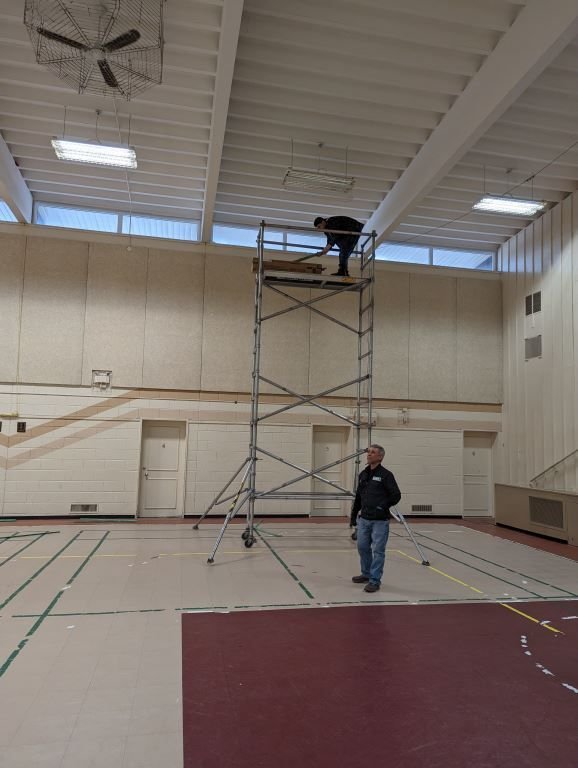
Replacing lights in the gymnasium at St. Paul’s United
While encouraging congregants to donate with an envelope titled “‘Let There Be Light,” the project team provided the opportunity for congregants to support particular areas of the lighting retrofit by categorizing the renovation into three levels of lights:
Pendant light - $272/per light
Dome light - $36/per light
Hall bulb - $57/per light
“It's a way to make them feel like they can contribute to any level, and understand what they are spending the money for,” Devenne says.
Within just four weeks, St. Paul’s United had enough funds raised from the congregation to cover their share of the total project costs.
“I was pretty confident that they were going to come up with the amount for the lights. I was surprised when we exceeded our goal and had enough to use for other building upgrades,” Devenne reflects.
Turning on the Lights
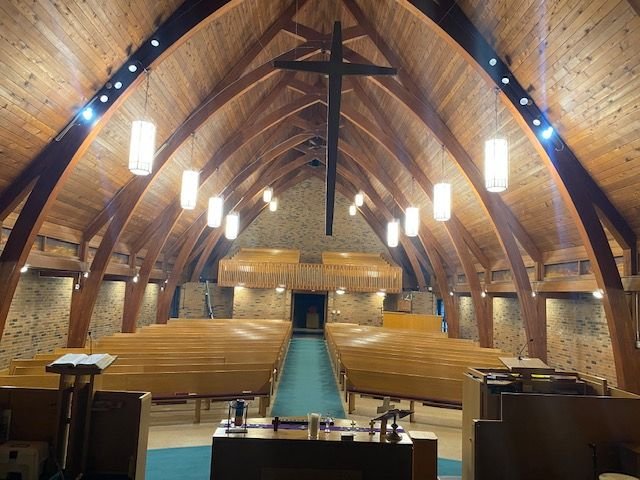
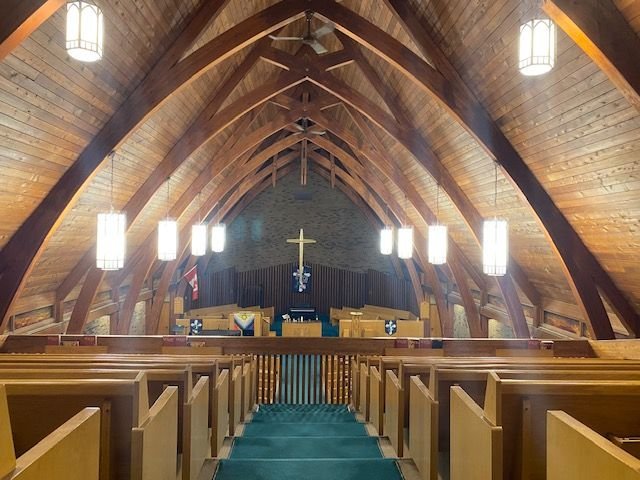
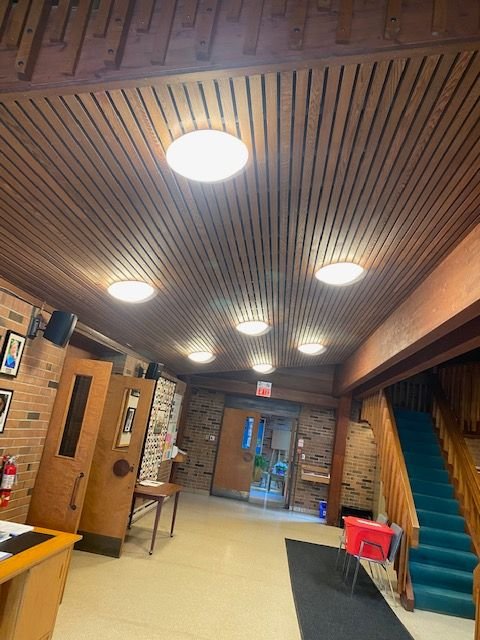
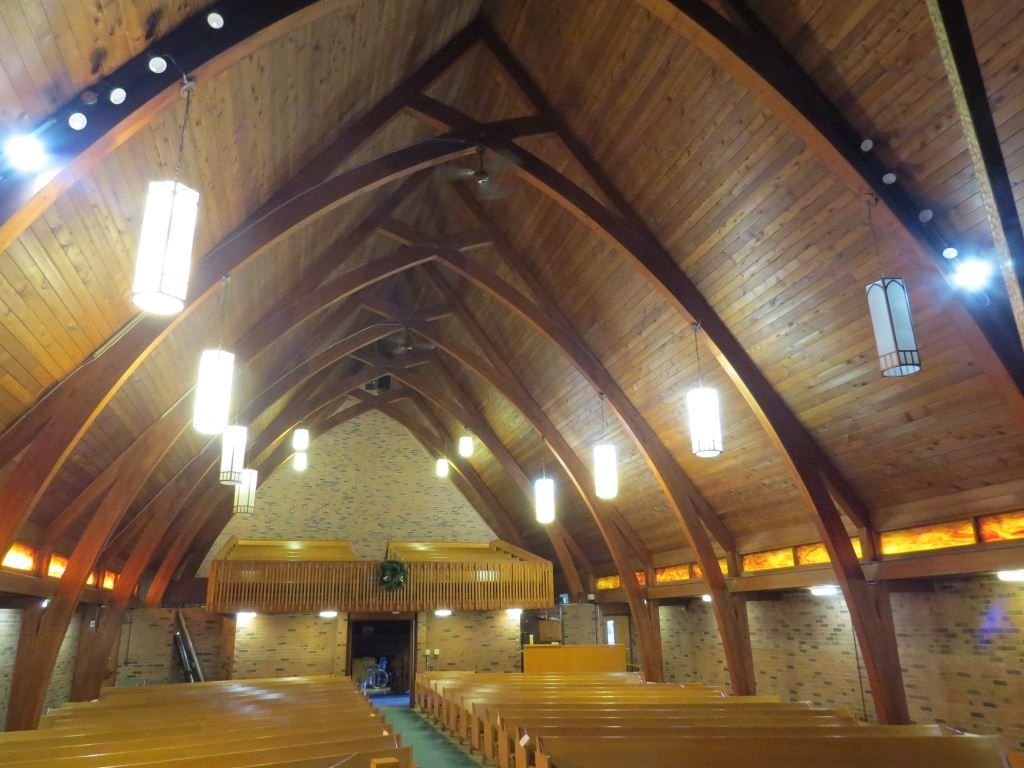
Since completing the renovations, St. Paul’s United has already seen a drastic difference in the quality of lighting.
“The LED bulbs add a little sparkle to the ceiling as well as more light than before while not being harsh,” Harold reports. “The new dome lights down the aisles and in the narthex produce more light than the old ones and look much better.”
With the recent upgrade, St. Paul's United looks forward to lowering its electricity bills. The church says they will continue seeking opportunities to reduce their energy consumption wherever possible.
Stay in the loop about St. Paul's Retrofit Project
Stay updated about St. Paul’s reductions in emissions, electricity usage, fossil fuel use, energy costs, and energy use intensity. Sign up for the Faithful Footprints Monthly Newsletter.
Faithful Footprints Program
The United Church of Canada’s Faithful Footprints program offers inspiration, tools, and grants to help its faith communities reduce their carbon footprint. With the Church’s commitment to reducing its greenhouse gasses (GHG) emissions by 80% by 2030, this one of a kind program offers up to $30,000 in grants towards energy conservation and renewable energy projects (conditions apply).
Faith & the Common Good is the delivery partner for the Faithful Footprints program. To date, we have engaged over 300 congregations, camps, and buildings across the country. Your participation in the program puts your faith into action and helps the Church reach its target.
Aleyxa Gates Julien is the PR/Communications Coordinator for Faithful Footprints and can be reached at agatesjulien@faithcommongood.org.
Now fly: Wesley United Church takes the lead in St. Andrews, New Brunswick
Across the country, United Churches are doing their part to address the climate crisis by getting their houses in order and reducing their own carbon emissions. Through a partnership with Faith & the Common Good, the United Church of Canada is offering grants and support for churches to measure their energy use and reduce their climate pollution, in ways that save money and strengthen congregational renewal.
Across the country, United Churches are doing their part to address the climate crisis by getting their houses in order and reducing their own carbon emissions. Through a partnership with Faith & the Common Good, the United Church of Canada is offering grants and support for churches to measure their energy use and reduce their climate pollution, in ways that save money and strengthen congregational renewal. The initiative, called Faithful Footprints is about living climate commitments, for future generations, and for all of creation. To inspire your congregation to get involved, we have stories from participating congregations.

Wesley United Church building is 152 years old and Faithful Footprints allows for renovations and updates while saving money.
Now fly: Wesley United Church in St.Andres, New Brunswick

The treasurer has the pulse of the church,” says Barb Sheen of Wesley United, in the tiny town of St. Andrews, New Brunswick. “We are always looking to reduce our costs.”
When Barb heard about the FF grant and brought it to the attention of the renovation committee, and church board, she secretly thought it sounded too good to be true, “but in our case it was true.”
Prior to the grant, Wesley United had already started a renovation project thanks to receiving a bequest. They had been visioning for two years about how they would use it to benefit the congregation and community at large: “We wanted to think bigger, widen our doors, asking, ‘what can we do to participate, what can we accomplish?’”

The Church building is 152 years old, “so there is no problem to find things to do,” Barb jokes. “As the stars lined up, we lined up.”
They restored some of the stain glass windows, revamped the heating systems, and with the FF grant and a fundraising campaign, they were able to pay for insulating much of the sanctuary, eliminating drafts by caulking the cracks in the original floors and doors and putting in energy-saving lighting in the halls and sanctuary. Of the $155,000 spent on renovations and energy-saving initiatives, they garnered $30,000 back.

Similarly to all the churches in the program, the congregations’ participation was key.
“We invited them all the way, kept the communication alive and they really came on board,” Barb says. With consistent updates at the forefront, “it gave us a real sense of energy use in the church, and to actually see what we were able to accomplish.” Nine months later they had finished the renovations.
“We have spread our wings and will continue to go further as we move into 2020,” concludes Barb. “The Faithful Footprints program has helped us do that.”
Helpful Hand-holding
Preparing a grant application can be daunting, but Stephen Collette, Grant Project Manager for the Faithful Footprints program is here to help! Stephen ensures your application form is properly completed and that your energy efficiency package will actually save you money. Stephen’s assistance helps expedite the application approval process tremendously, with typical turnaround times under two weeks, and often in a matter of days.
The Faithful Footprint program also features support hubs for United Church congregations in the Prairies and Atlantic Canada. “We know that lack of capacity is one of the major obstacles to “Greening” our sacred spaces, so we are proud to be working with Ecology Action Centre in Halifax and Purpose Construction in Winnipeg to pilot how to provide in-person support to United Churches around energy efficiency action,” said Cummings. Guided by regional multi-faith advisory circles, the hubs are lead by local building and energy efficiency experts and aim to connect congregations with municipal and provincial energy incentives, recommend contractors, and foster collaboration among other local places of faith facing similar challenges.
UCC Carbon Baseline Report
The United Church of Canada is committed to reducing its carbon emissions by 80% by 2050, in line with the Paris Climate Targets. With an initial focus on buildings – one of the church’s largest sources of emissions – the program Faithful Footprints will be working with 500 congregations by 2025 to reduce their energy use and energy costs.In 2016 the UCC General Council commissioned Caring for Creation, Our Communities and Our Congregations: The Case for a National Carbon Reduction Program for Faith Buildings. Faithful Footprints is the beginning of implementing those learnings.
As people of faith, we recognize that to bring truly inspiring climate leadership to our communities, we must practice what we preach. Together we can renew our congregations, care for the planet, save money, and stop climate pollution.
Stay tuned for a full feature of Faithful Footprints in the February 2020 edition of the United Church of Canada’s Mandate Magazine.
Nurturing collaborations: Mckillop United in Lethbridge, Alberta
Across the country, United Churches are doing their part to address the climate crisis by getting their houses in order and reducing their own carbon emissions. Through a partnership with Faith & the Common Good, the United Church of Canada is offering grants and support for churches to measure their energy use and reduce their climate pollution, in ways that save money and strengthen congregational renewal.
Across the country, United Churches are doing their part to address the climate crisis by getting their houses in order and reducing their own carbon emissions. Through a partnership with Faith & the Common Good, the United Church of Canada is offering grants and support for churches to measure their energy use and reduce their climate pollution, in ways that save money and strengthen congregational renewal. The initiative, called Faithful Footprints is about living climate commitments, for future generations, and for all of creation. To inspire your congregation to get involved, we have stories from participating congregations from across the country.

Mckillop United Church in Lethbridge Alberta started with a modest proposal to renovate their kitchen which evolved into a 1.6 million dollar project.
Nurturing collaborations: Mckillop United in Lethbridge, Alberta

It started with a modest proposal for a kitchen renovation and evolved into a 1.6 million project.
“So much of our activities centers around food, so many initiatives grow from it,” says John Bolton, coordinator for the renovation committee at Mckillop United in Lethbridge, Alberta.
But for as long as he can remember, the congregation had been talking about a kitchen renovation, because they had an ancient stove out of the prisoner of war camp: “People were afraid to use it.”
Pushing to be a community hub, a federal New Horizon grant for Seniors helped pay for the kitchen. Moving on to the main hall, in terms of safety, they recognized the heating system as being antiquated; large, inefficient 1950 vintage boilers.

“The FF grant allowed us to do what we wanted to do,” says John. $30,000 funded two boilers. “What that means is that there is a significant reduction in our utility costs, allowing more funds to be directed into community outreach.”
Now, thanks to a FF grant and other monies, including fundraising, the church enjoys a commercial-level kitchen, high-efficiency furnaces, new inclusive washrooms, full-service elevator for accessibility, and several other infrastructure improvements.
Being a congregation with “a strong social justice conscience,” and the belief that they can do a lot to “make a better world,” (they work to uplift LGBTQ+ and Indigenous communities and are eco-focus, sitting as the only church on the Environment Lethbridge Committee), John says they really needed to move beyond the walls. “We couldn’t only be a Sunday morning service, we have too much potential for one day a week use.”

It was important that they look out for partnership options and organizations that mesh well with their faith pillars. “You have to look for partners that fit, they don’t just drop in your lap,” John says. Mckillop contracted with a consultant to help identify collaboration opportunities. In January of 2019, area organizations started to use the renovated facilities, including a meal-preparation program to address senior isolation, in cooperation with the Lethbridge Senior Community Organization. Coming up is the possibility for a similar program for disabled adults to run with L’Arche. “Next, we hope to continue to green the church, perhaps using solar panels--with government incentives.”
UCC Carbon Baseline Report
The United Church of Canada is committed to reducing its carbon emissions by 80% by 2050, in line with the Paris Climate Targets. With an initial focus on buildings – one of the church’s largest sources of emissions – the program Faithful Footprints will be working with 500 congregations by 2025 to reduce their energy use and energy costs.In 2016 the UCC General Council commissioned Caring for Creation, Our Communities and Our Congregations: The Case for a National Carbon Reduction Program for Faith Buildings. Faithful Footprints is the beginning of implementing those learnings.
As people of faith, we recognize that to bring truly inspiring climate leadership to our communities, we must practice what we preach. Together we can renew our congregations, care for the planet, save money, and stop climate pollution.
Stay tuned for a full feature of Faithful Footprints in the February 2020 edition of the United Church of Canada’s Mandate Magazine.

Our Neighbours, Ourselves, and all of Creation
The Green Covenant asks them “to care for our neighbours, ourselves and all of Creation by: integrating the love of Creation in our worship and spiritual lives. We will lead by example and ask those who use our building to partner in this covenant.”
In 2011, Saint Andrew’s United Church in Halifax, NS, celebrated a ‘Greening Sunday’ and covenanted with God and each other to be a Green Church. The Green Covenant asks them “to care for our neighbours, ourselves and all of Creation by: integrating the love of Creation in our worship and spiritual lives, increasing environmental awareness and education, practicing stewardship by conservation of natural resources, and working with others for environmental justice. As a congregation and as individuals, we will make every effort possible to reduce our carbon and ecological footprint. We will lead by example and ask those who use our building to partner in this covenant.”
Saint Andrew’s has already been practicing this covenant for the past several years by:
Including climate change and other ecological concerns in worship and celebrating ‘The Season of Creation’ in worship and education for all ages,
Partnering with Shambhala to co-sponsor ‘Sacred Earth Awake’ film series,
Having a professional energy audit on our building,
Converting from oil heat to natural gas, and
Changing the lighting to CFC or LED lights,
Using and promoting Fair Trade coffee and other products,
Organizing climate justice events and supporting First Nations communities as they raise awareness about the effects of the Alberta oil sands on their lives.
They are continuing to invite members, groups – especially youth, staff and neighbours to share suggestions and to act together to more fully integrate our care of Creation in all that we do. Including:
Make every effort to save heat and paper,
Include ‘Green Tips’ in the weekly bulletin,
Increase the number of recycle bins,
Use environmentally friendly cleaning products,
Designate ‘idle free’ areas,
Install bike racks,
Collect/recycle ink cartridges,
Search for a biodegradable alternative to Styrofoam (for the Sunday Supper for the homeless),
Explore the possibilities of a community garden and/or fruit tree planting on church property, and
Advocate to stop the destructive impacts of the Alberta tar sands and work for a provincial moratorium on Hydraulic Fracturing.
Check out more from St. Andrew's United Church on their website: www.standrewshfx.ca

Mount Bruno United Takes on the Green Challenge
Mount Bruno United Church, in Saint-Bruno-de-Montarville, QC, has taken on the green challenge by taking a look at how they use energy in their building.
Mount Bruno United Church, in Saint-Bruno-de-Montarville, QC has taken on the green challenge by taking a look at how they use energy in their building. Temperature control sensors have been installed inside and reflector screens behind all the radiators are used to make sure that as little heat as possible is being lost during the winter.
Very aware that churches can often use a great deal of paper during the everyday life of a congregation, Mount Bruno makes sure that unused bulletins don’t go to waste, by reusing them for various other services during the year. Finally, as well as running their own recycling program Mount Bruno is also reaching out to the community by organizing a twice-a-year large-scale recycling event for people in the surrounding area.
They are a member of the Green Churches network.

The Newest Oldest Church You've Ever Seen - Laidlaw Memorial United
“We know we are doing things that outlive us, and that is what brings life to the world, and that is what brings life to the church.”
““We know we are doing things that outlive us, and that is what brings life to the world, and that is what brings life to the church””
Laidlaw Memorial United Church is a beautiful old building built in 1912. The community boasts 140 members and an average Sunday worship attendance of approx. 80 people.
In 2008, Laidlaw Memorial United Church was a community faced with a dwindling membership, continuous budget deficits and a facility requiring multiple retrofits including a failed roof. Slowly, bit by bit, the community tackled their budget deficit by making small energy and money saving measures in just about every aspect of their facility. From installing a 7-day electronic set back thermostat, turning off the pilot lights when not in use, turning off the water heater in the summer to moving the heat ducts from the ceiling to the floor, setting up a convection current and making the gym warmer and using less fuel. In the process, they realized that they were going green. When it came time to deal with the cost of a replacement roof, it was proposed that the Church investigate the possibility of installing solar panels through the microFIT program in order to help pay for it. As they say, the rest is history as a mortgage loan was taken out to help pay for the new steel roof and the solar installation. On June 4, 2010, the project went live.
Remarkably, there have been no issues. Since an inspection after the first year after installation, where no trouble was found, the panels and equipment have functioned perfectly, and within parameters.

"The panels have been remarkable in starting conversations about being greener in practical ways. The congregation has always and unanimously welcomed the panels. The businesses on the street who buy 'bullfrog' green power, like pointing down the street to where it comes from. Younger people are attracted to our church, in part, because there is a practical expression of care for creation, and the good of generations to come. We have entertained the media, a youtube video and a local cable spot, as well as a spot for 100 Huntly street's "Good News" program. There is credibility to our calling for care for creation, and we have continued to upgrade lighting, windows, and energy efficiency. The solar project was, for us, a public statement of our values, and our ongoing commitment to God's creation."
This and more from Laidlaw United Church on their website: www.laidlawchurch.ca/about

Parkdale United Creates a Change for Climate
We are inspired by the Biblical call to be good stewards of the Earth and by the warnings from the International Panel on Climate Change. We have the means to be part of the healing of the Earth. Here is what we have done so far.
Parkdale United Church in Calgary is working on Creating a Climate for Change
Pictured above are Parkdale Members Bev Delong, Eneyda Rios, Ken Coburn, and Ted Moon (left to right) getting ready to replace their old seven-pilot boiler.
The following is the text from their ‘Creating a Climate for Change’ brochure. Read more about Parkdale United in Calgary here.
We are inspired by the Biblical call to be good stewards of the Earth and by the warnings from the International Panel on Climate Change. Our community has shared books and movies further explaining the need to adapt to lessen our use of power and water. We have the means to be part of the healing of the Earth. Here is what we have done so far.
To learn about options, we engaged in an environmental audit in June 2012 by Stephen Collette organized through Faith & the Common Good resulting in recommendations for action.
To lessen our carbon output, Parkdale is:
Purchasing a boiler that will reduce our output by an annual 15 - 18 tonnes of CO 2
Anticipates the installation of solar panels will further reduce our CO2 production annually by 10 tonnes.
Plans that the auditorium roof insulation will reduce CO2 by a further 3.0 to 5.0 tonnes.
Switched many light fixtures to T8 compact fluorescent bulbs
Has replaced an elderly fridge with a more energy efficient model
Gas stopped use of the inefficient freezer in the main kitchen and
Installed foam gaskets for insulation in the exterior wall electrical outlets.
To lessen the volume of water treated, and conserve water, Parkdale has:
Installed five low flush toilets reducing water usage from 13 litres per flush to 6 litres
Water faucets have been checked to ensure there are no leaks and
1.5 GPM low flow aerators were installed to reduce hot (and cold) water consumption.
To create a healthier building, we have: moved to environmentally friendly clearing products & dishwashing liquid, removed a volume of old VOC-carrying paint cans from the church, and called for a “no-scent” policy among users of the building
To decrease production of plastics, and lessen waste going to the landfill, Parkdale has: called for called on users to minimize use of disposable dishes and cutlery and to not use styrofoam and placed paper recycling bins throughout the church.
To discourage the commercial production of water and in keeping with recommendations from the United Church of Canada, Parkdale has installed two filtered water systems and is encouraging all users of the building to use them rather than bottled water.
To enable paper recycling, paper recycling bins to be placed in conference rooms that are available for rental.
Next Steps? What would you suggest?
Are you interested in information on solar panels for your home? Perhaps you would like other information on environmental possibilities. Let us know!
Words of thanks!
Our gratitude goes to Parkdale Council, Parkdale’s Operations Committee and Faith and Justice Committee for their considerable work on these projects.
We acknowledge with thanks the financial support received from the bequest of Janet Tollefson and the work of the Committee that evaluated potential projects to be addressed by that bequest.
We also thank the people who regularly contribute to these projects at our monthly movie night.

A Hub for Community Growth - Beacon United Church Energy Efficiency Journey
“This was part of a larger plan to make sure the building remained used and had income to help offset the costs of operation. Another initially controversial move to use the auditorium space for a heavy metal festival, which ended up being a great fit, as “the music was amazing and the festival attendees very respectful!””
Story from the Ecology Action Centre website.
Beacon United Church's Energy Efficiency Story (2016)
At 22,000 square feet, Beacon United Church and its attached community space is not easy to heat. Especially so in a cold, humid climate like Yarmouth, a small town of just under 6,800 on the southern-most tip of Nova Scotia. Like many places of worship around Canada, just six years ago it was struggling to make ends meet in a rural town, with a declining population and a declining congregation. The church was up for sale – the congregation had agreed that it could no longer pay for upkeep and operations. However, this church has taken a leap into the future by becoming a hub for community growth and environmental justice amongst its congregation and the local population.
“I received some comments of concern but once they saw how good a space this was for some activities that even the congregation enjoys, the concern dispersed. ”
One of the more notable projects is the former chapel, which has been turned into a multi-purpose room to accommodate for just about any user-group. It’s mostly used by a group of local seniors who enjoy the space three times a week. Stephen Sollows, the green enthusiast at Beacon United Church, recalls some resistance that he encountered when he initially proposed that the space be turned from a small chapel into a multi-purpose space. “I received some comments of concern but once they saw how good a space this was for some activities that even the congregation enjoys, the concern dispersed,” he recalls with a laugh. Of course, this was part of a larger plan to make sure the building remained used and had income to help offset the costs of operation. Sollows also recalls another initially controversial move to use the auditorium space for a heavy metal festival, which ended up being a great fit, as “the music was amazing and the festival attendees very respectful!”
The multi-purpose room also received some energy-efficiency-influenced changes. Since the enormous building is heated by the same oil-fired heating system, they had a heat pump installed so that the room could be heated without turning up the heat in the entire building. Finding the appropriate lighting was a challenge, as certain colour spectrums make reading difficult for aging eyes. Beacon found that by using LED lights on the blue (cold) spectrum, reading was easier. Furthermore, the quiet LEDs replaced old fluorescent tubes that made some high-pitched buzzing noises. This retrofit did not put a large dent in the pocket of the church: it was covered by a New Horizons grant.
Another initiative of the church to reach out has been its enormous community garden, started 4 years ago. This garden has 130 plots. Two-thirds of the plots are owned by members of the community, one-third of the plots belong to the church. The space is used by many of the user groups of the church, even the youth-oriented groups, to learn about gardening. It also includes a labyrinth, where anyone is welcome to walk and meditate.
The garden had issues with storm-water management, as there was a slope from the large parking lot towards the garden. The church planted a storm water garden with native plant species that has successfully mitigated this problem.
Next steps for Beacon United are big: they have had a solar assessment done and are in the process of having an ASHRAE level energy assessment from a local energy consultant who is generously giving the assessment at a very discounted price. They are looking forward to implementing the money and greenhouse gas savings measures as soon as they can.