
BLOGS
Churches across the country are stepping up. Read their stories and access other climate and energy resources here.

Our Cultural Heritage and Community Engagement
In admiring the stunning Gothic cathedrals that overlook our downtown centres, we can all agree that places of worship hold our collective cultural heritage. But what about our smaller faith community buildings?
In admiring the stunning Gothic cathedrals that overlook our downtown centres, we can all agree that places of worship hold our collective cultural heritage. But what about our smaller faith community buildings? The rural church in a Nova Scotia village that may not have been built by hundreds of people, but by a local shipwright in the off-season, or the chapel in an Alberta community constructed by one mason and farmers, bringing rocks off their farms?
People were baptized, married, and buried within those walls. They celebrated the high points of life together or rallied around an important cause for the greater community. Meals were had, friendships were made, communities were strengthened. Folks learned how to dance in the hall, cook in the kitchen, play basketball in the gym, and did homework in the classrooms after school. Whether large or small, built by many or few, our buildings, sanctuaries, halls, lounges, and classrooms have been gathering places for the congregational and the greater community for decades. They, like the cathedrals, hold our cultural heritage and memorable history.
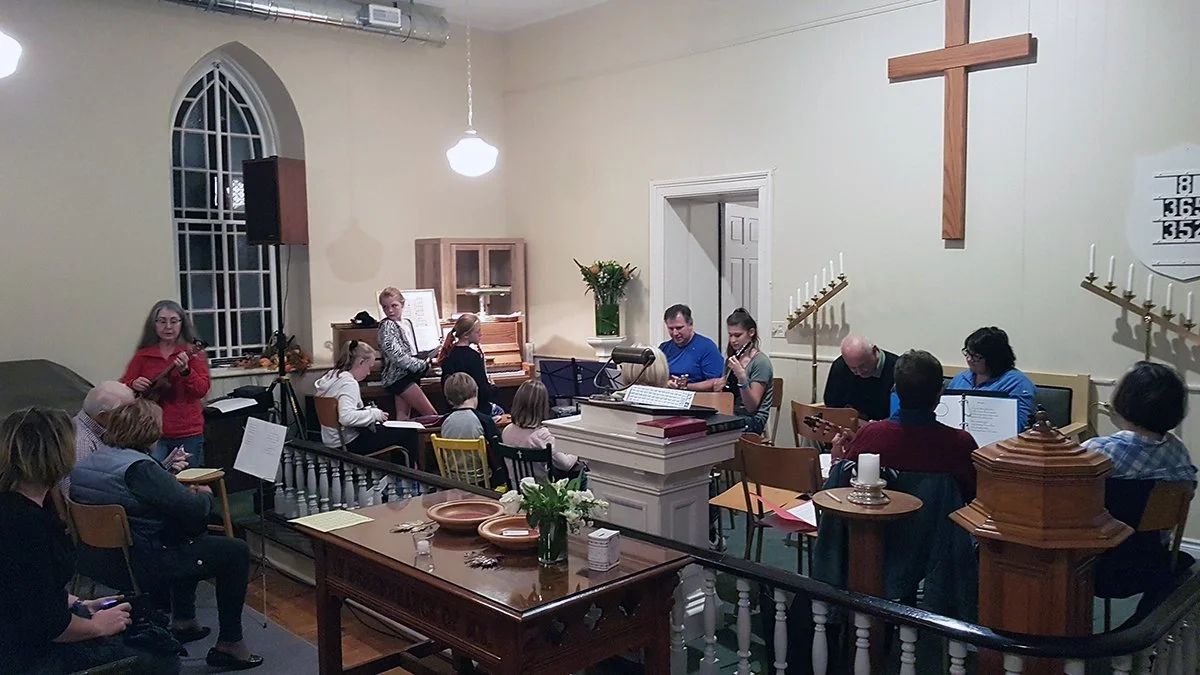
Ukulele Group. Kilworth United, London
However, since the pandemic, in-person gatherings have been limited, as many communities have transitioned to streaming their services and events virtually. As a result, gatherings have felt distant, leaving many members craving community and the chance to laugh, cry, and celebrate together. As we slowly start to open back up and hopefully return to public life again, we will want to come together not only for worship, but for Tai Chi, antique radio clubs, singing, sewing classes, learning English, and many other community gatherings.

Baking. Trinity United, Shediac
Looking ahead to when we can welcome our communities back, now is the time to improve the comfort, health, and understanding of our buildings. Before the doors open, a fresh coat of paint might be in order but why not start to focus on making our spaces more energy-efficient and user-friendly? Installing LED lights, water-efficient fixtures, and energy-efficient appliances will make for a more environmentally friendly kitchen or facility, as will caulking leaky windows against the winter cold.

Bollywood Night. Norval United, Norval
This is also a perfect opportunity to start tracking your energy and operational costs, for a better understanding of what fair community rental rates should be. Energy tracking is a critical piece of that calculation that most people miss. You can have mission rentals at deep discounted prices, of course, but you should make sure that the regular rentals are actually covering your costs.
The more you can learn about your building, the more you can save energy, minimize maintenance costs, and maximize the usage of your amazing faith community building. You can utilize our professional knowledge with virtual Green Audits that look at energy, air quality, food, water, waste, maintenance, rental agreements, heritage, and much more.
By thinking about the opportunity and role your building can play for the greater community, you can help create sustainable income for your faith community, and actively invest that money in energy upgrades, mission work, and strengthening your communities and cultural heritage.
Faithful Footprints Program
The United Church of Canada (UCC) Faithful Footprints program offers grants, tools, and inspiration to help its congregations reduce their carbon footprint. With UCC’s commitment to reducing its greenhouse gases (GHG) emissions 80% by 2050, this one of a kind pro,gram offers up to $30,000 in grants towards energy conservation and renewable energy projects (conditions apply).
Faith & the Common Good is the delivery partner for UCCs Faithful Footprints program. To date, we have engaged over 200 UCC congregations, camps, and buildings across the country. Your participation in the program puts your faith into action and helps UCC reach its target.
Stephen Collette is the Building Manager for Faith & the Common Good and can be reached at 705-652-5159 EDT, scollette@faithcommongood.org

Retrofitting our Sacred Space with Faithful Footprints Funding
Our buildings, our spaces matter. There are, of course, the practicalities of making drafty rooms comfortable and bringing energy and climate costs down. But more than these issues, our spaces house and embody our values. They hold our gatherings, celebrations, prayers and sacred ceremonies and should reflect who we are and what matters to us.
Guest post by Nanci Lee, Executive Director, Tatamagouche Centre
Our buildings, our spaces matter. There are, of course, the practicalities of making drafty rooms comfortable and bringing energy and climate costs down. But more than these issues, our spaces house and embody our values. They hold our gatherings, celebrations, prayers and sacred ceremonies and should reflect who we are and what matters to us.
So, when we decided to green retrofit our main building, Stewart Hall, we realized that this would be more than a bricks and mortar project. We began Phase I with two practical and strategic projects. The first was to replace our main roof and insulate it to R40 from R3, essentially putting a hat on. The second project was to renovate our sanctuary space, one of the most meaningful spaces in all of our buildings that would set the tone for what was to come.
With 18-foot ceilings, a wall of windows and lovely boat-shaped curves, the sanctuary space had been awe-inspiring in its day and still holds such meaning. I recently met a woman who married her husband in this chapel. It has remained an intimate place of coming together in song and learning, in prayer and smudging, grief and joy. While the magic of the space has been held by the people and talented facilitators, the room itself was beginning to feel tattered. Built in the fifties, it also had the unfortunate condition of being too hot in the summer and too cold in the winter.
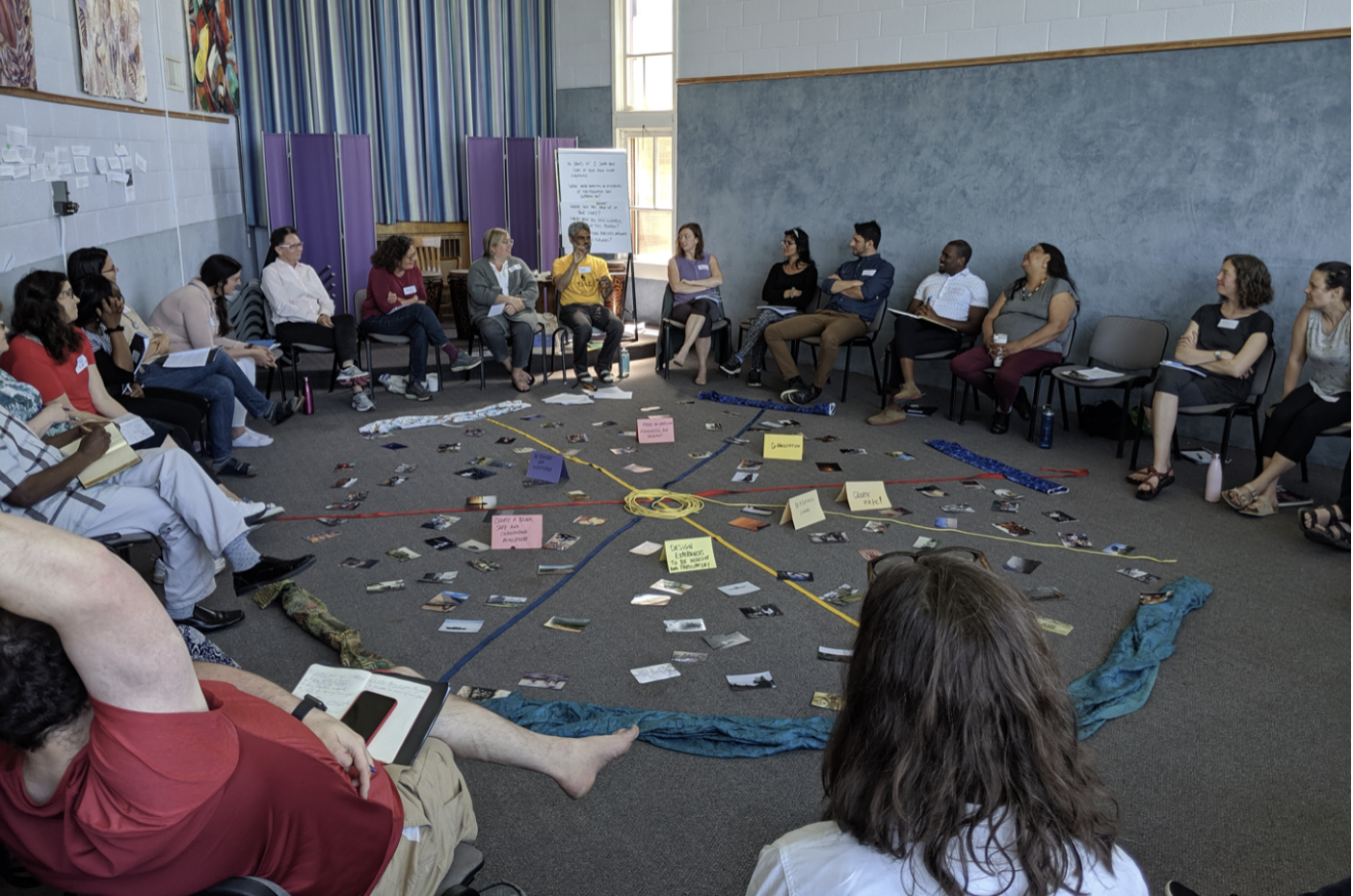
Sanctuary space before retrofits. Photo credit: Lee Fleming, Manager (Green Retrofit)
In conversations with our partners and our Board of Directors, it was clear that the project of renovating our sanctuary would be a balancing act. How to be widely welcoming and practically energy efficient while keeping that sacred intimacy? How to genuinely embody our communities across such a diversity in faith, spirituality, race and gender identities?
As we think about decolonizing our organizations and our churches, our faith institutions, how we decolonize our space is important. We heard that people wanted the space to be comfy, sacred but not precious, good air circulation, good energy efficiency, welcoming to different faiths. Honouring our origins, connections and core funding with the United Church, how could the space reflect the multi-faith and multi-cultural nature of our communities? That meant that it is as home to a Black Baptist choir as it is to an Indigenous circle or contemplative Christian silent retreat.
Practically-speaking, this meant windows that we kept the wall of light but weren’t so clearly associated with one faith. Even the raised floor at the front, designed to point the space toward a Minister was taken out and replaced with a removable riser that could be used for prayer, ceremony, ritual but also removed for more circular gatherings. The once single cross will be joined with a number of other spiritual and sacred objects celebrating the diversity of communities we have of spiritual seekers. We are still in dialogue about how to do this well. As one Board member put it, we are a microcosm for society’s struggle with values, equity, safety and community.
A Welcoming Space

Sanctuary space after retrofits
What does it mean to be widely welcoming and sacred across faith and spiritual diversity? Some have asked- why isn’t it enough that we welcome with open arms? The United Church has long been welcoming and early worked at apology and reconciliation with Indigenous friends and neighbours. While this is true, it is also true that it is not enough to be a welcoming chapel if, as we heard from Elders, the cinder block and the large cross remind you of the residential school you attended. Apology is a practice. Being able to truly relax and feel at home in a space is as much a part of reconciliation as any of these processes.
We decided to go with warm, neutral tones that can later invite final flourishes and welcoming touches. Ideas include textiles and blankets, art from different communities. The ceiling could hold ribs of a boat, like ribs of our bodies, an image that came from one of the Mi’kmaw grandmothers, Women of First Light. For the floor, we chose a natural, local Ash on recommendation from our architect Jane Abbott and main contractor, Hal Fowler. Certainly, it will require a little more care but for this space, we are happy to invest in those extra touches.
We have more work to do, more conversations to ensure that the space feels like home as widely as possible but it feels like a place where we can embody the world we want of love and justice that I feel come together through spirit. Through this lovely space we can talk about who we are and how to be in step together. We are committed to these right relations.
We were grateful for the seasoned experience and insights of Stephen Collette, Building Manager for Faith & the Common Good (FCG) and coordinator of the United Church of Canada’s (UCC) Faithful Footprints Program. FCG is the delivery partner for this grants, resources and inspirational program. Stephen was able to help us think through first steps, how to make sense of monitoring energy efficiency and provided excellent support through the process.
Overall, Phase I cost $214,600 for both the roof (41%) and the sanctuary space and we were able to raise $199,824. Faithful Footprints funding provided 15% of our funding raised. Certainly partners like UCC make other funding possible. We are immensely grateful for both this funding and the technical support from Stephen. Gratefully, we have also raised $88,920 for Phase II of Stewart Hall retrofit to focus on heating, cooling, space utilization, windows and groundwater.
Our first program offered this year onsite, Licenced Lay Worship Leaders will be the first to make use of the Sanctuary Space. We are all very excited and look forward to welcoming each and every one of you to our new stunning, sacred space.
About the Faithful Footprints Program
The United Church of Canada (UCC) Faithful Footprints program offers grants, tools and inspiration to help its congregations reduce their carbon footprint. With UCC’s commitment to reducing its greenhouse gases (GHG) emissions 80% by 2050, this one of a kind program offers up to $30,000 in grants towards energy conservation and renewable energy projects (conditions apply).
Faith & the Common Good is the delivery partner for UCCs Faithful Footprints program. To date, we have engaged over 200 UCC congregations, camps, and buildings across the country. Your participation in the program puts your faith into action and helps UCC reach its target.
Stephen Collette is the Building Manager for Faith & the Common Good and can be reached at 705-652-5159 EDT, scollette@faithcommongood.org