
BLOGS
Churches across the country are stepping up. Read their stories and access other climate and energy resources here.

4 Must-Know Tips for Choosing the Right Contractor for Your Faith-Building Project
Choosing the right contractor can sometimes be a stressful decision. This blog shares four essential tips to ensure you know how to make an informed decision and hire the best contractor for your building project.

Navigating construction and renovation projects for faith community buildings requires careful planning and consideration. Unlike residential projects, these projects can demand specialized expertise and understanding of community needs. While handling some tasks yourself can minimize costs and risks, professional assistance is often needed. Choosing the right contractor can sometimes be a stressful decision. This blog shares four essential tips to ensure you know how to make an informed decision and hire the best contractor for your building project.
Tip 1: Ask Around
It is essential to recognize that faith community buildings differ significantly from residential homes. Your go-to contractor for home projects may not necessarily have the expertise required for commercial buildings, which can vary based on size and usage. If you have a trusted contractor in mind, ask about their experience with buildings of similar size and type. If they lack experience in this area, consider asking for recommendations from professionals who they trust.
You can also consult your municipality’s building official, especially in smaller municipalities, for referrals. They will usually provide several names without favouritism but will suggest people who make their lives easier. Local insurance companies follow a similar approach, due to liability concerns. These recommendations will help narrow down your options. Additionally, don’t be afraid to reach out to neighbouring communities of faith, regardless of denomination or faith. They may recommend experienced contractors who understand how faith communities work.
Tip 2: Compare Quotes
Projects Located in the City
In a big city, receiving multiple quotes is important. Unfortunately, larger urban areas can attract fly-by-night contractors who may disappear after delivering shoddy work. By gathering several quotes you can better compare prices, services, and deliverables. This not only helps you understand the market rate in your area but also allows you to identify any outliers who may be underbidding to win the contract without the intention or capability to deliver quality work and others who are overcharging.
Additionally, multiple quotes give you leverage to negotiate better terms and understand what is included in each contractor's offer. For instance, some quotes might include cleanup services, and warranties, while others might charge extra for these services. Being aware of these details helps you avoid hidden costs and choose a contractor who offers the best value for your budget.
Projects Located in Small and Rural Towns
For those in small towns, shopping around can be more challenging. Getting three quotes may not be possible for a certain trade. However, the advantage of small-town and rural contractors is you can’t do terrible work and get away with it for long. In a close-knit community, everyone knows everyone, and word travels fast, so maintaining a good reputation is crucial. This often means that you might end up using "Chris’s Contracting" simply because it's the only option available.
Expanding your search to a nearby town or city can be more difficult and may drive up costs. However, if the contractor from another town is more competent, the quality of the result is what ultimately matters most. On the other hand, if the local contractor is willing to learn and is keen to get involved, then that becomes a conversation for your board. Some of the best outcomes, in my opinion, come from those who are keen to learn and do things right.
Tip 3: Confirm Reputability
Call References
When evaluating potential contractors, it's crucial to call references and ask detailed, tough questions. Inquire about how they handled cost overruns, their approach to problem-solving, and whether they followed through to the project schedule. Understanding their performance in these areas will give you a clearer picture of their professionalism and reliability. Don't hesitate to ask about their responsiveness to questions and concerns, as well as their availability for follow-up after the project’s completion. These aspects are important for assessing their customer service and long-term commitment. People often gloss over the stressful parts once a project is completed, so make sure to ask about the specific pinch points during the project. Were there areas where the contractor's performance was lacking? How did these issues impact the overall experience?
Years of Service
For those focused on advancing energy efficiency and decarbonization, certain trades tend to grow when funding is available. Solar and heat pump installers are prime examples of this trend. While there are excellent solar and heat pump installers across Canada, some companies emerge when the trough is full and vanish afterward, leaving you in the lurch with follow-up maintenance. This doesn’t mean you should avoid or not support new or small companies, but it's essential to approach their promises with caution.
Registered Professionals
For specialized heritage work, such as examining stained glass or addressing structural concerns in a 150-year-old building, you can find experts through the Canadian Association of Heritage Professionals' website. Provincial Trust Websites may also list heritage professionals. Additionally, you can search for local experts through professional organizations related to the specific trade you need. For instance, the Canadian Solar Industries Association and the Canadian Renewable Energy Association are excellent resources for finding reputable professionals in the renewable energy sector.
Tip 4: Choose People Over Products
It’s important to prioritize people over products or price. The person you're working with can significantly impact your experience and the project's success. Look for individuals who are pleasant, patient, and responsive to questions. They should respect and understand the committee process of your faith community, be eager to learn, solve problems, and price their services fairly. These types of individuals are the ones likely to remain available and supportive long after the initial work is completed and the ones willing to provide ongoing assistance when you have follow-up questions or encounter an issue.
Choosing the cheapest option often doesn't equate to the best decision. Low prices can sometimes indicate compromises in quality or service. When spending your faith community's money, it's crucial to do your due diligence. By selecting the right people, and focusing on those who demonstrate dedication and compatibility, you can relax, be confident that you've made the best decision possible, and enjoy the results.
Faithful Footprints Program
The United Church of Canada’s Faithful Footprints program offers inspiration, tools, and grants to help its faith communities reduce their carbon footprint. With the Church’s commitment to reducing its greenhouse gasses (GHG) emissions by 80% by 2030, this one-of-a-kind program offers up to $30,000 in grants towards energy conservation and renewable energy projects (conditions apply).
Faith & the Common Good is the delivery partner for the Faithful Footprints program. To date, we have engaged over 400 congregations, camps, and buildings across the country. Your participation in the program puts your faith into action and helps the Church reach its target.
Stephen Collette is the Building Manager for Faith & the Common Good and can be reached at 705-930-1011 EDT, scollette@faithcommongood.org

How Thermal Mass and Thermal Insulation Work for Your Faith Building
Many faith communities have buildings with exterior structures that are made out of wooden framing– hence low thermal mass. Without insulation between the walls, such buildings typically experience thermal heat loss. Find out what thermal mass and thermal insulation impact your faith building.
'Thermal mass' describes a material's capacity to absorb, store and release heat. Thermal movement – the transferring of heat – occurs much faster in materials with low thermal mass (eg. wood) than materials with high thermal mass (eg. bricks). These types of materials experience higher thermal conductivity than materials that absorb, store and release heat at a lower rate. Thermal Insulation helps to reduce the movement of heat between materials, especially of those with low thermal mass.
Many faith communities have buildings with exterior structures that are made out of wooden framing– hence low thermal mass. Without insulation between the walls, such buildings typically experience thermal heat loss. This happens when the air from outside comes into contact with the exterior of the building, moves through the material, enters the cavity between the walls, heats up, and then rises. This process, also known as a convection loop, causes constant movement of heat – thermal movement – within the walls (imagine the air moving up and down like an elevator) and sucks the thermal energy out of the warm side and deposits it on the other side of the building.


Trinity United Church (Rose Bay, NS) - Wooden Framed Building Exterior Example Source: John Hayne
Because wood is a conductor, the wooden framing holding up the structures of these buildings acts as a thermal bridge. That means it is colder than the insulation, causing high amounts of thermal conductivity, and moving your precious heating dollars outside.
Breaking it Down: How Buildings are Kind of Like Winter Coats
To explain how it works in more detail, consider your winter coat. In winter, to keep us warm, we pull on our parkas full of fluffy down or Thinsulate. On its own, the fluffy stuff doesn’t keep us warm; rather, it is the material’s ability to trap pockets of air. The better a material traps air pockets, the better it performs as an insulation. Similarly, adding insulation to the outside of your buiding holds the pockets of air, preventing them from moving, so they stay the same temperature for longer. Opposite to the coat's stuffing, the coat’s metal zipper acts as a thermal bridge which is why it can feel freezing cold compared to other parts of the coat. Designers have reduced the process of thermal bridging in winter coats, by adding insulated flaps over zippers. This additional fabric helps keep that thermal bridge (and our bodies!) warm. Similarly, adding “outsulation” or insulation that it on the outside of your structure, will help keep your building’s conductors warm and toasty.
What about Buildings with non-Wooden Exteriors?
Many of our faith-buildings are thermally massive structures. This means, these buildings absorb, store, and release large amounts of heat. These buildings are typically built out of some sort of derivative of rock, such as stone, masonry, plaster, rubble, brick or block. Unlike wood, these materials perform differently, as they are solid and not full of pockets of air that hold heat. Instead, these materials act like a thermal storage battery.


St. Augustine United Church (Winnipeg, MB) - Stone/Solid Masonry Building Exterior Example
Source: Mohammad Ziaei and Jesse Mass
Breaking it Down: How Thermally Massive Buildings are Kind of Like Stones
To clarify, imagine passing by a large stone on a cool but sunny fall day. If the sun has been shining on the stone all afternoon, the stone will be warm to touch; much warmer than the air or even the ground around you. This is because the sun has been “charging” the thermal battery of the stone, making it warm. When the temperature drops, the stone will release that energy to its surrounding environment. Thermally massive buildings act in the same way. They store the energy from the sun and from the radiators inside (which use the same kind of heat as the sun, that is, radiant). We may have all experienced the “stone cold” feeling of a faith building before the heating kicks on for the season. It takes a while for the heating to “prime” those thermal batteries, but when it does, the space stays thermally comfortable.
However, unlike buildings with wooden framed exteriors, insulating the outside of stone and stone-like structures can be done, but is not always recommended. Though there are some occasions where covering the outside of the building with insulation would improve the performance, such as in brick clad or masonry post War structures, in the case of stone buildings, adding the “outsulation” insulation can dramatically impact the beauty of the structure.
Getting to Know Your Building
The more you can learn about your building, the more you can save energy, minimize maintenance costs, and maximize the usage of your amazing faith community building. By understanding building science and how your building performs, you are able to make better decisions for the durability, and sustainability of the building that houses your faith community.
Start with free guides available on the Faith & the Common Good website, such as the DIY Faith Building Energy Audit Guidebook and the Energy Star Action Workbook for Congregations.
Faithful Footprints Program
The United Church of Canada (UCCan) Faithful Footprints program offers inspiration, tools, and grants to help its faith-communities reduce their carbon footprint. With the Church’s commitment to reducing its greenhouse gases (GHG) emissions by 80% by 2030, this one of a kind program offers up to $30,000 in grants towards energy conservation and renewable energy projects (conditions apply).
Faith & the Common Good is the delivery partner for UCCans Faithful Footprints program. To date, we have engaged over 300 congregations, camps, and buildings across the country. Your participation in the program puts your faith into action and helps the Church reach its target.
Stephen Collette is the Building Manager for Faith & the Common Good and can be reached at 705-652-5159 EDT, scollette@faithcommongood.org

Extreme Weather Neighbourhood Resilience and Your Energy-Efficient Faith Building
Wondering what energy efficiency has to do with emergency preparedness? Not knowing what our energy needs are makes it more challenging to manage or provide services. Depending on the service you would like to provide at times of extreme weather crisis, there are different building and energy systems to consider.
Extreme weather, ice storms, flooding, and wind events are increasing in frequency and affecting our communities on a more regular basis. The New York Disaster Interfaith Services (NYDIS) is a faith-based federation of service providers and charitable organizations who work in partnership to provide disaster readiness, response, and recovery services to New York City (NYC). Their goal is to help faith-based organizations (FBOs) in NYC be better prepared for climate disasters and able to offer support to their neighbourhoods. Recently, as part of their Faith Sector Community Preparedness Program (FSCPP) Summer 2022 ‘Lunch n Learn’ Webinar Series, I gave a talk called “Green Your House of Worship: Save $ and Increase Resiliency.” There were various non-profit and governmental organizations, and leaders from faith communities in attendance, all trying to grapple with the climate crisis and what their role would or could look like during an event, given that many NYDIS faith communities are within marginalized areas of the city with limited support in times of need.
In my talk, I discussed how lowering the energy footprint of your house of worship can increase its resilience and in times of crisis, with the right resources and a plan in place, serve as a community ‘climate disaster emergency hub.’
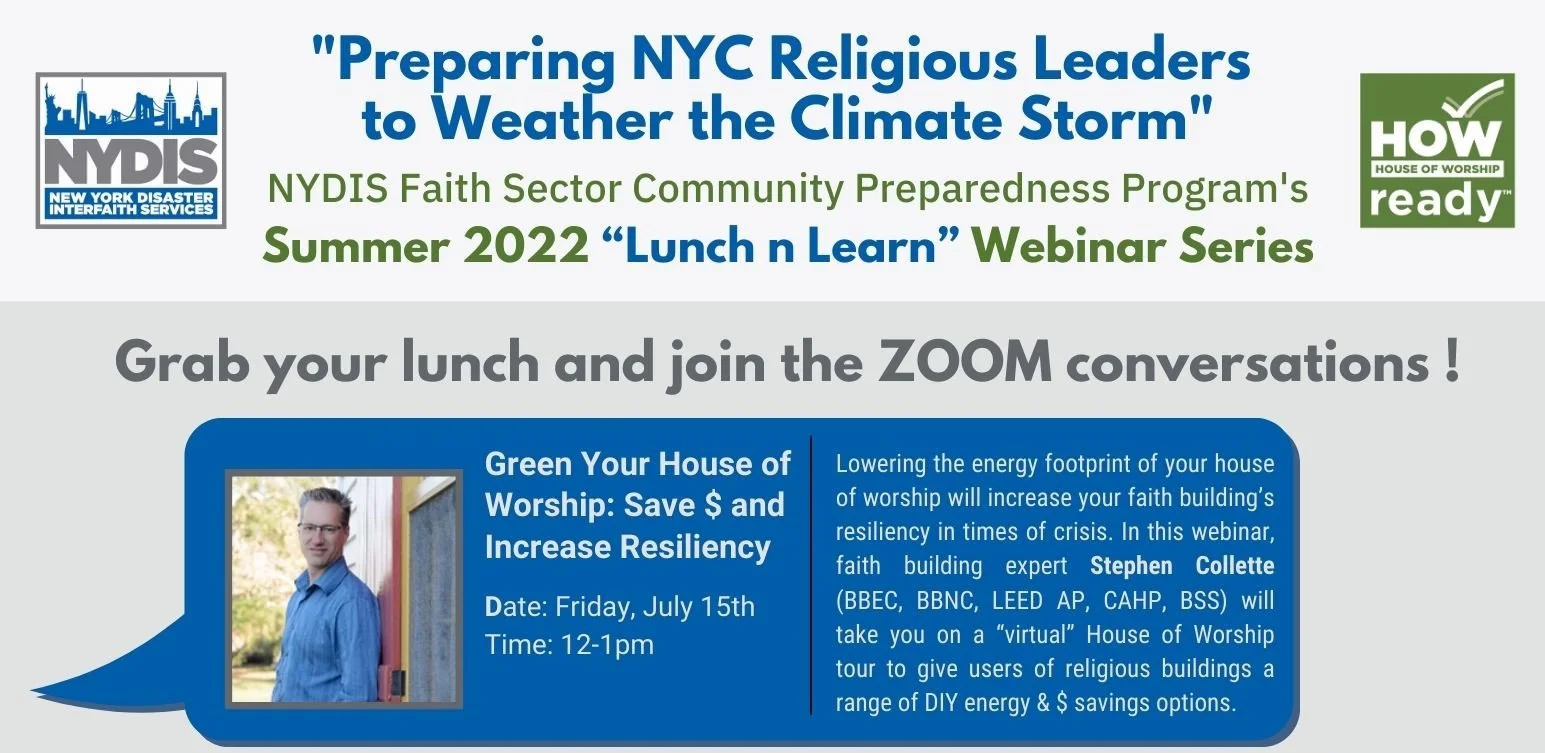
You may be wondering, what energy efficiency has to do with emergency preparedness. Well, not knowing what our energy needs are makes it more challenging to manage or provide services. Organizations on the call strongly supported my recommendation of using software like Energy Star Portfolio Manager to understand building energy usage and consumption. This unique software is an interactive resource management tool that enables users to benchmark their energy use, and track and improve the energy efficiency of any type of building, all in a secure online environment. The national benchmarking tool in Canada, the Energy Star Portfolio Manager is a great tool to use across a wide portfolio of properties, including United Church (UCCan) buildings as it can show congregations their energy data in a meaningful and easy to understand way. UCCan’s Faithful Footprints grant program is a proud supporter and user of the system.
Identifying Your Needs and Service Plans
Once you have a sense of your building’s energy consumption, you can then look at ways to lower it. Depending on the service you would like to provide at times of extreme weather crisis, there are different building and energy systems to consider. Do you wish to offer a place for neighbours to charge their phones and maybe get a cup of coffee? That could probably be supplied by a portable gas generator operating outside the building. For heat waves you may want to provide cold beverages. In the latter case, if you are still using that 1980’s fridge, the portable generator won’t be enough. You would also need good lighting throughout the building. LED lights would be a great option, as they are going to use way less electricity than incandescent lights. If you decide to offer meals, then you would need a lot of electricity for hot water, fridges, freezers, stoves, and more.* In many cases, a permanent backup generator can be the solution to offering multiple services, due to its wide array of uses. A backup generator can provide the capacity to have people stay overnight as well as offer public facilities like bathrooms and showers. It can help supply heating or air conditioning for temporary shelter as well.
Ultimately, in times of crisis, any service is a great help to the community. The first 72 hours after an extreme weather-related event is the most challenging as neighbours are at their greatest need. There are no right answers to what your faith community could offer. However, it is important to remember that equipping your building is only one aspect of preparing to be a climate disaster emergency hub. For instance, making sure you have enough volunteers and ensuring there are secure travel arrangements, safety precautions, and communication methods in place. All of this is critical in the planning process of preparing to serve your community during times of crisis.
Taking Part in City-Wide Extreme Weather Preparedness
It’s more than likely your municipality is already discussing climate-induced, extreme weather preparedness strategies. But they can’t do it alone. As pillars in the community, often located in central areas, FBOs can share the responsibility of responding to weather emergencies in becoming neighbourhood resilience hubs. In the case of Oakville, Ontario, as part of developing climate adaptation and community master plans to reduce vulnerability and increase resilience, the Town of Oakville works with local FBOs directly to roll out the OakvilleReady program. Faith & the Common Good is the inspiration behind this program and also a partner.

Funded by the Oakville Community Foundation, OakvilleReady has established neighbourhood extreme weather resilience hubs serving as care anchors. Currently, eight OakvilleReady hubs are operating across the city, including St. Paul United Church and Faithful Footprints participant, Maple Grove United Church.
Your municipality may also have local initiatives and financial incentives to help your faith group become better equipped to help the broader community during emergencies.

St.Paul United Church, Oakville, ON
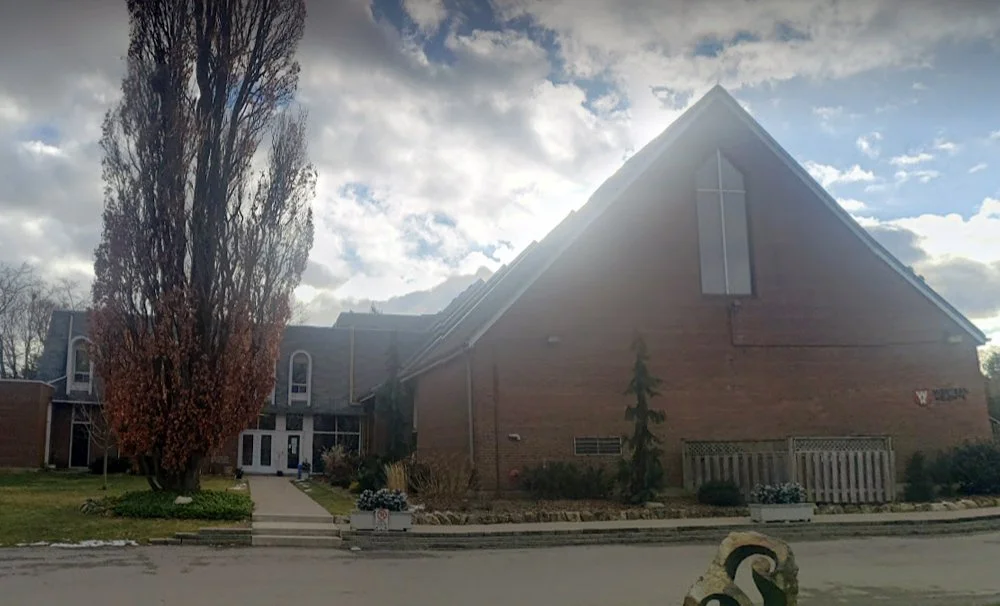
Maple Grove United Church, Oakville, ON
Getting started
By better understanding your building and its energy consumption, you can make informed decisions moving forward, concerning how you can take part in serving your community in times of crisis and local environmental disasters.
Start with free guides that we have on our website. The DIY Faith Building Energy Audit Guidebook and the Energy Star Action Workbook for Congregations are amazing resources you can download, read, learn, and even take action with these free resources!
You can also utilize our professional knowledge with virtual Green Audits that look at energy, air quality, food, water, waste, maintenance, rental agreements, heritage and much more. The more you can learn about your building, the more you can save energy, minimize maintenance costs, and maximize the usage of your amazing faith community building.
Faithful Footprints Program
The United Church of Canada (UCCan) Faithful Footprints program offers grants, tools and inspiration to help its congregations reduce their carbon footprint. With the Church’s commitment to reducing its greenhouse gases (GHG) emissions by 80% by 2050, this one of a kind program offers up to $30,000 in grants towards energy conservation and renewable energy projects (conditions apply).
Faith & the Common Good is the delivery partner for UCCans Faithful Footprints program. To date, we have engaged almost 300 congregations, camps, and buildings across the country. Your participation in the program puts your faith into action and helps the Church reach its target.
Stephen Collette is the Building Manager for Faith & the Common Good and can be reached at 705-652-5159 EDT, scollette@faithcommongood.org
*Warning! Gas stoves still need ventilation when in use, to prevent carbon monoxide poisoning.

Cooling Older Buildings Cheaply
Hot and humid air is miserable for human comfort–deadly, even. That’s why, with summer upon us, Canadians are all looking at ways to beat the heat and stay cool within our buildings. Before chasing the newest technology (provided you can even afford it) it is worth considering the unique ways that some buildings can cool naturally, as well as quick and easy ways to keep the heat out.
Hot and humid air is miserable for human comfort–deadly, even. That’s why, with summer upon us, Canadians are all looking at ways to beat the heat and stay cool within our buildings. Before chasing the newest technology (provided you can even afford it) it is worth considering the unique ways that some buildings can cool naturally, as well as quick and easy ways to keep the heat out.
Cooling by Design: Smart Old Buildings
Many Church buildings are designed to enable natural cooling. In last month’s blog ‘Level up the energy efficiency of your building: Control air leakages’, I wrote about the ceiling vents found in many old faith community buildings and how these should be air sealed and insulated, so as to prevent heat loss in the cold weather. However, these ceiling vents actually benefited the building in the hotter months (pick your poison?). Their initial purpose was to cool the building down by creating a chimney effect to draw the hot air up. At the bottom, since we need a supply point, this was typically the windows along the sides of the sanctuary where the congregation gathered. These are hopper-style windows in the bottom of the stained glass (opening from the bottom hinge), or sash windows, that slide upwards. This cooling system would pull air across the congregation and then be sucked out the hole at the top. So if you can make those holes airtight in winter, and still operable in summer (just like normal doors and windows), then you can use the design to your advantage.

A pretty fresh air inlet that is also stained glass -St. Lambert United Church, Saint-Lambert, QC

A pretty exhaust chimney, that is also a steeple -St John the Evangelist United Church, Crapaud PEI
No sweat ways to keep it cool
Whether your building was built a century ago or a few decades back, there are several ways to cool your building that don’t involve spending a lot of money. Take a look around your building, and you will be surprised to find many design elements that help with cooling.
Try opening doors, especially on the north side and front and back of the building, to help create a supply source of air. If you have an attic hatch, a door to a tower, minaret, or steeple, opening the access point in the summer will create the draft and exit point in your building. This natural ventilation also called the stack effect or chimney effect works pretty well. This will, of course, pull hot summer air in, but the breeze itself can create a cooling effect.
Tip: Staying safe is always more important than a nice breeze. Do remember, that if people are crawling around in the attic, or up on old ladders that safety must come first. Ensure to always consider the safety risks beforehand.
Make sure to insulate the attic. Insulation protects from the heat in the summer, and the cold in the winter. The more insulation in the attic, the more comfortable it is in the summer and in the winter.
Ceiling fans in the sanctuary should be running in the summer. This is the simplest, low-cost mechanical step to take first. We actually want the fans blowing down on us so we feel a breeze on our skin. This does seem counterintuitive since the hot air is up there, but it is actually the movement of air across our skin from a fan that makes us feel cooler, through transpiration.
Tip: Only run the fans while people are in the building, and let the stack effect work on its own. Another trick is to flush the building out at night by opening windows, and hatches, and closing them all up during the day. This can cool a building, including your home, and helps reduce the need for mechanical interventions.
When all else fails
The above recommendations are great ways to save money, relieve your community of the hot scorching weather, and reduce the need for mechanical cooling in your building. However, the likelihood that any of these tips will completely eliminate the need for mechanical intervention is rare. With the effects of global warming, some of these recommendations may not be as efficient and even backfire in certain regions with high humidity. This is an issue that is experienced more and more across the country, so it is important to pay attention to your local weather beforehand and make a suitable judgment call.
But what kind of mechanical intervention is beneficial? Well, we’ve discussed before the use of heat pumps in faith community buildings as a way to save energy in the winter; but they also provide much more efficient cooling in the summer as well. The old window air conditioner you may have in the office is a beast and costs you a lot of money to run. Switching it out for a heat pump, and maybe ceiling fans in offices and rental spaces will be worth the upfront cost as they will pay for themselves quickly in happiness. I worked with one congregation who was putting heat pumps in just to make sure their administrator didn’t quit because it was too hot in her office in the summer!
By understanding your building better you can make better energy and environmental decisions moving forward. Start with free guides that we have on our website. The DIY Faith Building Energy Audit Guidebook and the Energy Star Action Workbook for Congregations are amazing resources you can download, read, learn, and even take action for these free resources!
You can also utilize our professional knowledge with virtual Green Audits that look at energy, air quality, food, water, waste, maintenance, rental agreements, heritage, and much more.
The more you can learn about your building, the more you can save energy, minimize maintenance costs, and maximize the usage of your amazing faith community building.
Faithful Footprints Program
The United Church of Canada (UCCan) Faithful Footprints program offers grants, tools, and inspiration to help its congregations reduce their carbon footprint. With UCC’s commitment to reducing its greenhouse gases (GHG) emissions by 80% by 2050, this one-of-a-kind program offers up to $30,000 in grants toward energy conservation and renewable energy projects (conditions apply).
Faith & the Common Good is the delivery partner for UCCans Faithful Footprints program. To date, we have engaged over 200 UCCan congregations, camps, and buildings across the country. Your participation in the program puts your faith into action and helps UCC reach its target.
Stephen Collette is the Building Manager for Faith & the Common Good and can be reached at 705-652-5159 EDT, scollette@faithcommongood.org

Level up the energy efficiency of your building: Control air leakages
We have been trained to think about energy efficiency best practices for buildings in terms of improving insulation. It’s an easy enough concept to understand because we can experience heat loss personally. However, we often overlook other influences that affect energy efficiency, such as air leakage. Learn more you can control air leakage in your faith building.
We have been trained to think about energy efficiency best practices for buildings in terms of improving insulation. It’s an easy enough concept to understand because we can experience heat loss personally. For example, on a cold day, if you don’t have a thick enough coat, you feel cold. It follows that more insulation will keep us warmer in colder weather. However, we often overlook other influences that affect energy efficiency, such as air leakage. If you have ever had the wind blowing up under your coat in winter, chilling you to the bone, you can probably envision the impact of air leakage as it relates to your buildings; a similar experience occurs when cold air enters through unsealed or exposed gaps. In addition to causing discomfort, air leakages in winter can create massive heat loss as well as condensation, resulting in damage to the building itself.

Old ceiling roundel at Calvary United Church in London, ON
Many faith community buildings are made of materials like stones, blocks, bricks, and plaster. These ‘heavy’ buildings are considered thermally massive, as they perform differently than our thermally insulative homes (having insulation in the walls). Thermally massive buildings act like energy batteries; they store heat in the masonry and then release it when the temperature drops. This process helps effectively regulate the indoor climate of the building. This is why tile floors on the north of a building feel cool. The tile floors remain cool because they don’t get warmed by the sun. By contrast, a stone path on a sunny but cold spring day feels really warm.
Air Leakages – A Loss of Hot Air
In many houses of worship, if insulation isn’t the issue, then air leakage is usually the main reason for heat loss. Since hot air rises, the taller the chimney the greater the draught. Typically, faith buildings are REALLY tall, often with a taller chimney attached to it, called a bell tower/spire. These chimneys are so tall that the leaking air is sucked out of the holes at the top of the ceiling or into the tower. This air leakage can be measured as cubic metres of air per minutes.
This means (jokingly) that you might as well be standing under the chimney with the collection plate until all the $20 bills are sucked up to plug the hole, because that’s how much it’s costing you!
The point is, the conditioned air is not where it needs to be. Instead, this air is exiting from around attic hatches and doors to the bell tower, and through old ceiling roundels. The image depicted above is an old ceiling roundel, and is basically a four foot diameter hole in the ceiling straight to the attic. This roundel is causing a large amount of heat to escape from the room to the upper attic. I’ve seen a church that had two – eight foot roundels in their sanctuary. Can you Imagine how much heating dollars were leaving those open holes out to the sky?
Plug it up!
There are several ways to reduce heat loss in faith buildings. For one, air sealing the holes in the ceilings, attic hatches and doors to attic spaces, is extremely important in saving energy. In the attic, consider installing an air barrier across the access, and then adding in some insulation. Batts of insulation in black garbage bags can be an easy and lightweight way to safely take care of this. The bags stop the air leakage, and the insulation adds thermal value to the hole. For attic hatches and doors, it is important to make sure they are tightly sealed. The same goes for doors; add weatherstripping and latches. You will see dramatic savings in your energy bills and a significant reduction in your building’s total carbon output. With the carbon you reduce and the money you save, you’ll be making a difference in your climate action goals.
Start the process with the free guides on our website. The DIY Faith Building Energy Audit Guidebook and the Energy Star Action Workbook for Congregations are amazing, free resources you can download, read, learn, and inspire action. You can also utilize our professional knowledge with virtual Green Audits that look at energy, air quality, food, water, waste, maintenance, rental agreements, heritage and much more.
The more you can learn about your building, the more you can save energy, minimize maintenance costs, and maximize the usage of your amazing faith community building.
Faithful Footprints Program
The United Church of Canada (UCC) Faithful Footprints program offers grants, tools and inspiration to help its congregations reduce their carbon footprint. With UCC’s commitment to reducing its greenhouse gases (GHG) emissions 80% by 2050, this one of a kind program offers up to $30,000 in grants towards energy conservation and renewable energy projects (conditions apply).
Faith & the Common Good is the delivery partner for UCCs Faithful Footprints program. To date, we have engaged over 200 UCC congregations, camps, and buildings across the country. Your participation in the program puts your faith into action and helps UCC reach its target.
Stephen Collette is the Building Manager for Faith & the Common Good and can be reached at 705-652-5159 EDT, scollette@faithcommongood.org

LED Lights – A Bright Idea for Your Faith Building
Why should faith community buildings switch to LED lights? Well, what really drives the goal of using LEDs is energy and cost savings. Changing your faith-building lights to LEDs will pay for themselves easily and quickly. Get to know some tips on getting started.
Light Emitting Diodes, also known as LED lights, have become commonplace at home, but not so much with houses of worship. It's time that this changes.
For a bit of history, LED lights have been around for almost 100 years, however it wasn’t until the early 2000’s that we started to see them really being used. Where did we see them first? Christmas lights of course! The use of LED Christmas lights drove the cost per bulb down dramatically enough that the economy of scale picked up and we were spotting them more and more in fixtures of various kinds. Since then, incandescent bulbs are hard to get, and hazardous, mercury-containing compact fluorescent bulbs are on their way out. LED lights have been filling all the gaps within the lighting world today.
But wait, weren’t the old bluey-white LED Christmas lights ugly? Certainly! That blue-tinged white is referred to as a cool colour, while the yellow tinge we are familiar with from incandescents is referred to as warm colour bulbs. Fortunately, nowadays, you can buy warm or cool colour LED bulbs to meet your lighting needs. New and improved bulbs have also resolved the issue of brightness, as the old LEDs were not as bright as the incandescent bulbs.
So why should faith community buildings switch to LED lights? Well, what really drives the goal of using LEDs is energy and cost savings. Changing your faith-building lights to LEDs will pay for themselves easily and quickly. As you can see from the chart below, the savings on replacing your bulbs with LEDs is huge, and the payback can be measured oftentimes in months or even sooner (for example, 40 Watt exit lights have the potential to pay back in several weeks). With such large spaces, faith buildings can see drastic reductions in their energy usage when transitioning to LED lights.
From an aesthetics perspective, faith buildings can improve visibility, with brighter bulbs (lumens) as well as purchasing color-changing LED light bulbs (super popular on TikTok), which work via WiFi on any smartphone. This allows congregations to create cost-effective “stage lighting” in their spaces, for holidays, special events, or rentals.

Getting Started
Well, how does my congregation get started, you may ask? In the worship space, I always recommend changing all of the lights at the same time. This is because if you change lights at different times, there will be noticeable differences in the colour and warmth of the various types of lights. Although this isn't as important in other rooms, for the worship space and sanctuary, such disharmony is not ideal. Faithful Footprints participant, Trinity-Providence United Church in Bobcaygeon, Ontario, avoided this problem by installing new LED lights not only in one room but throughout its entire building.
“Now that we have LED lighting throughout our church, our church is a much brighter place!” - Armand Hachey, Co-Chair of Property at Trinity-Providence United, Bobcaygeon, ON

Trinity-Providence United Church installing new LED lights throughout its entire building.
For many congregations, changing lights can be done in-house, with worker bees, no need for professional assistance. New fixtures for the 2-foot and 4-foot fluorescent tubes are designed so that only the bulb needs changing–no messing around with ballasts or fixtures.
“We purchased 14 new light fixtures for the Parlour and Choir Room. Some of our Congregation members installed these new lights at no cost” - Paul Brown, Chair of Trustees & Property Committee at Palmerston United, Palmerston, Ontario

Before and After results of Palmerston United Church replacing light fixtures and installing LED lights.
Note: Please make sure to safely dispose of old fluorescent tubes and CFLs.
From Christmas lights to homes, LED lights can also be part of your congregation’s climate effort in becoming more energy-efficient. Pick a space in your building, and begin your transition today!
The more you can learn about your building, the more you can save energy, minimize maintenance costs, and maximize the usage of your amazing faith community building. Utilize our professional knowledge with virtual Green Audits that look at energy, air quality, food, water, waste, maintenance, rental agreements, heritage, and much more.
Faithful Footprints Program
The United Church of Canada (UCC) Faithful Footprints program offers grants, tools and inspiration to help its congregations reduce their carbon footprint. With UCC’s commitment to reducing its greenhouse gases (GHG) emissions 80% by 2050, this one of a kind program offers up to $30,000 in grants towards energy conservation and renewable energy projects (conditions apply).
Faith & the Common Good is the delivery partner for UCCs Faithful Footprints program. To date, we have engaged over 200 UCC congregations, camps, and buildings across the country. Your participation in the program puts your faith into action and helps UCC reach its target.
Stephen Collette is the Building Manager for Faith & the Common Good and can be reached at 705-652-5159 EDT, scollette@faithcommongood.org

Efficiency – Squeezing Every Bit of Energy Out of What You Have
When we look at radiator systems with all the various parts, there are numerous opportunities to improve efficiencies. Learn how you can maximize what you have.

Refurbished radiators installed with electric heating coil inside. St Paul’s United Magog.
In a previous blog post, I recommended switching your fossil fuel-burning appliances over to heat pumps to heat your building. That recommendation still stands for everyone who has mid and low energy efficiency furnaces and boilers and anyone whose heating appliance is older than 25 years. I recently spoke with a congregation whose heating system predates their building from 1962 (it was used and donated to them). Their heating contractor estimates that it is currently operating at 15% efficiency! So keep that in mind folks.
But what if you have a pretty new boiler, for example, and still want to maximize efficiency? Is there anything you can do? Yes, there is! When we look at radiator systems with all the various parts, there are numerous opportunities to improve efficiencies.
For one, would you say that you have effective thermal comfort in every room everywhere in your building? Based on my experience, the answer is probably no. Oftentimes, some rooms will be too hot, with people opening windows, while others will be too cold with space heaters under desks. So what can you do to improve comfort? There are valves on the individual radiators that can be adjusted, but they typically have 12 coats of paint and couldn’t be moved without a hammer and vice grips. Having all of the valves serviced, and operable, will allow minor adjustments to the temperatures within each of the rooms, ensuring heat is not blowing out the window, but delivered where you need it.
If you walk into the boiler room and find it sweltering hot in the winter, all of that heat is being wasted, as it is not going where you need it to go. Installing insulation around any or all of the pipes you can access between the boiler and the radiator can save you tremendous amounts of money on energy.
Additionally, you can even have the radiators removed and restored with new valves, cleaned inside and out, so that the rust is gone. This can reduce clogging and inefficiencies, and restore the heritage value of your heating system to the 21st century!
In addition to properly located programmable thermostats that can help improve efficiency, in large thermally massive buildings (like stone churches), keeping the temperature even may help to ensure better comfort. For example, ceiling fans in the sanctuary and in the halls are great, and can really help keep constant temperatures.
Finally, having a competent heating contractor that truly understands radiant heat go through and commission the entire system (not just the boiler), will most definitely find efficiencies in the layout and delivery of the hot water or steam to guarantee energy and money savings for your congregation.
Those who have a modern boiler in place, make sure that the system it is connected to is also operating at maximum efficiency to reduce the fossil fuels burned, and save energy.
The more you can learn about your building, the more you can save energy, minimize maintenance costs, and maximize the usage of your amazing faith community building. You can utilize our professional knowledge with our virtual Green Audits that look at energy, air quality, food, water, waste, maintenance, rental agreements, heritage and much more.
Faithful Footprints Program
The United Church of Canada (UCC) Faithful Footprints program offers grants, tools and inspiration to help its congregations reduce their carbon footprint. With UCC’s commitment to reducing its greenhouse gases (GHG) emissions 80% by 2050, this one of a kind program offers up to $30,000 in grants towards energy conservation and renewable energy projects (conditions apply).
Faith & the Common Good is the delivery partner for UCCs Faithful Footprints program. To date, we have engaged over 200 UCC congregations, camps, and buildings across the country. Your participation in the program puts your faith into action and helps UCC reach its target.
Stephen Collette is the Building Manager for Faith & the Common Good and can be reached at 705-652-5159 EDT, scollette@faithcommongood.org

Your Fridge Might be Keeping the Milk Cold and the Planet Hot
We all love to gather after worship and share food and drink together. It’s at these times that we grow as a community. For this reason alone, a major hub of activity in faith communities (post COVID) is the kitchen. So it is worth taking the time to look at the major energy consumers within this space in order to save some energy and money.

Old fridges and freezers are energy guzzlers.
We all love to gather after worship and share food and drink together. It’s at these times that we grow as a community. For this reason alone, a major hub of activity in faith communities (post COVID) is the kitchen. So it is worth taking the time to look at the major energy consumers within this space in order to save some energy and money.
Fridges and freezers are present in every congregation’s kitchen. Typically, the efficiency of these kinds of appliances increases dramatically every few years with newer models. That means that the energy consumption of a new fridge compared to one made approximately five years ago can be half the energy! That’s a lot of energy savings to be had.

From coast to coast to coast, I have seen several examples where the freezers for fundraisers (those were great turkey pot pies), or food banks are so old that the cost to run these beasts is actually a liability for the fundraising or operation of the food bank.
Now, if your faith community, like many others, is rocking a donated Harvest Gold or Green Avocado fridge from the 1970s, it is absolutely impacting your bottom line, and the climate. A rule of thumb is if it has chrome on it, it’s really old! You can check the age of your fridge or freezer by looking for the manufacturer’s data plate. It should be right on it. If you don’t see the date, it will be baked into the serial number.
Older dishwashers also consume a great deal of energy. The newer commercial dishwashers work incredibly fast and are effective and fun to use; fun enough that some folks might get dragged into the kitchen “to help,” just so that they can play with these efficient washers.
For stoves, we really want to start moving away from gas stoves. Current research has shown that they have a massive impact on indoor air quality, and with continuously running pilot lights, burn fuel when not even in use (such as during the pandemic). Because of this, switching to electric stoves has become more common.
As with all appliances, when purchasing new, we want to purchase ENERGY STAR® rated ones, so we get the maximum value for our purchase. ENERGY STAR® rating means it is in the top 10% of efficiency for its category. So you get the best of the best.
To improve your building’s carbon footprint, you can also utilize our professional knowledge with virtual Green Audits that look at energy, air quality, food, water, waste, maintenance, rental agreements, heritage and much more.
The more you can learn about your building, the more you can save energy, minimize maintenance costs, and maximize the usage of your amazing faith community building.
Faithful Footprints Program
The United Church of Canada (UCC) Faithful Footprints program offers grants, tools and inspiration to help its congregations reduce their carbon footprint. With UCC’s commitment to reducing its greenhouse gases (GHG) emissions 80% by 2050, this one of a kind program offers up to $30,000 in grants towards energy conservation and renewable energy projects (conditions apply).
Faith & the Common Good is the delivery partner for UCCs Faithful Footprints program. To date, we have engaged over 200 UCC congregations, camps, and buildings across the country. Your participation in the program puts your faith into action and helps UCC reach its target.
Stephen Collette is the Building Manager for Faith & the Common Good and can be reached at 705-652-5159 EDT, scollette@faithcommongood.org

Why a Heat Pump For Your Place of Worship?
For faith communities, replacing a heating system is one of the single largest capital cost expenses (the other one is replacing the roof). Most congregational spaces have either boilers with radiators, or furnaces with ductwork that consume oil, gas or propane. While the typical lifespan may be 25 years for these appliances, I have seen many span decades of service.

Dundas Cardigan, PEI
For faith communities, replacing a heating system is one of the single largest capital cost expenses (the other one is replacing the roof). Most congregational spaces have either boilers with radiators, or furnaces with ductwork that consume oil, gas or propane. While the typical lifespan may be 25 years for these appliances, I have seen many span decades of service.
Sure, they keep going, so why change them? Well, just like you and I, we get less efficient with age. For instance, a furnace from the 1990s may have started out at, say, 84% efficient (meaning, for simplicity’s sake that 84% of the fuel is turned into heat, and 16% of the energy is wasted), but after 25+ years may be operating in the low 70% range. Older furnaces and boilers could be much, much lower efficiency. Now take your gas/oil/propane bill for the year and find what that 30% costs you per year. It is a lot! Your payback to switching becomes much clearer.
Instead of swapping out old units for new ones and carrying on, many congregations are switching to air source heat pumps.

Kings United, Bay Fortune NS
You may know these as mini-splits, or just heat pumps. These are electrically powered, so they remove the need for fossil fuels within your building. They work like a refrigerator taking cold air from the outside of the building, and with a fan blowing it over a coil with a refrigerant in it. There is a compressor, and basically it makes heat. How much heat? Well, for every unit of electricity it uses, it can make 3-4 units of heat! Compare this to an electric baseboard where 1 unit of electricity makes about .75 units of heat, and you get the efficiency picture really quickly. Now the cool thing (literally) about these is that they can run backwards and also make cool air, so it also supplies air conditioning to the building. With climate change and other factors to consider, such as more and more permanent tenants in these spaces, air conditioning helps to make renting your various spaces much easier.
Again, it is even more efficient than your regular air conditioning. So you may have seen the mini split systems with a head on the inside, and the compressor on the outside, which being split in two units, is where the name comes from. But you can also have a compressor on the outside run to a new furnace blower box and supply conditioned air to your existing ductwork. There are also rooftop units for those larger buildings and mechanical systems.

Brunswick Street Mission, Halifax NS

The main question people ask is will they still provide heat in the really cold winter? The answer is yes. Newer units, especially ENERGY STAR® approved units, have dual stage compressors, so they can basically “go around again” and extract more heat from the coils. Yes, the efficiency of the unit does drop as it gets really cold. So if you are working at 4:1 efficiency at -12C, then maybe 3:1 at -19C and 2:1 at -26C, as a rough example. That’s a conversation to have with your HVAC contractor.
I know that the Faithful Footprints grant program (see below) has approved heat pumps for ALL climate zones across the country, with everyone praising the comfort and energy savings gained. So consider heat pumps wherever you are as a way to reduce your energy costs and impact upon the climate.
You can also utilize our professional knowledge with virtual Green Audits that look at energy, air quality, food, water, waste, maintenance, rental agreements, heritage and much more.
The more you can learn about your building, the more you can save energy, minimize maintenance costs, and maximize the usage of your amazing faith community building.
Faithful Footprints Program
The United Church of Canada (UCC) Faithful Footprints program offers grants, tools and inspiration to help its congregations reduce their carbon footprint. With UCC’s commitment to reducing its greenhouse gases (GHG) emissions 80% by 2050, this one of a kind program offers up to $30,000 in grants towards energy conservation and renewable energy projects (conditions apply).
Faith & the Common Good is the delivery partner for UCCs Faithful Footprints program. To date, we have engaged over 200 UCC congregations, camps, and buildings across the country. Your participation in the program puts your faith into action and helps UCC reach its target.
Stephen Collette is the Building Manager for Faith & the Common Good and can be reached at 705-652-5159 EDT, scollette@faithcommongood.org

Music to My Ears – Pipe Organs and Heat Loss
One of the most beautiful experiences in religious services is the sound of a pipe organ filling a church, whether in a small wood framed, rural church, or a full size Casavant in a large Gothic, stone church. The sounds fill the building as well as one’s soul with joy.
One of the most beautiful experiences in religious services is the sound of a pipe organ filling a church, whether in a small wood framed, rural church, or a full size Casavant in a large Gothic, stone church. The sounds fill the building as well as one’s soul with joy.
What people may not know is that many pipe organs have leather and wood parts, specifically in the stops in the pipes. This is merely an interesting detail until you think about what happens to those materials when temperatures drop – that is, they change in shape and size. These changes can impact the sound of the organ.
So when the temperature drops, the sound of the organ can change for the worse. Now that’s not music to anyone’s ears. With the pipes at the top of the sanctuary, sometimes right near the attic hatch, the heat loss, and sound quality change can be dramatic. So start by making sure the attic hatch, especially if near the pipe organ is airtight.
Air circulation can be a quick solution. Ceiling fans can move the air easily, spreading conditioned air around the space, keeping the temperature more even. The old metal 1980’s ceiling fans that beat themselves to death only blow down. That’s great for keeping cool in summer as well as for picking up the wobbly sounds in the microphones, but having cool air blow down on us in the winter time isn’t helpful. Ideally we want Energy Star rated ceiling fans that are reversible, so in the winter they blow upwards, forcing the air along the ceiling and down the walls without any drafts, and stirring the heat like a pot of tea. Also commercial fans can move much more air at a slower speed with the bigger blades, making the process quieter and more effective.
Insulation in the attic, where possible, would be the final step to help keep the organ in tune and sounding amazing throughout the entire year. Energy efficiency is something everyone can benefit from and is music to one’s ears!
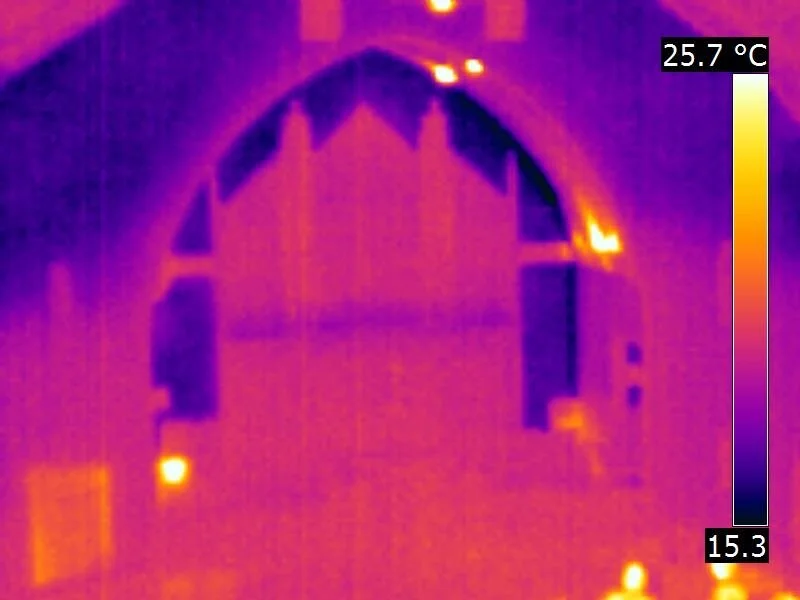
Infrared image of a pipe organ in winter. The darker the colour, the colder the temperature. Note: there is an attic hatch located over this pipe organ.
Financing your project
If you are wondering how you might finance upgrades that benefit your organ - and any other energy efficiency projects you group might be interested in conducting - the United Church of Canada (UCC) has just the program for you. Launched in 2018, the Faithful Footprints program offers grants, tools and inspiration to help UCC congregations reduce their carbon footprint. With UCC’s commitment to reducing its greenhouse gases (GHG) emissions 80% by 2050, this one of a kind program offers up to $30,000 in grants towards energy conservation, decarbonization, and renewable energy projects (conditions apply).
Faith & the Common Good is the delivery partner for UCC’s Faithful Footprints program and I am the voice on the other end of the phone for congregations, since I am a sustainable building consultant, a building scientist, and a heritage professional specializing in faith community buildings.
To date, we have engaged over 200 UCC congregations, camps, and buildings across the country. Your participation in the program puts your faith into action and helps UCC reach its target.
I invite you to begin your energy efficiency journey by reading the free guides that we have on our website. The DIY Faith Building Energy Audit Guidebook and the Energy Star Action Workbook for Congregations are amazing free resources.
You can also utilize our professional knowledge with virtual Green Audits that look at energy, air quality, food, water, waste, maintenance, rental agreements, heritage and much more.
The more you can learn about your building, the more you can save energy, minimize maintenance costs, and maximize the usage of your faith community building.
Stephen Collette is the Building Manager for Faith & the Common Good and can be reached at 705-652-5159 EDT, scollette@faithcommongood.org