
BLOGS
Churches across the country are stepping up. Read their stories and access other climate and energy resources here.

Environmentally Progressive: Westworth United Expands its Mission with a Faithful Footprints Grant
With a belief that God calls us to make a positive difference in the lives of others and in the world, Westworth United Church strives to be “the hands and feet of Christ within Westworth and beyond”. Living with respect for Creation, Westworth United took on two energy retrofit projects to green their sacred space.

Leo Mol stained glass windows, Westworth United Church. Source: westworth.ca/about-us/history/
Known for the stunning Leo Mol stained glass windows in its 63-year-old sanctuary, Westworth United Church, in Winnipeg, Manitoba is also broadly celebrated in the community for its commitment to supporting local groups and refugee families. With its belief that God calls us to make a positive difference in the lives of others and in the world, Westworth United wants to be “the hands and feet of Christ within Westworth and beyond,'' and prides itself in demonstrating a living faith; one that is expressed not only in ministry, but also in mission, in and with the world. Part of this mission is to live with respect for Creation and to be ecologically and environmentally progressive. The congregation aspires to make a positive impact, and because of this commitment, they decided to green their sacred space by applying for a Faithful Footprints grant.
Two successful retrofit projects: How they got there
The Faithful Footprints retrofit projects perfectly align with Westworth United Church’s work of “being ecologically and environmentally progressive.”
-Faithful Footprints Prairies Regional Support Centre
Dr. Loraine MacKenzie Shepherd, the minister at Westworth United, knew their church needed additional renovations back in 2018. She had seen information about the Faithful Footprints Program on the Faith and the Common Good website and thought it would be a good fit, bringing it to the attention of the Westworth Outreach Team.This team works to inspire congregation members and the broader community to respond to environmental challenges, locally, nationally, and globally. They are responsible for a variety of environmental initiatives, including educational, promotional, and measurable environmental action. Their past efforts include upgrading the lighting in the building with LED, and replacing the original windows of the church with energy efficient ones.
The team contacted Stephen Collette, the Faithful Footprints’ Building Grants Manager, and filled out the program application after two consultations. Frank Wynes, the Property Team Manager at the time, said the process went quite smoothly thanks to the support of the Faithful Footprints team who kept him on track with every step in the application process.
After three months, their application was approved, which fit perfectly with their plan for the building renovation, as it came together with other grants they applied for. In the summer of 2019, Westworth United Church started their first Faithful Footprints project: removing and replacing insulation and roofing.
Upon completion of its first project, the church was motivated to continue their renovations. With continued support from the Faithful Footprints staff, Westworth United applied again for a grant. This time around, the church planned to install 20 new PVC windows – a suggestion recommended by Stephen, as the windows on the North side of the church which are on the ground level, were leaky, and were letting cold air enter into the building. In addition to raising funds for the project, the church received a second Faithful Footprints grant of $10,000 for the windows. The second project was completed by the end of 2020.

Removal and replacement of insulation and roofing on Westworth United’s sanctuary roof.

20 new PVC windows.
These two projects have helped Westworth United to decarbonize and become more energy efficient, supporting its aspirations of being environmentally progressive. A year following the projects, Westworth United has reduced its GHG emissions by 15.9%, and its natural gas usage by 16.0%.
“I would recommend the Faithful Footprints program for any congregation wanting to green their sacred spaces.”
-Frank Wynes, past Property Team Manager of Westworth United Church
Westworth United hopes to continue their climate efforts by pursuing additional energy saving upgrades, including:
Preserving and ensuring that the stain-glass windows in the chapel are energy efficient
Weatherproofing the gym windows with caulking and insulation
Replacing the lights in the sanctuary and narthex with LED lights
Installing low energy appliances
Adding dual-pane glass to the vestibule doors
Replacing dried caulking on older windows
Weather-stripping entry doors
Faithful Footprints Program
The United Church of Canada (UCCan) Faithful Footprints program offers inspiration, tools, and grants to help its faith-communities reduce their carbon footprint. With the Church’s commitment to reducing its greenhouse gases (GHG) emissions by 80% by 2030, this one of a kind program offers up to $30,000 in grants towards energy conservation and renewable energy projects (conditions apply).
Faith & the Common Good is the delivery partner for UCCans Faithful Footprints program. To date, we have engaged over 300 congregations, camps, and buildings across the country. Your participation in the program puts your faith into action and helps the Church reach its target.
Kalen Taylor is the Prairies Regional Support Coordinator for Faithful Footprints and can be reached at ktaylor@purposeconstruction.ca

Future Ready: Sandy-Saulteaux Spiritual Centre retrofits with Faithful Footprints Grant
The Sandy-Saulteaux Spiritual Centre is an accredited theological college located one mile east of Beausejour, Manitoba that offers cross-cultural learning and Indigenous ministry training, as well as a peaceful place on the land for retreats, meetings and gatherings. Its vision is to create a place where First Nations, Métis, Inuit, and Christian spiritual beliefs are respected, shared, and understood.
The Sandy-Saulteaux Spiritual Centre is an accredited theological college located one mile east of Beausejour, Manitoba that offers cross-cultural learning and Indigenous ministry training, as well as a peaceful place on the land for retreats, meetings and gatherings. Its vision is to create a place where First Nations, Métis, Inuit, and Christian spiritual beliefs are respected, shared, and understood.
Previously known as the Dr. Jessie Saulteaux Resource Centre, amalgamated with the Francis Sandy Theological Centre (originally located in southern Ontario) in 2011, becoming the United Church of Canada’s national theological college for training Indigenous peoples for leadership in their church and communities.
The Centre pictures its future as one that is growing with the need for training people for ministry in the Indigenous Church, and hopes to provide a retreat space for cross cultural youth, Prairie Jubliee, Mamawe Ota Askihk/Sharing Life Together Here on Earth events, sweat lodge ceremonies and much more.
Receiving a Faithful Footprints Grant
“It’s a very good program. It was easy to go through the application and there was a lot of support—it was really worthwhile.”
Robert Smith, Keeper of the Centre
With the aspiration to continue serving as a place for learning, training, and gathering, the comfortableness and the operational needs of the building space are important factors to consider. Past upgrades to the buildings include replacing light bulbs and fixtures and installing low-flush toilets. Robert Smith, the Keeper of the Centre, looks after and suggests improvements to the Centre’s buildings and surroundings. In 2018, after hearing about the Faithful Footprints program through a regional United Church of Canada gathering, Robert took initiative in looking further into the grant.
“What attracted me to the program was the funding […] to help the Centre be more environmentally friendly, reduce our greenhouse gas and carbon footprint, and reduce our hydroelectric bill in the future,” he said.
From there, Sandy-Saulteaux Spiritual Centre decided to continue their greening efforts with the support of a building retrofit. A tour and assessment of the Centre with Faithful Footprints Building Grants Manager, Stephen Collette, helped the Centre decide which upgrades would be most beneficial to their building. The Centre began retrofitting projects in 2019, and completed the rest of its renovations during the pandemic, while it was not hosting guests.
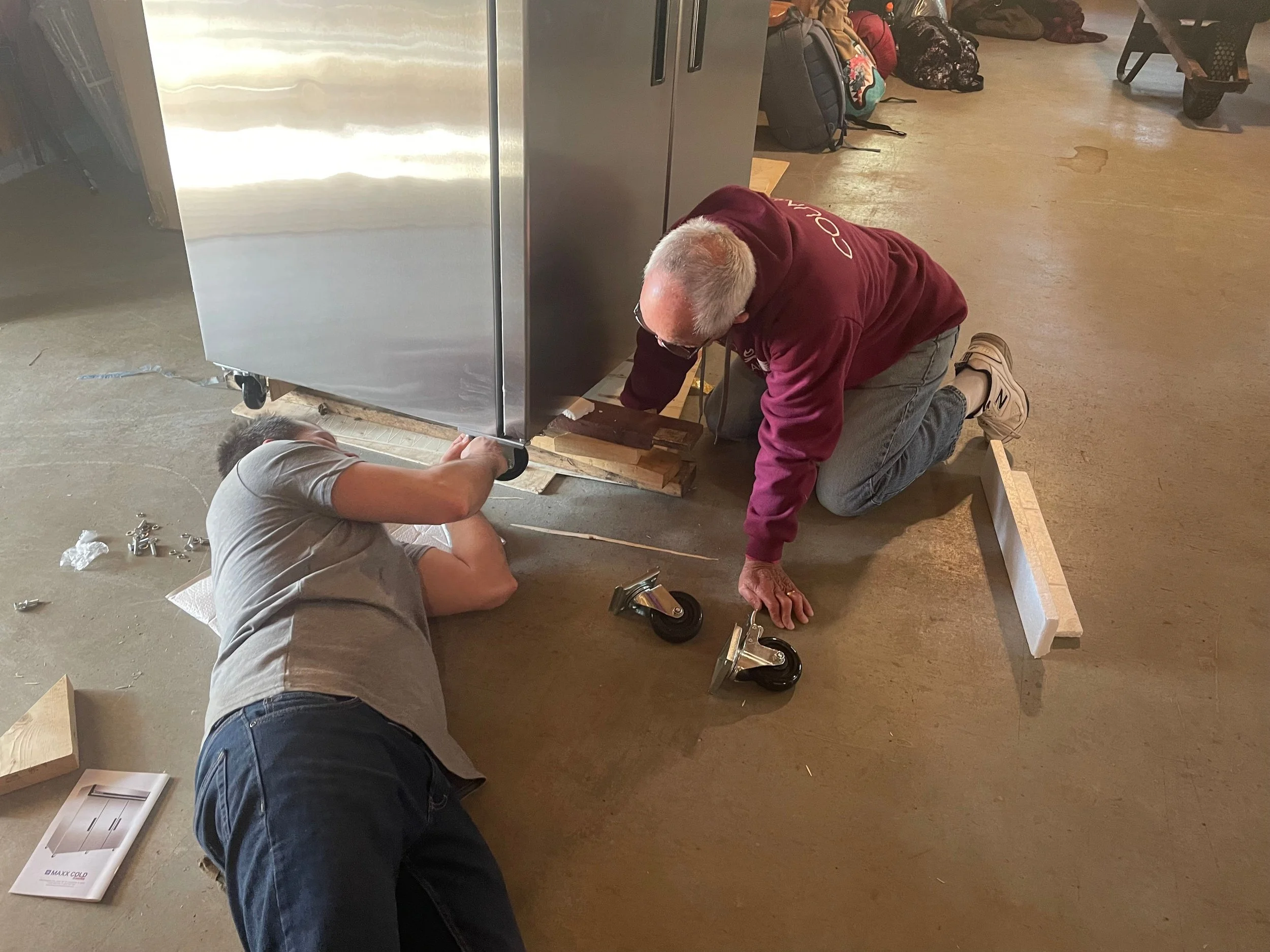
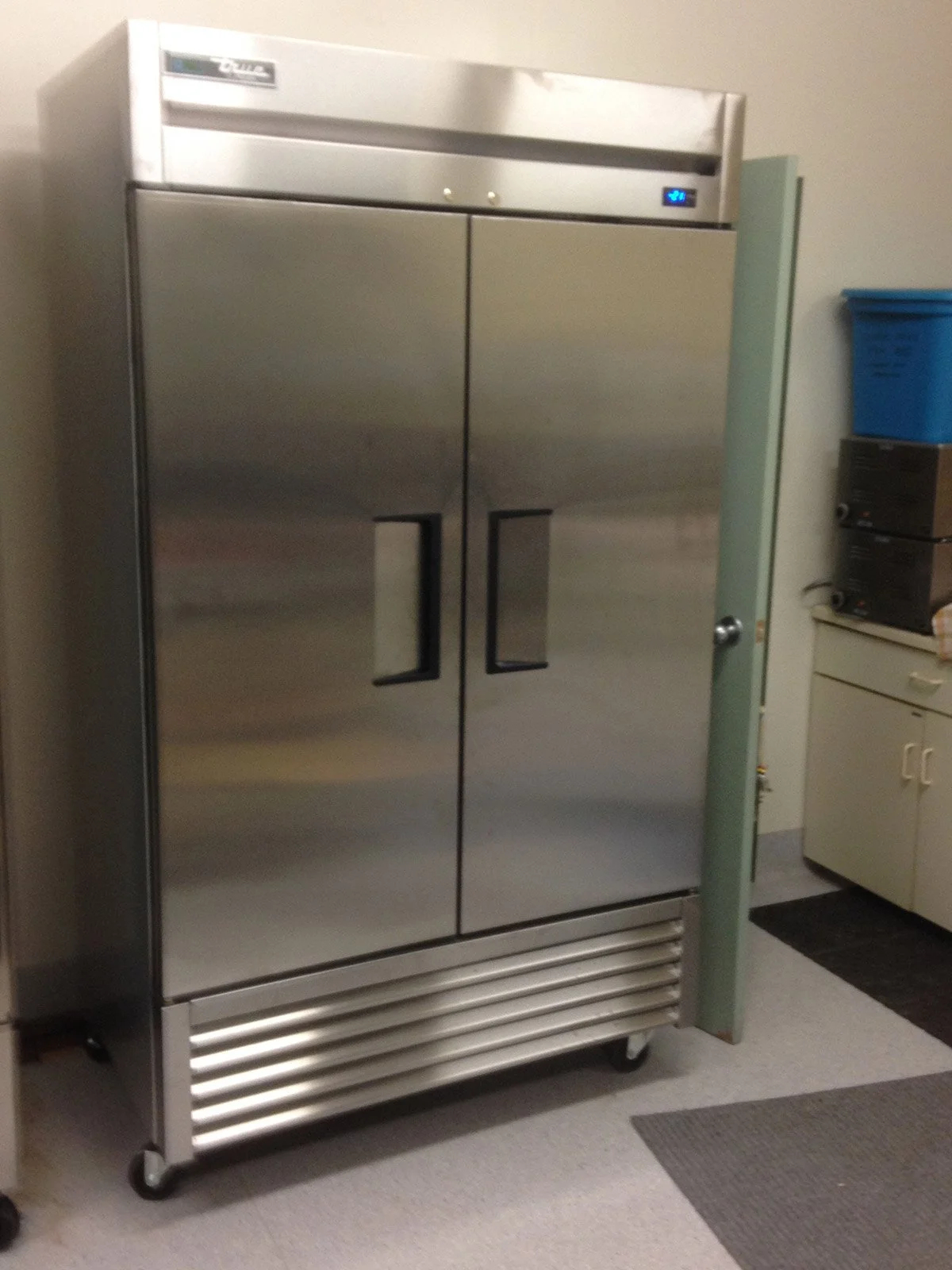
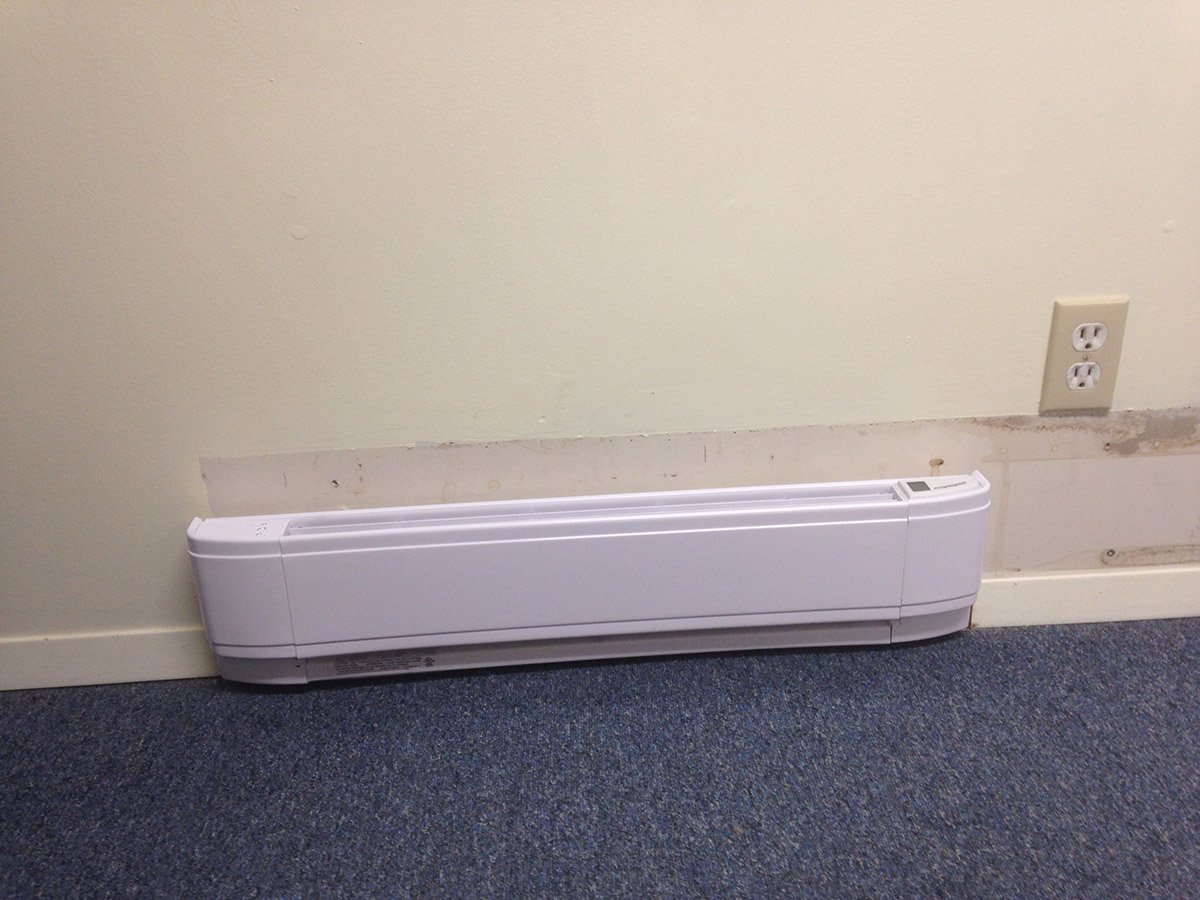
With the funding they received from the Faithful Footprints program, the Centre was able to replace all of their overhead lights with LEDs, invested in high-efficiency baseboard heaters in their office and lodges, and replaced their fridge and freezer. A year following these projects, Sandy-Saulteaux reduced its electricity usage by 22.1%, and energy costs by 9.5%.
Faithful Footprints Program
The United Church of Canada (UCCan) Faithful Footprints program offers inspiration, tools, and grants to help its faith-communities reduce their carbon footprint. With the Church’s commitment to reducing its greenhouse gases (GHG) emissions by 80% by 2030, this one of a kind program offers up to $30,000 in grants towards energy conservation and renewable energy projects (conditions apply).
Faith & the Common Good is the delivery partner for UCCans Faithful Footprints program. To date, we have engaged over 300 congregations, camps, and buildings across the country. Your participation in the program puts your faith into action and helps the Church reach its target.
Kalen Taylor is the Prairies Regional Support Coordinator for Faithful Footprints and can be reached at ktaylor@purposeconstruction.ca

How the Power of Perseverance Sustained the Tatamagouche Centre Rebuild Project
Following through with large-scale building renovations requires commitment and persistence, as there are many obstacles that are likely to arise. Financial barriers, resource shortages, and global issues can cause delays and even full on restructuring of project plans.
Following through with large-scale building renovations requires commitment and persistence, as there are many obstacles that are likely to arise. Financial barriers, resource shortages, and global issues can cause delays and even full on restructuring of project plans.
Over the past two years, due to COVID-19, Canadians experienced the brunt of timber scarcity, inflation, and building closures. United Churches and affiliated buildings were no exception. As a result, ministry transitioned online, and buildings and property plans were put on hold. But despite these challenges, many United Church properties were still able to see the crisis as an opportunity to retrofit their buildings, and become more sustainable, thanks to the support of the Faithful Footprints program.
“The Centre’s Board of Directors, Executive Director, and staff team all agreed that this moment presents a rare opportunity to do the first phase of their retrofit plans while the programs were closed.”
- Tatamagouche Centre Project Team, NS
The Tatamagouche Centre, also known as The Atlantic Christian Training Centre is a Community Ministry of the United Church of Canada, located in Tatamagouche, Nova Scotia. The Centre was one of the many communities that took full advantage of their building closure and continued their efforts to rejuvenate and upgrade it.
After a brief closure back in 2015, and through a deep, spiritual process of loss and renewed commitment, the Centre was on a promising track to turn things around for the Ministry. In the fall of 2016, the Centre’s Board of Directors, Executive Director, and staff team prepared a robust business plan for 2017-2021, renewing the Centre’s finances, programming, and administration. But everything changed in March 2020, and, as with many congregations across Canada, the Tatamagouche Centre was closed until further notice. Yet, through financial setbacks and the uncertainty of the pandemic, and with no idea as to when their work would continue, the working group persevered in their efforts. There was enough optimism amongst the team to consider doing a green retrofit.
Developing a Plan to Prosper: A 3-Phase Retrofit
The working group was confident in their ability to anticipate and mitigate potential risks that could come up in the process of completing their retrofit project. They were aware that the costs of the renovations might exceed original estimates, and were concerned that they might not have the in-house staff expertise pertaining to building, construction, and engineering, rendering them vulnerable to mistakes and exaggerated quotations. So, the team established a thorough mitigation strategy to confront these risks, including splitting their full project plans into three phases. The three phase plan would enable them to make informed and incremental changes in subsequent phases. This would allow them the opportunity to seek a feasible amount of funding for each phase, and lean on the extensive project management and community finance experience of a highly skilled advisory group of staff and experts.
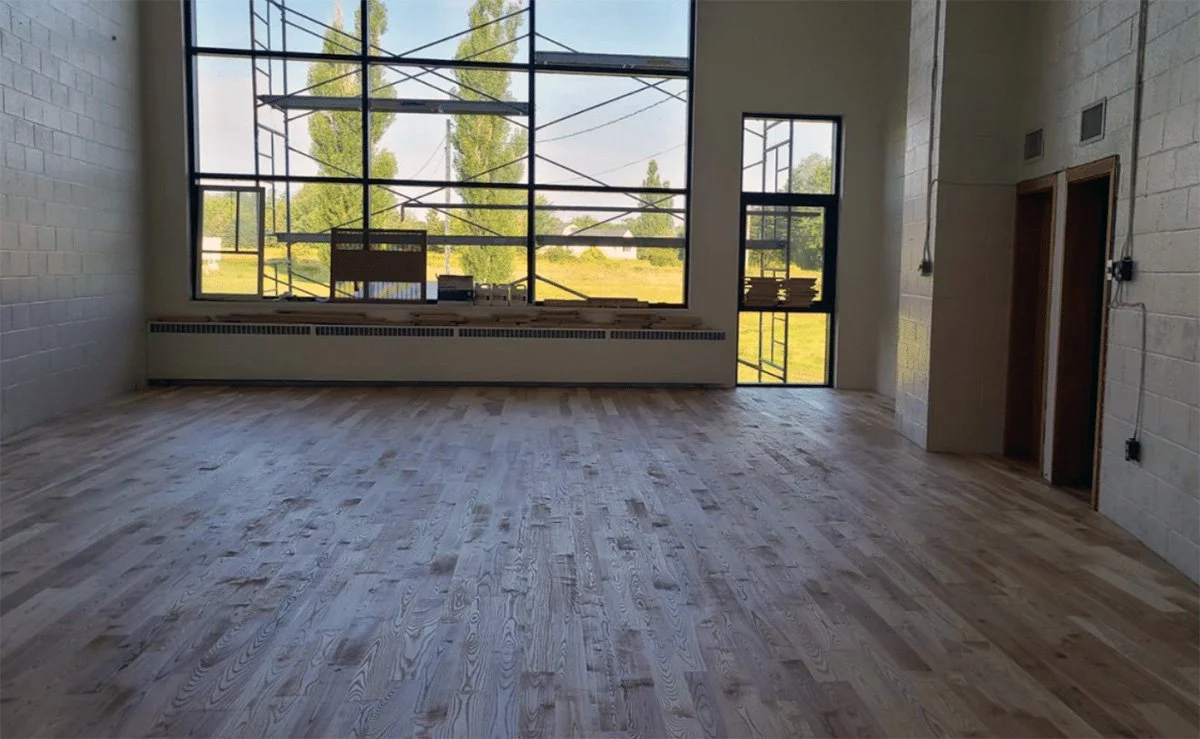
Considering the challenges at the time, the Tatamagouche Centre applied to the Faithful Footprints retrofit grant to support the most strategic part of the green retrofit project. Phase 1 focused on replacing and insulating the main roof and re-doing the wall and windows in the chapel in preparation for Phase 2. Phase 1 was completed in June 2021.
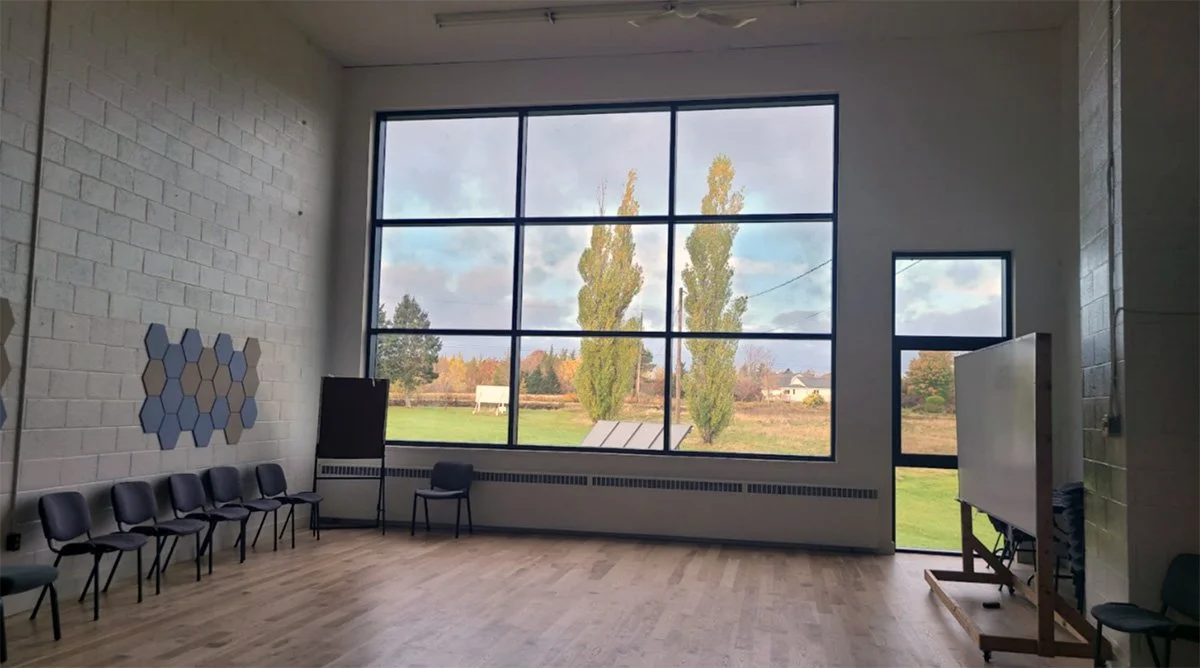
A year on, following these projects, the Tatamagouche Centre reduced GHG emissions by 44.9%, energy costs by 20.6%, electricity use by 38.1%, and fuel oil usage by 47.8%, demonstrating some of the highest energy and decarbonization reductions among United Church properties within the program. Even further reductions are expected over the next couple of years, as the team plans to complete the second and third phase of their retrofit project. Phase 2 will include a full electrical upgrade, heating and cooling replacement, with an overall envelope re-design. Phase 3 will include replacing remaining windows, repairing and insulating the exterior North-facing wall and re-cladding.
Building Up The Tatamagouche Centre
“We’re so grateful for your partnerships and donations. Every bit of loving support from our communities makes a difference.The support of our community has meant so much to us in these past years, and we thank you for your love and stewardship of the Centre. It has been a brutal time but we feel more resilient and hopeful than ever – the Tatamagouche Centre is more important and relevant than ever, and we see it enduring and flourishing.”
- Staff and Board of Tatamagouche Centre, NS
Behind the dedication to rebuilding the Tatamagouche Centre, there is a large supportive network who value the Centre deeply, including current and past participants, program leads, former staff, members of local communities, and hundreds of members of the United Church of Canada. Their devotion to sustaining the Centre is much larger than the building itself.
Thinking ahead, ten years from now, The Tatamagouche Centre’s vision is for their whole building to be updated, and to have hundreds of highly engaged members within the ministry. The team hopes to become known locally for their green retrofit. They hope faith communities with old buildings that have an interest in alternative energies and those who have heard about the breathtaking chapel, will flock to the Centre to learn more about how they accomplished their restoration goals.
You can read more about the spiritual meaning behind The Tatamagouche Centre’s Green Retrofit project in our guest blog ‘Retrofitting our Sacred Space with Faithful Footprints Funding’ written by Tatamagouche Executive Director, Nanci Lee.
Faithful Footprints Program
The United Church of Canada (UCCan) Faithful Footprints program offers grants, tools and inspiration to help its congregations reduce their carbon footprint. With the Church’s commitment to reducing its greenhouse gases (GHG) emissions by 80% by 2030, this one of a kind program offers up to $30,000 in grants towards energy conservation and renewable energy projects (conditions apply).
Faith & the Common Good is the delivery partner for UCCans Faithful Footprints program. To date, we have engaged over 300 congregations, camps, and buildings across the country. Your participation in the program puts your faith into action and helps the Church reach its target.
Aleyxa Gates Julien is the PR/Communications Coordinator for Faithful Footprints and can be reached at agatesjulien@faithcommongood.org

Topsail United’s Retrofit Project: A Supportive Team is the key to Success
Without the right tools, resources and team in place, renovating and updating a faith community building can seem difficult and overwhelming. In the case of Topsail United Church in Conception Bay South, Newfoundland, a supportive church community was key to the success of the church’s first efforts at greening its building and reducing their energy footprint.
"The most important lesson that our church community has learned from our partnership with Faithful Footprints is how easy it was to participate in the program. Our contacts at Faithful Footprints were always accessible and they walked us through the program steps promptly and efficiently."
– Paul Burt, Topsail United Church, Conception Bay South, NL
It's no secret that renovating and updating a faith community building or even just the sanctuary requires a lot of planning and support. Without the right tools, resources and team in place, this process can seem difficult and overwhelming.
Sometimes, support for a retrofit project can come from members of the congregation themselves. In the case of Topsail United Church in Conception Bay South, Newfoundland, a supportive church community was key to the success of the church’s first efforts at greening its building and reducing their energy footprint.
In addition to having an energetic and enthusiastic church community, it was equally important for the church to have the support of a team with building retrofitting expertise that could guide them throughout each stage of their project plans. The church found that team in the Faithful Footprints.
A United Church of Canada program, Faithful Footprints aims to bridge those gaps by providing United Church congregations, camps, or outreach ministries the appropriate tools, financial and educational resources, and supportive staff to fulfill their energy efficient and decarbonization building retrofit projects.
The Journey begins
Topsail United’s Board Chair, Paul Burt came to the Faithful Footprints grant program with the hope of reducing their energy costs and improving lighting quality – two very common reasons that congregations seek out this program. Within a few days of receiving their expression of interest, Faithful Footprints Building Manager, Stephen Collette went over the grant program with Paul, as is the first step of the program. This stage allows property managers to understand the possibilities that exist within the program, as well as any changes or suggestions that can be made to the initial retrofit idea. It is also an opportunity for Stephen to get in depth details about a building.
Burt explained that they had a wood framed building with a walkout basement, as the site slopes down towards the ocean. Newfoundland has one of the cleaner electrical grids in Canada, so it was no surprise that the building ran on all electric heat. Stephen said that the building’s energy usage was in great shape from a carbon perspective, with no oil appliances in use. What they did have was old electric baseboards and fluorescent tubes everywhere, and both of those were costing them energy dollars.
Even before applying to the Faithful Footprints grant, Topsail United’s idea for a mini-split heat pump and LED lighting retrofit had been discussed with enthusiasm in annual congregational meetings for the past three years but had been delayed due to COVID-19. With the virus curtailed, the energy-conscious congregants were excited to resume their plans and finally green their church building. Stephen agreed: it was a solid plan, with easy payback given the energy savings, and the bonus $20,000 support from the United Church of Canada. The church knew that they had some older fridges and freezers that needed replacing as well, but instead stuck to a budget and a plan that would allow them to do what they could with the money available to them.
Two months and ten days later, Topsail United’s project was completed from start to finish. This community is proof that with the right tools, resources, and willing team in place, anything is possible!

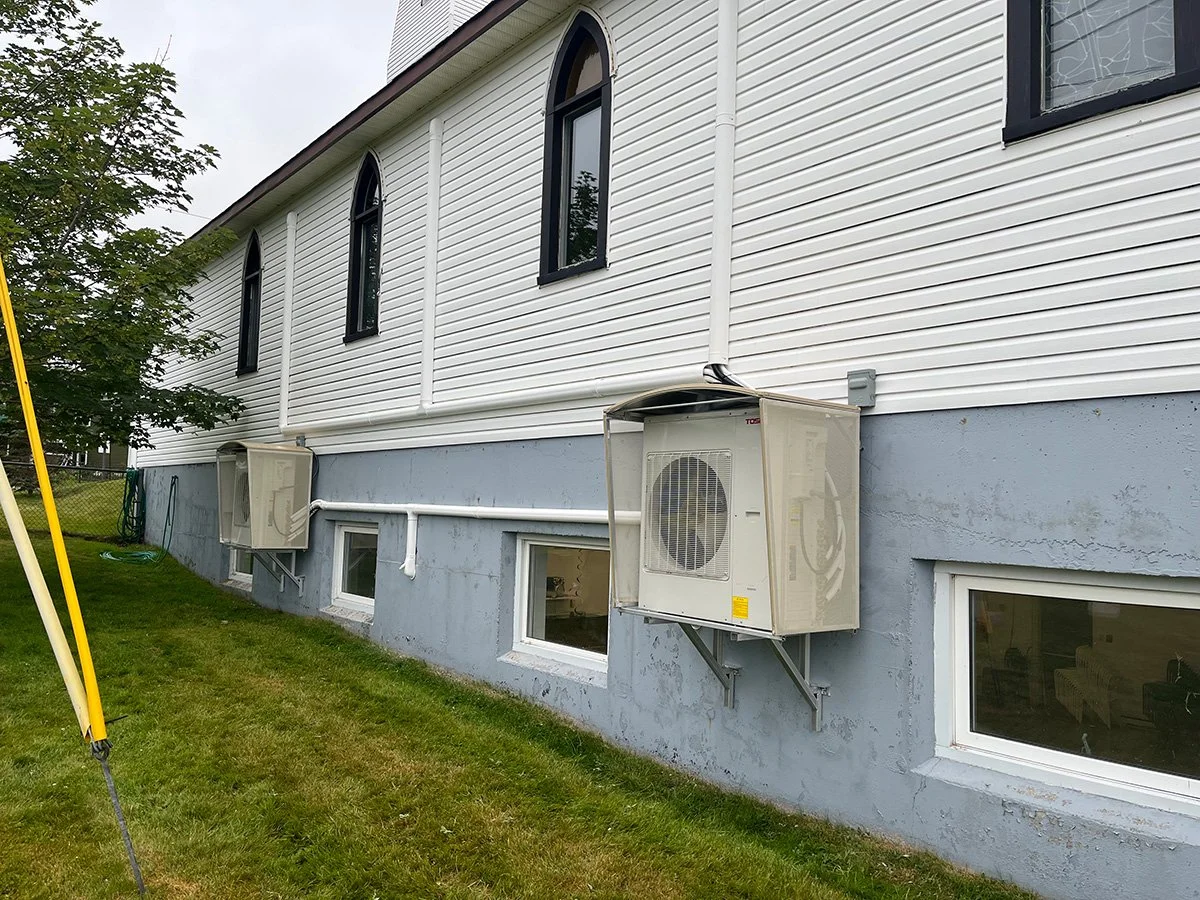
Topsail United installation of mini-split heat pump system


Topsail United with fluorescent lights and after the installation of LED lights
A year from now, the Faithful Footprint’s team will be reaching out to collect another year’s worth of energy data to compare the before and after energy savings and greenhouse gas reductions of Topsail United’s congregation's efforts.
Testimonials from Faithful Footprints participants
After successfully completing the program, many participating congregations have expressed how the support and guidance they received from the Faithful Footprints staff contributed to the success of their projects. Here’s what they say:
“Along the way we have learned that applying for grants in support of building renovations can be a large amount of work, but very worthwhile. Supporting large renovation projects of this type requires a dedicated group of people willing to stay on board for a long period of time.”
Rosemary Embree, Trenton United Church, Trenton, ON
“Once we decided to actually go for the project and pursue it with some dedication, things went very smoothly. We went from an idea, to a grant application the next day, to a fully funded project three months later."
Justin Wheler, St. Paul's United Church, Edmonton, AB
Explore our other stories on community, support, and collaborations:
Getting Started
The more you can learn about your building, the more you can save energy, minimize maintenance costs, and maximize the usage of your amazing faith community building.
Start with free guides that we have on our website. The DIY Faith Building Energy Audit Guidebook and the Energy Star Action Workbook for Congregations are amazing resources you can download, read, learn, and even take action with these free resources!
You can also utilize our professional knowledge with virtual Green Audits that look at energy, air quality, food, water, waste, maintenance, rental agreements, heritage and much more.
Faithful Footprints Program
The United Church of Canada (UCCan) Faithful Footprints program offers grants, tools and inspiration to help its congregations reduce their carbon footprint. With the Church’s commitment to reducing its greenhouse gases (GHG) emissions by 80% by 2030, this one of a kind program offers up to $30,000 in grants towards energy conservation and renewable energy projects (conditions apply).
Faith & the Common Good is the delivery partner for UCCans Faithful Footprints program. To date, we have engaged 300 congregations, camps, and buildings across the country. Your participation in the program puts your faith into action and helps the Church reach its target.
Stephen Collette is the Building Manager for Faith & the Common Good and can be reached at 705-652-5159 EDT, scollette@faithcommongood.org

Retrofitting to Serve Community Better - Camp Scugog’s Journey to a Four-Season Building
Camp Scugog is one of the oldest camps in Canada. Its buildings were not designed for all weather use. Camp staff knew that in order to maximize the use of the property, and expand capacity for winter operations, a building retrofit that involved installing a heating and cooling system to their property’s main facility was not only critical but necessary.
“For so many years we've wanted to be able to make better use of our property. We have over 300 acres and only having a summer camp really didn't seem fair. To be able to expand into the colder seasons and now the winter is just like a dream come true”
- Carol Rhynas, Assistant Director at Camp Scugog
United Church Fresh Air Camp, Camp Scugog, has been offering programming since 1912 to thousands of children, youth, and mothers affected by poverty and other barriers to wellbeing. Located in Nestleton, ON, on the shores of Lake Scugog and surrounded by over 300 acres of the beautiful natural landscape, the camp specializes in providing an outdoor camping experience, focused on community, stewardship, growth, play, and respect. With a dozen different programs, it aims to foster creativity and cooperation and to build a strong sense of self and community among campers.


Camp Scugog entrance gate and main facility building
Camp Scugog is one of the oldest camps in Canada. Its buildings were not designed for all weather use. Several staff members had been suggesting that it felt wasteful for their programs to only run two to three months a year. So, with a vision to create a year-round haven for inner city kids and their families and serve their community better, Camp Scugog embarked on a long journey to renovate their property.
Camp staff knew that in order to maximize the use of the property, and expand capacity for winter operations, a building retrofit that involved installing a heating and cooling system to their property’s main facility was not only critical but necessary.
Farm House Reno Geothermal Project: Towards a Four-Season Building
“Our new geothermal system is going to improve the lives of our staff and campers immensely”
- Gary Hoey, Assistant Director at Camp Scugog
As Camp Scugog’s first major green infrastructure build, the Farm House Reno would require the largest financial investment out of all its buildings. The staff was adamant about selecting a heating and cooling system that would be both economically and environmentally friendly. After much research, the camp decided to install a geothermal system. Geothermal is a renewable energy source that is both environmentally and economically sustainable. The ground source system uses water circulation to convert the natural underground temperatures of the Earth to a viable source of energy to heat and cool indoor spaces, without the need for additional energy conversion. In search of additional funding for the project, Camp Scugog applied for the Faithful Footprints grant. They were successful and in 2022, the Farm House was renovated with a geothermal heating and cooling system. Because of this retrofit, after over one hundred years of service, Camp Scugog is now equipped to run programs year-round.

Installation of geothermal piping. Credits: Gary Hoey

Camp Scugog Meadow after geothermal system installation
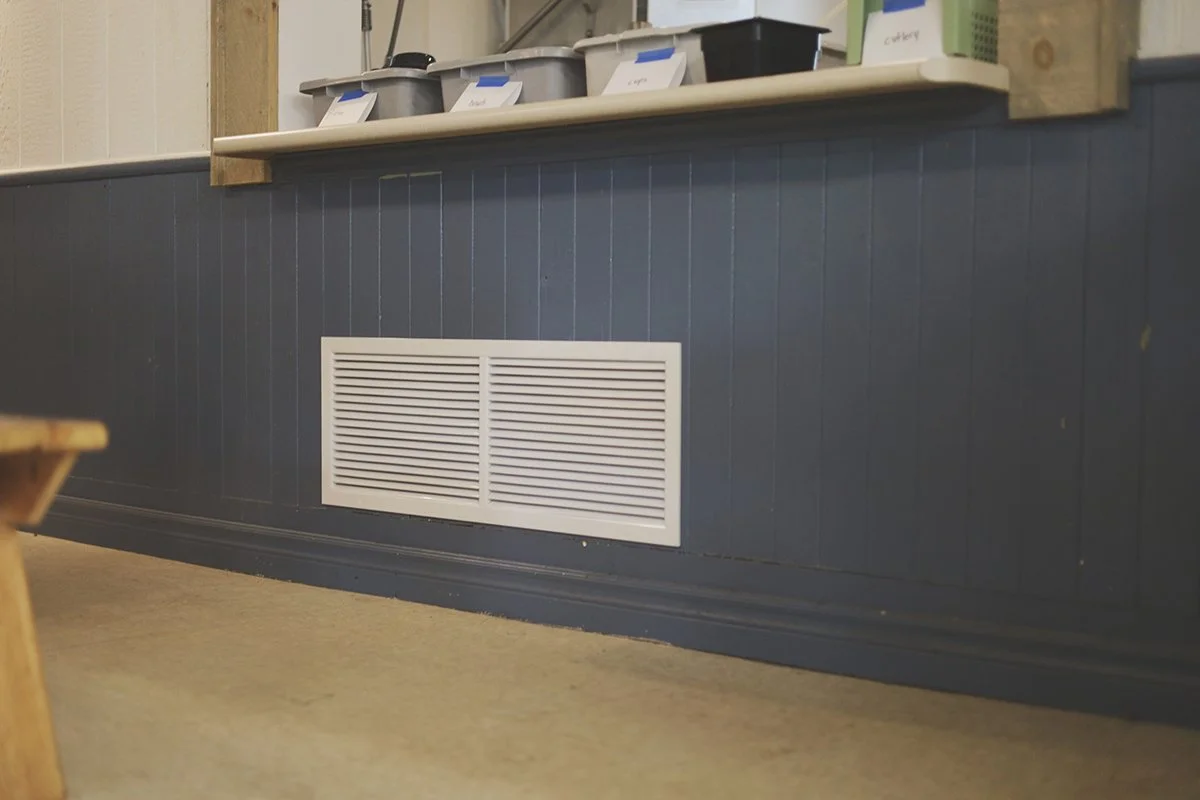
Newly installed vents in Dining Hall

Newly installed ducts in basement
Growing Capacity to Serve Better
“We can use the site and offer so much more, to many more kids and families”
- Carol Rhynas, Assistant Director at Camp Scugog
With their newly transformed four-season facility, Camp Scugog is in a position to provide additional programming and establish new programs specifically designed for the colder months. For example, the camp will now be able to host events and programs like Winter Weekends, March break, and leadership camps. The updated main facility will also provide additional programming space for their Nature School campers during the summer. It will also open doors for revenue-generating opportunities like event rentals and school groups.

Credits: Camp Scugog Website

Retrofitting: An Investment in the Future
“We get to be models for our kids. We get to lead in this fashion, teaching some the younger generations, and demonstrating to our campers more efficient models of heating and cooling for the future.”
- Gary Hoey, Assistant Director at Camp Scugog

The property’s Farm House renovation and geothermal system represent not only an investment in the future of Camp Scugog and its campers but also, in that of generations to come. The new four-season facility symbolizes an active effort to ensure the camp’s continued safety, growth, and success in welcoming and serving under-privileged youth and families. To highlight the retrofit, Camp Scugog plans to install a permanent display outside their main facility describing the geothermal project, how the system works, and recognizing donors who contributed to the project.
Interested in more retrofit stories?
Every month, the Faithful Footprints program approves several applications and welcomes new United Churches and affiliated properties into the program, and celebrates with those congregations that complete their projects and receive their final energy reduction results. Keep up with these amazing retrofit projects by subscribing to our Monthly Newsletter and following us on Facebook and Twitter.
Faithful Footprints Program
The United Church of Canada Faithful Footprints program offers grants, tools and inspiration to help its congregations reduce their carbon footprint. With the Church’s commitment to reducing its greenhouse gases (GHG) emissions by 80% by 2050, this one-of-a-kind program offers up to $30,000 in grants towards energy conservation and renewable energy projects (conditions apply).
Faith & the Common Good is the delivery partner for the Church’s Faithful Footprints program. To date, we have engaged almost 300 congregations, camps, and buildings across the country. Your participation in the program puts your faith into action and helps the Church reach its target.
Aleyxa Gates Julien is the PR/Communications Coordinator for Faithful Footprints and can be reached at agatesjulien@faithcommongood.org.

A Great Team Making Great Decisions - Ralph Connor Memorial United Church
Nestled in a beautiful village at the feet of the Canadian Rockies, Ralph Connor Memorial United Church (RCMUC) in Canmore, Alberta has a 130 year old sanctuary and a 40 year old hall.
RCMUC’s Faithful Footprints story is one of how congregants’ connections and working together as a team led to incredible energy savings and conservation within their church building.
Nestled in a beautiful village at the feet of the Canadian Rockies, Ralph Connor Memorial United Church (RCMUC) in Canmore, Alberta has a 130 year old sanctuary and a 40 year old hall.
RCMUC’s Faithful Footprints story is one of how congregants’ connections and working together as a team led to incredible energy savings and conservation within their church building.

Rooftop Solar Installation, RCMUC
Wanting to tackle climate change and save energy at the same time, the very first step in the church’s greening process was to engage members whose skills and knowledge could be put to use. As with many congregations, RCMUC has a large portion of retired members, among which included engineers, a public building architect, and a high school shop instructor.
Their initial plan and focus was to partner with Bow Valley Green Energy Cooperative (BVEC) to install 30 solar panels on their roof. Becoming the first public partner for BVEC in September, 2021, the solar partnership produced 1,590 kWh in the first 90 days, with the planned goal of offsetting 80% of their electrical needs.
However, their efforts did not stop there. In discussions with Faithful Footprints’ Building Grants Manager, Stephen Collette, RCMUC learned that although solar is great, it is important for the church to be lowering energy usage and improving efficiencies as well. Both had been on the team’s mind, and when presented with the DIY Energy Audit Guidebook the team found some low hanging fruit that made sense to them to include in their efforts. This included LED lighting, Energy Star kitchen appliances, and solar powered outdoor lights.
To improve the efficiency of the building they learned that their narthex had two supply vents and no return, resulting in no air circulation, causing the area to be cold. So they decided to remove a supply and add a return to improve comfort. While doing so, they discovered that the ductwork in the crawlspace wasn’t insulated, so they fixed that as well. With the addition of a heat recovery ventilator, cold winter air is pre-heated by outgoing airflow, which improves the efficiency of their furnace.

Ducting under sanctuary
In addition to being the poster child for future partnerships with BVEC–thanks to its highly visible location in downtown Canmore–RCMUC‘s carbon reduction and energy saving projects have also provided many other benefits. The newly installed LED lights are much better for reading by reducing strain on eyes. The air quality has improved with sealed and insulated ductwork, noticeable during the fires this year in the region, and comfort for all using the building.

Greg Wooley, Minister of RCMUC & Jeff Roberts, Chair of BVEC

Solar-powered outdoor light
With various volunteers coming together, sharing their knowledge and skills, and working together, RCMUC is a great story of how your own congregation can similarly leverage these existing elements and help do your part to save energy, some money and the planet all at the same time.
Like RCMUC, the more you can learn about your building, the more you can save energy, minimize maintenance costs, and maximize the usage of your amazing faith community building.
Learn more about your building by utilizing our professional knowledge with virtual Green Audits that look at energy, air quality, food, water, waste, maintenance, rental agreements, heritage and much more.

Heat recovery ventilation system

New fridge and freezer
Faithful Footprints Program
The United Church of Canada (UCC) Faithful Footprints program offers grants, tools and inspiration to help its congregations reduce their carbon footprint. With UCC’s commitment to reducing its greenhouse gases (GHG) emissions 80% by 2050, this one of a kind program offers up to $30,000 in grants towards energy conservation and renewable energy projects (conditions apply).
Faith & the Common Good is the delivery partner for UCCs Faithful Footprints program. To date, we have engaged over 200 UCC congregations, camps, and buildings across the country. Your participation in the program puts your faith into action and helps UCC reach its target.
Stephen Collette is the Building Manager for Faith & the Common Good and can be reached at 705-652-5159 EDT, scollette@faithcommongood.org

Let Your Light Shine: LEDs, solar panels and greening faith buildings
McClure United Church in Saskatoon is shining new light on its congregation.
By line: Ava Gulino
McClure United Church in Saskatoon is shining new light on its congregation.
“The choir in particular appreciates being able to see the music and words the way the composer intended,” chuckles Angie Bugg, when she tells me about the lighting improvements in the church sanctuary.
A board member of the property committee, and a mechanical engineer herself, Angie says that replacing their fussy lighting system (from the late 1980s) and transitioning to energy efficient LED lighting has made a big difference.

“LED lighting is so much more efficient than any of the other kinds of lighting that we have,” she says. “It’s worth upgrading the lighting of any space that is used even just a little bit to LED. You know you’ll get a good payback on it.”
Environmentally-minded since her teenage years, Angie reflects on how her faith and the church LED upgrade project are connected.
“My profession is very closely tied to my faith. Protecting God's creation has to be part of how we live our lives and we can’t separate the church we go to on Sundays from how we live daily with this planet and how we show our respect to Creation.”
***************
The blessing of high quality lighting has tangible benefits not only for congregants and community members who use the church’s space for events, but also for the church budget by cutting down on lighting costs. And when combined with the United Church of Canada’s Faithful Footprints grant in partnership with Faith & the Common Good, which offers up to $30,000 per grant application, more expensive types of projects can be supported that will ultimately save a congregation money in the long-term.
Colleen Rollings of Rockingham United Church in Halifax saw a large financial payback when her church used the Faithful Footprints grant to carry out a sustainability project. As the chair of the building and property committee, her focus is clear: “certainly my goal has been to reduce operating costs and to leave the organization in better fiscal strength than when I came on board.”
In order to achieve this goal, Colleen gravitated towards solar panels. “I had been interested personally in solar both from an environmental perspective as well as the passive income piece to it,” she says.
Since it often produces surplus energy, a solar energy system can supply energy to the building as well as contribute energy to the grid. When the church expressed interest in replacing the roof, Colleen recognized a perfect opportunity to present her plan for a solar installation system.
Solar panels, as Colleen explains, are well suited to a brand new roof so as to avoid removing the solar panels when a new roof is needed. Since her church needed a new roof anyway, she figured she would suggest adding solar panels as a part of the renovation process. Colleen’s proposal for the project took flight with other church members, and soon after, solar panels were affixed to the new roof.
“The money saved from this project is astounding,” Colleen reports. “As well, once we pay off the small amount we owe, it's projected to generate around $20,000 a year in revenue, which is significant for an organization like ours.”
Colleen is grateful that her congregation trusted her vision for a solar panel installation.
It was a really nice feeling that they had faith in what I was presenting to them--the opportunity we had,” she says. “To see it come to fruition on such a large scale kind of gives me goosebumps just telling you about it.”
Similar to Angie, Colleen’s personal faith influenced the inception of the project. As she puts it, “we have been given a world with sunshine--the main ingredient needed for solar installations.”
Coupled with technical expertise to execute on such a project, Colleen tapped into her engineering prowess to push for solar: “I'm a strong believer in utilizing my God-given talents for the greater benefit of the church,” she concludes.
Now fly: Wesley United Church takes the lead in St. Andrews, New Brunswick
Across the country, United Churches are doing their part to address the climate crisis by getting their houses in order and reducing their own carbon emissions. Through a partnership with Faith & the Common Good, the United Church of Canada is offering grants and support for churches to measure their energy use and reduce their climate pollution, in ways that save money and strengthen congregational renewal.
Across the country, United Churches are doing their part to address the climate crisis by getting their houses in order and reducing their own carbon emissions. Through a partnership with Faith & the Common Good, the United Church of Canada is offering grants and support for churches to measure their energy use and reduce their climate pollution, in ways that save money and strengthen congregational renewal. The initiative, called Faithful Footprints is about living climate commitments, for future generations, and for all of creation. To inspire your congregation to get involved, we have stories from participating congregations.

Wesley United Church building is 152 years old and Faithful Footprints allows for renovations and updates while saving money.
Now fly: Wesley United Church in St.Andres, New Brunswick

The treasurer has the pulse of the church,” says Barb Sheen of Wesley United, in the tiny town of St. Andrews, New Brunswick. “We are always looking to reduce our costs.”
When Barb heard about the FF grant and brought it to the attention of the renovation committee, and church board, she secretly thought it sounded too good to be true, “but in our case it was true.”
Prior to the grant, Wesley United had already started a renovation project thanks to receiving a bequest. They had been visioning for two years about how they would use it to benefit the congregation and community at large: “We wanted to think bigger, widen our doors, asking, ‘what can we do to participate, what can we accomplish?’”

The Church building is 152 years old, “so there is no problem to find things to do,” Barb jokes. “As the stars lined up, we lined up.”
They restored some of the stain glass windows, revamped the heating systems, and with the FF grant and a fundraising campaign, they were able to pay for insulating much of the sanctuary, eliminating drafts by caulking the cracks in the original floors and doors and putting in energy-saving lighting in the halls and sanctuary. Of the $155,000 spent on renovations and energy-saving initiatives, they garnered $30,000 back.

Similarly to all the churches in the program, the congregations’ participation was key.
“We invited them all the way, kept the communication alive and they really came on board,” Barb says. With consistent updates at the forefront, “it gave us a real sense of energy use in the church, and to actually see what we were able to accomplish.” Nine months later they had finished the renovations.
“We have spread our wings and will continue to go further as we move into 2020,” concludes Barb. “The Faithful Footprints program has helped us do that.”
Helpful Hand-holding
Preparing a grant application can be daunting, but Stephen Collette, Grant Project Manager for the Faithful Footprints program is here to help! Stephen ensures your application form is properly completed and that your energy efficiency package will actually save you money. Stephen’s assistance helps expedite the application approval process tremendously, with typical turnaround times under two weeks, and often in a matter of days.
The Faithful Footprint program also features support hubs for United Church congregations in the Prairies and Atlantic Canada. “We know that lack of capacity is one of the major obstacles to “Greening” our sacred spaces, so we are proud to be working with Ecology Action Centre in Halifax and Purpose Construction in Winnipeg to pilot how to provide in-person support to United Churches around energy efficiency action,” said Cummings. Guided by regional multi-faith advisory circles, the hubs are lead by local building and energy efficiency experts and aim to connect congregations with municipal and provincial energy incentives, recommend contractors, and foster collaboration among other local places of faith facing similar challenges.
UCC Carbon Baseline Report
The United Church of Canada is committed to reducing its carbon emissions by 80% by 2050, in line with the Paris Climate Targets. With an initial focus on buildings – one of the church’s largest sources of emissions – the program Faithful Footprints will be working with 500 congregations by 2025 to reduce their energy use and energy costs.In 2016 the UCC General Council commissioned Caring for Creation, Our Communities and Our Congregations: The Case for a National Carbon Reduction Program for Faith Buildings. Faithful Footprints is the beginning of implementing those learnings.
As people of faith, we recognize that to bring truly inspiring climate leadership to our communities, we must practice what we preach. Together we can renew our congregations, care for the planet, save money, and stop climate pollution.
Stay tuned for a full feature of Faithful Footprints in the February 2020 edition of the United Church of Canada’s Mandate Magazine.
Nurturing collaborations: Mckillop United in Lethbridge, Alberta
Across the country, United Churches are doing their part to address the climate crisis by getting their houses in order and reducing their own carbon emissions. Through a partnership with Faith & the Common Good, the United Church of Canada is offering grants and support for churches to measure their energy use and reduce their climate pollution, in ways that save money and strengthen congregational renewal.
Across the country, United Churches are doing their part to address the climate crisis by getting their houses in order and reducing their own carbon emissions. Through a partnership with Faith & the Common Good, the United Church of Canada is offering grants and support for churches to measure their energy use and reduce their climate pollution, in ways that save money and strengthen congregational renewal. The initiative, called Faithful Footprints is about living climate commitments, for future generations, and for all of creation. To inspire your congregation to get involved, we have stories from participating congregations from across the country.

Mckillop United Church in Lethbridge Alberta started with a modest proposal to renovate their kitchen which evolved into a 1.6 million dollar project.
Nurturing collaborations: Mckillop United in Lethbridge, Alberta

It started with a modest proposal for a kitchen renovation and evolved into a 1.6 million project.
“So much of our activities centers around food, so many initiatives grow from it,” says John Bolton, coordinator for the renovation committee at Mckillop United in Lethbridge, Alberta.
But for as long as he can remember, the congregation had been talking about a kitchen renovation, because they had an ancient stove out of the prisoner of war camp: “People were afraid to use it.”
Pushing to be a community hub, a federal New Horizon grant for Seniors helped pay for the kitchen. Moving on to the main hall, in terms of safety, they recognized the heating system as being antiquated; large, inefficient 1950 vintage boilers.

“The FF grant allowed us to do what we wanted to do,” says John. $30,000 funded two boilers. “What that means is that there is a significant reduction in our utility costs, allowing more funds to be directed into community outreach.”
Now, thanks to a FF grant and other monies, including fundraising, the church enjoys a commercial-level kitchen, high-efficiency furnaces, new inclusive washrooms, full-service elevator for accessibility, and several other infrastructure improvements.
Being a congregation with “a strong social justice conscience,” and the belief that they can do a lot to “make a better world,” (they work to uplift LGBTQ+ and Indigenous communities and are eco-focus, sitting as the only church on the Environment Lethbridge Committee), John says they really needed to move beyond the walls. “We couldn’t only be a Sunday morning service, we have too much potential for one day a week use.”

It was important that they look out for partnership options and organizations that mesh well with their faith pillars. “You have to look for partners that fit, they don’t just drop in your lap,” John says. Mckillop contracted with a consultant to help identify collaboration opportunities. In January of 2019, area organizations started to use the renovated facilities, including a meal-preparation program to address senior isolation, in cooperation with the Lethbridge Senior Community Organization. Coming up is the possibility for a similar program for disabled adults to run with L’Arche. “Next, we hope to continue to green the church, perhaps using solar panels--with government incentives.”
UCC Carbon Baseline Report
The United Church of Canada is committed to reducing its carbon emissions by 80% by 2050, in line with the Paris Climate Targets. With an initial focus on buildings – one of the church’s largest sources of emissions – the program Faithful Footprints will be working with 500 congregations by 2025 to reduce their energy use and energy costs.In 2016 the UCC General Council commissioned Caring for Creation, Our Communities and Our Congregations: The Case for a National Carbon Reduction Program for Faith Buildings. Faithful Footprints is the beginning of implementing those learnings.
As people of faith, we recognize that to bring truly inspiring climate leadership to our communities, we must practice what we preach. Together we can renew our congregations, care for the planet, save money, and stop climate pollution.
Stay tuned for a full feature of Faithful Footprints in the February 2020 edition of the United Church of Canada’s Mandate Magazine.

Crescent Fort Rouge United Church takes steps toward climate action with Faithful Footprints
In 2018, Crescent Fort Rouge United Church participated in a National Trust and Faith & The Common Good seminar in our building and benefitted from an energy audit. We discovered the possibility of a Faithful Footprints grant for energy upgrades which aligned perfectly with planning and built on our activities to date.

Across the country, United Churches are doing their part to address the climate crisis by getting their houses in order and reducing their own carbon emissions. Through a partnership with Faith & the Common Good, the United Church of Canada is offering grants and support for churches to measure their energy use and reduce their climate pollution, in ways that save money and strengthen congregational renewal. The initiative, called Faithful Footprints is about living climate commitments, for future generations, and for all of creation. To inspire your congregation to get involved, we have stories lined up from three participating congregations from across the country. Crescent Fort Rouge United Church, in Winnipeg, Manitoba is the first.
As well, stay tuned for a full feature of Faithful Footprints in the February 2020 edition of the United Church of Canada’s Mandate Magazine.
In 2018, Crescent Fort Rouge United Church participated in a National Trust and Faith & The Common Good seminar in our building and benefitted from an energy audit. We discovered the possibility of a Faithful Footprints grant for energy upgrades which aligned perfectly with planning and built on our activities to date.
As with many churches, CFRUC has considered its future. In 2012, CFRUC explored possible building development with EDGE National. In 2015, we began a further clarification of values by turning to community consultation to mine the wisdom of the congregation and external partners. Our thinking was that we needed to build on our strengths – who we are and our success to date which includes the asset that the building provides to external partners, especially to the arts. A key question at every turn is “What is God calling us to do?” Thus, in 2017, the congregation of CFRUC approved outreach missions in three areas: 1. Children, Youth, and Families 2. Seniors 3. Hospitality to the Arts. We live out our ministry in these multiple ways.
CFRUC sees the arts as transformative, revealing of truth and new ways of seeing feeding spirit, and a means of serving others outside our walls. Opening our doors to the arts and using art in our programming with children and seniors helps us to live out our values of inclusion and engagement with the community.
CFRUC boasts a large, acoustically acclaimed sanctuary that seats over 700, a fellowship hall, a second-floor hall with a stage and small kitchen area, several small meeting rooms, a basement child care facility with large gymnasium and outdoor play area. CFRUC seeks to become a multi-use community facility offering hospitality and care to our missional areas with energy and reciprocal benefits between the arts initiatives and the programming for children, youth and seniors.
CFRUC continues to explore change and ways to sustain and increase operational funding. At the same time, we are not currently financially threatened and can continue should we not be able to create any substantive additional change. The congregation at CFRUC has always been steadfast and peaceful about the way forward. They do not wish to trade their values for economic decisions that are presented to them because of their prime real estate in Winnipeg. They are not willing to incur debt to keep the doors open. They are willing to increase their effort to better serve their mission and vision.
CFRUC has the asset of skilled, experienced and energized volunteer congregation members added to by engaged and committed external partner networks and expertise. We have been blessed by a property management team that are skilled and dedicated and who have kept our building in good shape on top of its sound foundation and has made small and steady progress in energy improvements.
Faithful Footprints offered us an opportunity aligned with our values and we are grateful! It allows us to participate as a partner in addressing climate change while adding funding to our own monetary and in-kind contributions. We are replacing two fridges, a freezer and a dishwasher with energy-efficient appliances which will impact the electricity bill. We are also replacing dated and inefficient light bulbs and fixtures, also reducing the bill. We are replacing the baseboard heaters in our Fellowship Hall on the main floor with infrared heating panels, and replacing caulking and seals on the windows, thus also reducing the electricity bill and potentially the natural gas bill. These efforts, along with our commitments to recycling, composting and buying locally, demonstrate our dedication to climate justice.
Written by: Sandi Howell, sandihowell@shaw.ca

Greening Small with St. John's United
Over more than a decade, this small, thoughtful congregation in Northern Ontario has made some surprising headway in reducing their carbon footprint.
Thanks to Rev David Giuliano for sharing this story about greening at St. John's United in Marathon, Ontario.
It’s been more evolution than revolution. As with most change in small communities of faith, greening at St. John’s, in Marathon, Ontario, has come about organically. There was no master plan, no environmental concerns committee but over more than a decade a small, thoughtful congregation has made some surprising headway in reducing their carbon footprint.
Some were baby steps. Early on Styrofoam coffee cups were replaced with ceramic mugs. Growing awareness of the human and environmental costs of the coffee in those mugs led to serving and selling fair trade coffee.
On a larger scale, in 2010, St. John’s installed the first solar array in town. The manse was sold. Most congregations invest the money realized from the sale of manses in GICs and use interest earned to pay a housing allowance. St. John’s persuaded their presbytery to instead allow them to invest in green energy and took advantage of the province’s Micro-FIT program.
Those solar panels stand witness beside the cross. They have so far resulted in about a 50 tonne carbon offset (equivalent to planting 5 acres of forest or powering 5 stadiums for a day) and paid the minister’s housing allowance. At the same time congregational members, inspired by the church, installed solar arrays on their homes. Since then the municipality and other residents have followed suit.


Ongoing maintenance shaped by environmental awareness resulted in changes. When the incandescent light bulbs in the sanctuary needed changing, low energy CFC bulbs were used. Now the shift is to LEDs is underway.
Windows and siding needed replacing. An additional layer of insulation was added first. On the south side, the coloured glass was replaced with clear high-efficiency windows to capture more of the natural heat of the sun. The number of windows on the north side of the building was reduced by half.
One environmental update was in response to disaster. The outdoor oil tank that fueled the old boiler system in the church basement leaked contaminating the soil. An $80,000 cleanup and ongoing ground water monitoring was paid for by the insurance company. A new, double lined oil tank was installed. Within two years it leaked too.
The congregation decided to get out of oil all together. However, given geographic location, natural gas is not available and hydro costs are so high that the building would have to be sold to pay its electricity bill. Geothermal options were entering the market and also far beyond the financial means of the small community of faith. A propane-fueled, high efficiency boiler system, with computerized zone and timing management, replaced the old furnace.

The core ministry of St. John’s is “radical and intentional hospitality”. That commitment to hospitality includes maximizing the use of the building and property. A community garden run by the local food bank occupies the front lawn. When finances forced the Anglicans and Baptists close their buildings, St. John’s welcomed them into theirs. Now, three denominations worship in the building every Sunday. Coffee times sometimes overlap.
During the week A.A., N.A., yoga, meditation and craft groups meet. Opening space for birthday parties, anniversaries, baby showers, a monthly community potluck and other gatherings are a regular part of the congregation’s ministry to the community. American Scouting groups, choirs, traveling United Church youth groups and walkers and riders crossing the country raising awareness about all manner of causes, often bed down for a night or two in the hall downstairs.
There are no rental fees. The congregation asks only for cleanup and a donation if possible. Paradoxically, “rental” revenues have increased. More importantly there is deepened understanding of hospitality and awareness that the difference between the energy and environmental costs of an empty building and a full building, are marginal.
St. John’s is small in membersip and financial resources. They are rich with creativity. They pay attention to their impact on the planet. A gradual evolution has reduced their carbon footprint and expanded their practice of greening their community of faith.

Our Neighbours, Ourselves, and all of Creation
The Green Covenant asks them “to care for our neighbours, ourselves and all of Creation by: integrating the love of Creation in our worship and spiritual lives. We will lead by example and ask those who use our building to partner in this covenant.”
In 2011, Saint Andrew’s United Church in Halifax, NS, celebrated a ‘Greening Sunday’ and covenanted with God and each other to be a Green Church. The Green Covenant asks them “to care for our neighbours, ourselves and all of Creation by: integrating the love of Creation in our worship and spiritual lives, increasing environmental awareness and education, practicing stewardship by conservation of natural resources, and working with others for environmental justice. As a congregation and as individuals, we will make every effort possible to reduce our carbon and ecological footprint. We will lead by example and ask those who use our building to partner in this covenant.”
Saint Andrew’s has already been practicing this covenant for the past several years by:
Including climate change and other ecological concerns in worship and celebrating ‘The Season of Creation’ in worship and education for all ages,
Partnering with Shambhala to co-sponsor ‘Sacred Earth Awake’ film series,
Having a professional energy audit on our building,
Converting from oil heat to natural gas, and
Changing the lighting to CFC or LED lights,
Using and promoting Fair Trade coffee and other products,
Organizing climate justice events and supporting First Nations communities as they raise awareness about the effects of the Alberta oil sands on their lives.
They are continuing to invite members, groups – especially youth, staff and neighbours to share suggestions and to act together to more fully integrate our care of Creation in all that we do. Including:
Make every effort to save heat and paper,
Include ‘Green Tips’ in the weekly bulletin,
Increase the number of recycle bins,
Use environmentally friendly cleaning products,
Designate ‘idle free’ areas,
Install bike racks,
Collect/recycle ink cartridges,
Search for a biodegradable alternative to Styrofoam (for the Sunday Supper for the homeless),
Explore the possibilities of a community garden and/or fruit tree planting on church property, and
Advocate to stop the destructive impacts of the Alberta tar sands and work for a provincial moratorium on Hydraulic Fracturing.
Check out more from St. Andrew's United Church on their website: www.standrewshfx.ca

Mount Bruno United Takes on the Green Challenge
Mount Bruno United Church, in Saint-Bruno-de-Montarville, QC, has taken on the green challenge by taking a look at how they use energy in their building.
Mount Bruno United Church, in Saint-Bruno-de-Montarville, QC has taken on the green challenge by taking a look at how they use energy in their building. Temperature control sensors have been installed inside and reflector screens behind all the radiators are used to make sure that as little heat as possible is being lost during the winter.
Very aware that churches can often use a great deal of paper during the everyday life of a congregation, Mount Bruno makes sure that unused bulletins don’t go to waste, by reusing them for various other services during the year. Finally, as well as running their own recycling program Mount Bruno is also reaching out to the community by organizing a twice-a-year large-scale recycling event for people in the surrounding area.
They are a member of the Green Churches network.

The Newest Oldest Church You've Ever Seen - Laidlaw Memorial United
“We know we are doing things that outlive us, and that is what brings life to the world, and that is what brings life to the church.”
““We know we are doing things that outlive us, and that is what brings life to the world, and that is what brings life to the church””
Laidlaw Memorial United Church is a beautiful old building built in 1912. The community boasts 140 members and an average Sunday worship attendance of approx. 80 people.
In 2008, Laidlaw Memorial United Church was a community faced with a dwindling membership, continuous budget deficits and a facility requiring multiple retrofits including a failed roof. Slowly, bit by bit, the community tackled their budget deficit by making small energy and money saving measures in just about every aspect of their facility. From installing a 7-day electronic set back thermostat, turning off the pilot lights when not in use, turning off the water heater in the summer to moving the heat ducts from the ceiling to the floor, setting up a convection current and making the gym warmer and using less fuel. In the process, they realized that they were going green. When it came time to deal with the cost of a replacement roof, it was proposed that the Church investigate the possibility of installing solar panels through the microFIT program in order to help pay for it. As they say, the rest is history as a mortgage loan was taken out to help pay for the new steel roof and the solar installation. On June 4, 2010, the project went live.
Remarkably, there have been no issues. Since an inspection after the first year after installation, where no trouble was found, the panels and equipment have functioned perfectly, and within parameters.

"The panels have been remarkable in starting conversations about being greener in practical ways. The congregation has always and unanimously welcomed the panels. The businesses on the street who buy 'bullfrog' green power, like pointing down the street to where it comes from. Younger people are attracted to our church, in part, because there is a practical expression of care for creation, and the good of generations to come. We have entertained the media, a youtube video and a local cable spot, as well as a spot for 100 Huntly street's "Good News" program. There is credibility to our calling for care for creation, and we have continued to upgrade lighting, windows, and energy efficiency. The solar project was, for us, a public statement of our values, and our ongoing commitment to God's creation."
This and more from Laidlaw United Church on their website: www.laidlawchurch.ca/about

Compost and Community Building - Crescent Fort Rouge United
Little did we know how successful our program would be! We feel great to be providing this community compost opportunity and are already considering how we will respond to a need for even more compost capacity.
Expanding the compost footprint at Winnipeg's Crescent Fort Rouge United
“I am a member of the Green Team at Crescent Fort Rouge United Church. I am also a big fan of two-bin compost systems – where compost is added to one bin while the other is left to mature.
In 2010 we installed a four foot by four foot bin (made from old fence pieces from a neighbour who was building a new fence and discarding the old one) with a division down the centre, thinking a two foot by four foot area would be sufficient for the amount of compost we would collect.
Little did we know how successful our program would be! Just two years later we doubled the size of our compost operation. More recently we added commercial compost bins to give the area a neater appearance. The contents of these smaller bins are transferred to the larger compartments.


We harvest our mature compost each fall (the compost is used in the church’s adjacent Memory Garden) and every year we are producing more compost. This is thanks to the dedication of church members who live in apartments and bring their compost on a weekly basis.
We have also noticed folks in the community who do not attend the church bringing in their compost. We feel great to be providing this community compost opportunity and are already considering how we will respond to a need for even more compost capacity. Check out an excerpt from the Church Newsletter. (pictures here)
NOTE: At this point, Faithful Footprint grants are limited to building and energy efficiency projects, and are not available for waste-reduction efforts such as this. But these projects are great, and should be celebrated. Way to go Crescent Fort Rouge!

Parkdale United Creates a Change for Climate
We are inspired by the Biblical call to be good stewards of the Earth and by the warnings from the International Panel on Climate Change. We have the means to be part of the healing of the Earth. Here is what we have done so far.
Parkdale United Church in Calgary is working on Creating a Climate for Change
Pictured above are Parkdale Members Bev Delong, Eneyda Rios, Ken Coburn, and Ted Moon (left to right) getting ready to replace their old seven-pilot boiler.
The following is the text from their ‘Creating a Climate for Change’ brochure. Read more about Parkdale United in Calgary here.
We are inspired by the Biblical call to be good stewards of the Earth and by the warnings from the International Panel on Climate Change. Our community has shared books and movies further explaining the need to adapt to lessen our use of power and water. We have the means to be part of the healing of the Earth. Here is what we have done so far.
To learn about options, we engaged in an environmental audit in June 2012 by Stephen Collette organized through Faith & the Common Good resulting in recommendations for action.
To lessen our carbon output, Parkdale is:
Purchasing a boiler that will reduce our output by an annual 15 - 18 tonnes of CO 2
Anticipates the installation of solar panels will further reduce our CO2 production annually by 10 tonnes.
Plans that the auditorium roof insulation will reduce CO2 by a further 3.0 to 5.0 tonnes.
Switched many light fixtures to T8 compact fluorescent bulbs
Has replaced an elderly fridge with a more energy efficient model
Gas stopped use of the inefficient freezer in the main kitchen and
Installed foam gaskets for insulation in the exterior wall electrical outlets.
To lessen the volume of water treated, and conserve water, Parkdale has:
Installed five low flush toilets reducing water usage from 13 litres per flush to 6 litres
Water faucets have been checked to ensure there are no leaks and
1.5 GPM low flow aerators were installed to reduce hot (and cold) water consumption.
To create a healthier building, we have: moved to environmentally friendly clearing products & dishwashing liquid, removed a volume of old VOC-carrying paint cans from the church, and called for a “no-scent” policy among users of the building
To decrease production of plastics, and lessen waste going to the landfill, Parkdale has: called for called on users to minimize use of disposable dishes and cutlery and to not use styrofoam and placed paper recycling bins throughout the church.
To discourage the commercial production of water and in keeping with recommendations from the United Church of Canada, Parkdale has installed two filtered water systems and is encouraging all users of the building to use them rather than bottled water.
To enable paper recycling, paper recycling bins to be placed in conference rooms that are available for rental.
Next Steps? What would you suggest?
Are you interested in information on solar panels for your home? Perhaps you would like other information on environmental possibilities. Let us know!
Words of thanks!
Our gratitude goes to Parkdale Council, Parkdale’s Operations Committee and Faith and Justice Committee for their considerable work on these projects.
We acknowledge with thanks the financial support received from the bequest of Janet Tollefson and the work of the Committee that evaluated potential projects to be addressed by that bequest.
We also thank the people who regularly contribute to these projects at our monthly movie night.

A Covenant between Us and God - St Paul’s United's Promise to Become a Green Church
“As we seek to live with respect in Creation we ask for God to strengthen us and be with us in this endeavour, always striving to be more faithful in caring for the world around us.”
In 2014, St Paul’s United in Estevan Saskatchewan approved a covenant about becoming a Green Church, which has informed environmental and building decisions since. In their words:
“Always striving to be more faithful in caring for the world around us.”
“As of May 2014, St. Paul's United Church has covenanted between ourselves and God to be a green congregation, that is, a congregation that engages in practices that care for Creation and nurture the environment. We recognize that we will not be able to do this perfectly, and that best environmental practices will continue to evolve as we engage in them. However, as we "seek to live with respect in Creation" we ask for God to strengthen us and be with us in this endeavour, always striving to be more faithful in caring for the world around us.”
The complete covenant can be found here.


Not long after, a major building decision created a big opportunity to live into this covenant. After 53 years of faithful service, the reliability of their old furnace was in question. The congregation decided to replace the 1,000,000 BTU furnace with four high efficient 220,000 BTU furnaces. The four furnaces provide redundancy and replace two 45-gallon hot water heaters. Work was completed in the Fall of 2015.
The congregation continues to seek to live into this commitment.


St. Paul’s United Saves Money, and Sends Message with Solar
“Solar panels on the roof of a church are like a giant billboard for the church,” says Wheler. “It says: ‘Hey, we are going to be here for a while and we care about the environment. We are looking forward. We are progressive. This is a place where things are happening. Come on it and check us out.'”
STORY BY TERRY JORDEN IN THE EDMONTON PRIME TIME, MAR 28, 2018
When you walk past St. Paul’s United Church in Belgravia, you can’t help but notice the large and impressive south facing sloped roof.
In fact, if you’re an engineer specializing in green energy, you might even say it’s the perfect roof for solar panels. Even some church parishioners remarked that the church was ideally suited.
When Justin Wheler began attending the church in 2006, the thought may have crossed his mind, too. But it wasn’t until 2011, after the roof was upgraded, that the idea began to take shape. An energy audit of the 62-year-old building recommended the need for some new windows, the removal of an old fridge and gas stove and the installation of LED lights.
“One thing that surprised me was that a lot of people thought it would be much more complicated than it ended up being.”
By 2013, Wheler obtained a quote to install solar panels for the church to consider. But, as is often the case, budgets were tight and resources were going towards other church’s ministries such as a campus ministry, a food security program in Garneau and Old Strathcona, a quilting group and a school in Zambia.
One day in 2017 Wheler became aware of the City of Edmonton’s EcoCity grant program, created to support community projects that reduce greenhouse gas emissions. St. Paul’s solar panel project seemed like the perfect fit.
With two days before the grant application deadline, Wheler and the rest of the solar power committee of Clare Irwin, Bob Miller, Chris Peet, Jocelyn Proby and Hami Razaghi, received the blessing of the church board and submitted the grant application for the $70,000 project. (Other key church members include Coleen Falk and Dawn MacDonald.)
What was once just an idea became a reality when the $25,000 EcoCity grant was received, another $25,000 was quickly raised through donations and a $14,000 Energy Efficiency Alberta rebate was factored in.
Western Canada-based Skyfire Energy was selected to do the work and finished the project in late January. There are now 95 panels covering 75 percent of the south side sanctuary roof. It is estimated the panels will generate about 28,000 kWh annually, supplying most of the church’s electrical needs. St. Paul’s spends about $2,000 annually on electricity.
St. Paul Rev. Catherine MacLean says one of the challenges for the church was to generate donations for the project that would not divert funds away from other church activities.
“People were invited to donate, and made aware of the other investments of resources in which the congregation is involved,” says Rev. MacLean. “And we are happy to say that the solar panels are fully funded without inhibiting any other work. We believe that they enhance our purpose and reflect the wonder of God’s hand in creation.”
“One thing that surprised me was that a lot of people thought it would be much more complicated than it ended up being,” says Wheler.
“Once we decided to actually go for the project and pursue it with some dedication, things went very smoothly,” he says. “We went from an idea one day, to a grant application the next day, to a fully funded project three months later. Then we selected a contractor and had it installed in less than a year. For a volunteer organization, that is extremely fast.”
While solar panels are appearing throughout the city on private and public properties, relatively few are on church buildings.
One church to go solar was the St. Albert United Church. A 4.75 kWh solar panel awning system was installed in 2011. More recently the Zion Baptist Church of Kensington received a EcoCity grant for a solar panel project.
St. Paul’s United has begun to receive enquiries from other organizations because of its very visible location in the neighbourhood south of the main University of Alberta campus.
For all those considering going green, Wheler has some advice.
“Go for it. Now is the time. “There is great support from all levels of government right now and there are a lot of very skilled companies working in this industry.
“We are going through a lot of transitions in the electricity system in the province right now, so this might be an important opportunity to hedge against future price increases as well as contributing to climate leadership,” says Wheler.
So, not only do the solar panels reduce electricity costs and greenhouse emissions, they also send a powerful message to all who pass by.
“Solar panels on the roof of a church … are like a giant billboard for the church,” says Wheler. “It says: ‘Hey, we are going to be here for a while and we care about the environment. We are looking forward. We are progressive. This is a place where things are happening. Come on it and check us out.'”
You can monitor the project’s daily energy generation here.

A Hub for Community Growth - Beacon United Church Energy Efficiency Journey
“This was part of a larger plan to make sure the building remained used and had income to help offset the costs of operation. Another initially controversial move to use the auditorium space for a heavy metal festival, which ended up being a great fit, as “the music was amazing and the festival attendees very respectful!””
Story from the Ecology Action Centre website.
Beacon United Church's Energy Efficiency Story (2016)
At 22,000 square feet, Beacon United Church and its attached community space is not easy to heat. Especially so in a cold, humid climate like Yarmouth, a small town of just under 6,800 on the southern-most tip of Nova Scotia. Like many places of worship around Canada, just six years ago it was struggling to make ends meet in a rural town, with a declining population and a declining congregation. The church was up for sale – the congregation had agreed that it could no longer pay for upkeep and operations. However, this church has taken a leap into the future by becoming a hub for community growth and environmental justice amongst its congregation and the local population.
“I received some comments of concern but once they saw how good a space this was for some activities that even the congregation enjoys, the concern dispersed. ”
One of the more notable projects is the former chapel, which has been turned into a multi-purpose room to accommodate for just about any user-group. It’s mostly used by a group of local seniors who enjoy the space three times a week. Stephen Sollows, the green enthusiast at Beacon United Church, recalls some resistance that he encountered when he initially proposed that the space be turned from a small chapel into a multi-purpose space. “I received some comments of concern but once they saw how good a space this was for some activities that even the congregation enjoys, the concern dispersed,” he recalls with a laugh. Of course, this was part of a larger plan to make sure the building remained used and had income to help offset the costs of operation. Sollows also recalls another initially controversial move to use the auditorium space for a heavy metal festival, which ended up being a great fit, as “the music was amazing and the festival attendees very respectful!”
The multi-purpose room also received some energy-efficiency-influenced changes. Since the enormous building is heated by the same oil-fired heating system, they had a heat pump installed so that the room could be heated without turning up the heat in the entire building. Finding the appropriate lighting was a challenge, as certain colour spectrums make reading difficult for aging eyes. Beacon found that by using LED lights on the blue (cold) spectrum, reading was easier. Furthermore, the quiet LEDs replaced old fluorescent tubes that made some high-pitched buzzing noises. This retrofit did not put a large dent in the pocket of the church: it was covered by a New Horizons grant.
Another initiative of the church to reach out has been its enormous community garden, started 4 years ago. This garden has 130 plots. Two-thirds of the plots are owned by members of the community, one-third of the plots belong to the church. The space is used by many of the user groups of the church, even the youth-oriented groups, to learn about gardening. It also includes a labyrinth, where anyone is welcome to walk and meditate.
The garden had issues with storm-water management, as there was a slope from the large parking lot towards the garden. The church planted a storm water garden with native plant species that has successfully mitigated this problem.
Next steps for Beacon United are big: they have had a solar assessment done and are in the process of having an ASHRAE level energy assessment from a local energy consultant who is generously giving the assessment at a very discounted price. They are looking forward to implementing the money and greenhouse gas savings measures as soon as they can.